
CAS 14667-55-1PubChem CID 26808
Trimethylpyrazine
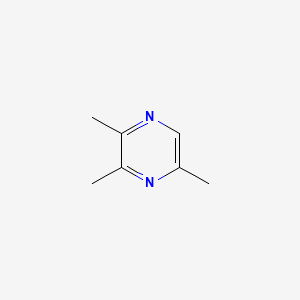
Trimethylpyrazine is a member of the class of pyrazines that is pyrazine in which three hydrogens at positions 2, 3 and 5 have been replaced by methyl groups. It has a role as a pheromone, a flavouring agent, an animal metabolite, a plant metabolite and a bacterial metabolite. — ChEBI
- IUPAC name
- 2,3,5-trimethylpyrazine
- Molecular formula
- C7H10N2
- Molecular weight
- 122.17 g/mol
- Exact mass
- 122.084398327 Da
- XLogP3
- 1.0
- Topological polar surface area
- 25.8 Ų
- Hydrogen-bond donors
- 0
- Hydrogen-bond acceptors
- 2
- Covalent units
- 1
- Defined stereocentres
- 0
Also known as
Pyrazine, trimethyl-2,3,5-Trimethyl pyrazine2,3,6-TrimethylpyrazineFEMA No. 3244Q8PR0W8TITCHEBI:190131RefChem:441845238-712-0
16 more reported names
Pyrazine, 2,3,5-trimethyl-Trimethyl-pyrazinetrimethyl pyrazinePyrazine, 2,3,5-trimethylCCRIS 2932EINECS 238-712-0UNII-Q8PR0W8TIT2,3,5-Trimethyl pyrazine (natural)BRN 0002423AI3-344422,3,5-Trimethyl-pyrazineFEMA 32442,3,5-Trimethylpyrazine, 99%Tox21_302314MSK1797-1000MCS-W011192
External database identifiers
- ChEBI:CHEBI:190131
- ChEMBL:CHEMBL320146
- EPA DTXSID:DTXSID1047075
- PubMed:22988937
- PubMed:22972787
- PubMed:22541463
- PubMed:22463717
- PubMed:22417522
- PubMed:21535747
- PubMed:20492142
- PubMed:20170168
- PubMed:20122694
- PubMed:20121201
- PubMed:19771358
- PubMed:19569109
Retrieved from NIH PubChem on 2026-08-31 by checksum-valid CAS matching. Chemical properties do not replace the regulatory decision on this page.