
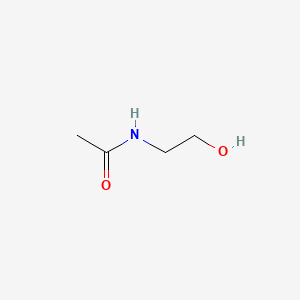
CAS 142-26-7PubChem CID 8880
Acetylethanolamine
N-acetylethanolamine is a member of the class of ethanolamines that is 2-aminoethanol in which one of the hydrogens of the amino group is replaced by an acetyl group. It has a role as a metabolite. It is a member of acetamides, a member of ethanolamines and a monocarboxylic acid amide. — ChEBI
- IUPAC name
- N-(2-hydroxyethyl)acetamide
- Molecular formula
- C4H9NO2
- Molecular weight
- 103.12 g/mol
- Exact mass
- 103.063328530 Da
- XLogP3
- -1.1
- Topological polar surface area
- 49.3 Ų
- Hydrogen-bond donors
- 2
- Hydrogen-bond acceptors
- 2
- Covalent units
- 1
- Defined stereocentres
- 0
Also known as
N-Acetylethanolamine2-AcetamidoethanolAcetylcolamineAcetamide, N-(2-hydroxyethyl)-Acetamide MEA2-AcetylaminoethanolN-EthanolacetamideN-Acetyl-2-aminoethanol
16 more reported names
Hydroxyethyl acetamideN-Acetyl ethanolamineN-2-HydroxyethylacetamideAcetic monoethanolamidebeta-HydroxyethylacetamideN-beta-HydroxyethylacetamideNSC 5999HSDB 2713EINECS 205-530-8BRN 1811708A9O0818TWDAcetic acid amide, N-(2-hydroxyethyl)-AI3-02836NSC-5999ACETAMIDE MEA [VANDF]acetamide, N-(2-hydroxyethyl)
External database identifiers
- ChEBI:CHEBI:74687
- ChEMBL:CHEMBL3188272
- EPA DTXSID:DTXSID6044804
- PubMed:20361802
Retrieved from NIH PubChem on 2026-08-31 by checksum-valid CAS matching. Chemical properties do not replace the regulatory decision on this page.