
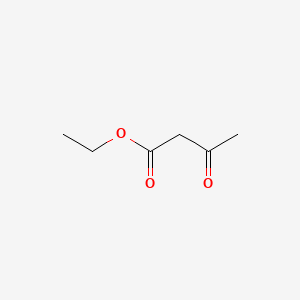
CAS 141-97-9PubChem CID 8868
Ethyl Acetoacetate
Ethyl acetoacetate is an ethyl ester resulting from the formal condensation of the carboxy group of acetoacetic acid with ethanol. It has a role as an antibacterial agent, a flavouring agent and a plant metabolite. It is functionally related to an acetoacetic acid. — ChEBI
- IUPAC name
- ethyl 3-oxobutanoate
- Molecular formula
- C6H10O3
- Molecular weight
- 130.14 g/mol
- Exact mass
- 130.062994177 Da
- XLogP3
- 0.2
- Topological polar surface area
- 43.4 Ų
- Hydrogen-bond donors
- 0
- Hydrogen-bond acceptors
- 3
- Covalent units
- 1
- Defined stereocentres
- 0
Also known as
ethyl acetylacetateethyl 3-oxobutyratediacetic etherButanoic acid, 3-oxo-, ethyl esterAcetoacetic esteracetoacetic acid, ethyl esterethyl acetylacetonate3-oxobutanoic acid ethyl ester
16 more reported names
active acetyl acetateActive acetylacetateEthyl acetyl acetateACETOACETIC ACID ETHYL ESTERethyl beta-ketobutyrateEthylacetacetat1-Ethoxybutane-1,3-dioneethyl-acetoacetateAcetoctan ethylnatyFEMA No. 2415Ethylester kyseliny acetoctoveIZP61H3TB1NSC-8657CHEBI:4893NSC-657NSC-37390
External database identifiers
- ChEBI:CHEBI:4893
- ChEMBL:CHEMBL169176
- EPA DTXSID:DTXSID2027092
- PubMed:23047114
- PubMed:23018926
- PubMed:22999476
- PubMed:22968474
- PubMed:22901391
- PubMed:22890170
- PubMed:22832883
- PubMed:22750815
- PubMed:22666168
- PubMed:22649326
- PubMed:22619575
- PubMed:22606154
Retrieved from NIH PubChem on 2026-08-31 by checksum-valid CAS matching. Chemical properties do not replace the regulatory decision on this page.