
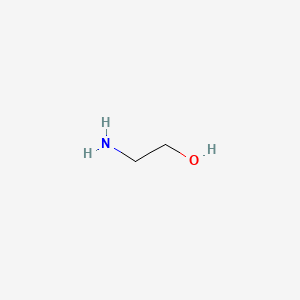
CAS 141-43-5PubChem CID 700
Ethanolamine
Ethanolamine is a member of the class of ethanolamines that is ethane with an amino substituent at C-1 and a hydroxy substituent at C-2, making it both a primary amine and a primary alcohol. It has a role as a mouse metabolite, an Escherichia coli metabolite and a human metabolite. It is a primary alcohol, a member of ethanolamines and a primary amine. It is a conjugate base of an ethanolaminium(1+). — ChEBI
- IUPAC name
- 2-aminoethanol
- Molecular formula
- C2H7NO
- Molecular weight
- 61.08 g/mol
- Exact mass
- 61.052763847 Da
- XLogP3
- -1.3
- Topological polar surface area
- 46.3 Ų
- Hydrogen-bond donors
- 2
- Hydrogen-bond acceptors
- 2
- Covalent units
- 1
- Defined stereocentres
- 0
Also known as
monoethanolamineOlamine2-Aminoethan-1-ol2-HydroxyethylaminecolamineAminoethanolEthylolamineEthanol, 2-amino-
16 more reported names
2-Hydroxyethanamine2-Amino-1-ethanolbeta-Hydroxyethylamine2-Ethanolamine1-Amino-2-hydroxyethanebeta-Aminoethyl alcoholThiofaco M-50Aethanolamin2-Aminoethyl alcoholMEA (alcohol)USAF EK-1597beta-AminoethanolKolaminMonoaethanolaminbeta-ethanolamine2-Aminoaethanol
External database identifiers
- ChEBI:CHEBI:16000
- ChEMBL:CHEMBL104943
- EPA DTXSID:DTXSID6022000
- PubMed:41203133
- PubMed:33358762
- PubMed:32979392
- PubMed:29968805
- PubMed:23122131
- PubMed:23094024
- PubMed:23064551
- PubMed:23010268
- PubMed:22989363
- PubMed:22980596
- PubMed:22964095
- PubMed:22959937
Retrieved from NIH PubChem on 2026-08-31 by checksum-valid CAS matching. Chemical properties do not replace the regulatory decision on this page.