
CAS 1406-65-1PubChem CID 156620228
Chlorophyll
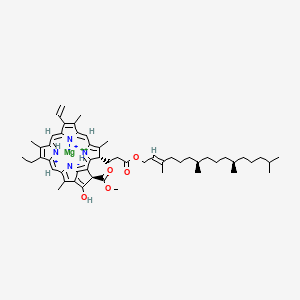
Chlorophyll is a porphyrin derivative conjugated with a magnesium ion that is found in plant chloroplasts, algae and cyanobacteria. Chlorophyll is essential to the process of photosynthesis. It absorbs light in the blue and red parts of the visible spectrum and transfers the absorbed photon energy to an electron, which is used to produce ATP. — NCI Thesaurus (NCIt)
- IUPAC name
- magnesium methyl (3R,22S)-16-ethenyl-11-ethyl-4-hydroxy-12,17,21,26-tetramethyl-22-[3-oxo-3-[(E,7R,11R)-3,7,11,15-tetramethylhexadec-2-enoxy]propyl]-23,25-diazonia-7,24-diazanidahexacyclo[18.2.1.15,8.110,13.115,18.02,6]hexacosa-1(23),2(6),4,8(26),9,11,13(25),14,16,18,20-undecaene-3-carboxylate
- Molecular formula
- C55H74MgN4O5+2
- Molecular weight
- 895.5 g/mol
- Exact mass
- 894.5509632 Da
- Topological polar surface area
- 103.0 Ų
- Hydrogen-bond donors
- 3
- Hydrogen-bond acceptors
- 7
- Covalent units
- 2
- Defined stereocentres
- 4
Also known as
ChlorofolinDeodophyllChlorofylChlorofyl [Czech]L-Gruen No. 1L-Gruen No. 1 [German]00WNZ48OR9CCRIS 9283
14 more reported names
EINECS 215-800-7C.I. 1956CHEBI:28966CHLOROPHYLL [MI]RefChem:575930CHLOROPHYLL [VANDF]CHLOROPHYLL [WHO-DD]PIGMENTS, BIOLOGICAL, CHLOROPHYLLS479-61-8 (CHLOROPHYLL A); 519-62-0 (B)CI Natural Green 3Magnesium ChlorophyllMagnesium PhaeophytinChlorophylls: 215-800-7, chlorophyll a: 207-536-6, Chlorophyll b: 208-272-4215-800-7ChlorophyllsUNII-00WNZ48OR9
Retrieved from NIH PubChem on 2026-08-31 by checksum-valid CAS matching. Chemical properties do not replace the regulatory decision on this page.