
CAS 137-32-6PubChem CID 8723
2-Methyl-1-butanol
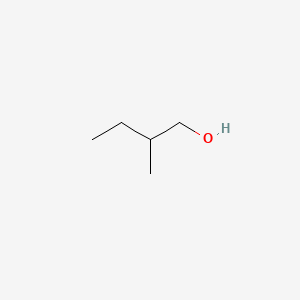
2-methylbutan-1-ol is a primary alcohol that is isopentane substituted by a hydroxy group at position 1. It has a role as a Saccharomyces cerevisiae metabolite. It is a primary alcohol and an alkyl alcohol. It derives from a hydride of an isopentane. — ChEBI
- IUPAC name
- 2-methylbutan-1-ol
- Molecular formula
- C5H12O
- Molecular weight
- 88.15 g/mol
- Exact mass
- 88.088815002 Da
- XLogP3
- 1.2
- Topological polar surface area
- 20.2 Ų
- Hydrogen-bond donors
- 1
- Hydrogen-bond acceptors
- 1
- Covalent units
- 1
- Defined stereocentres
- 0
Also known as
Active amyl alcoholsec-Butylcarbinol2-Methylbutanol1-Butanol, 2-methyl-2-Methylbutyl alcohol2-Methyl-n-butanolPrimary active amyl alcohol2-Methyl butanol-1
16 more reported names
Active primary amyl alcoholdl-sec-Butyl carbinol7VTJ239ASUNSC-8431FEMA NO. 3998CHEBI:48945RefChem:87986205-289-9252-163-4DL-2-Methyl-1-butanol(+/-)-2-Methyl-1-butanolsec-Butyl carbinolMethyl-2-butan-1-ol2-methyl-butanolNSC 8431(1)-2-Methylbutan-1-ol
External database identifiers
- ChEBI:CHEBI:48945
- ChEMBL:CHEMBL451923
- EPA DTXSID:DTXSID5027069
- PubMed:22986207
- PubMed:22913462
- PubMed:22701113
- PubMed:22649934
- PubMed:22644482
- PubMed:22519968
- PubMed:22504490
- PubMed:22426893
- PubMed:22417427
- PubMed:22224870
- PubMed:22163873
- PubMed:22109725
Retrieved from NIH PubChem on 2026-08-31 by checksum-valid CAS matching. Chemical properties do not replace the regulatory decision on this page.