
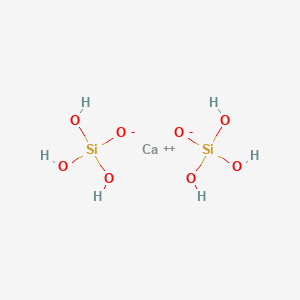
CAS 1344-95-2PubChem CID 73415800
Calcium Silicate
The Expert Panel for Cosmetic Ingredient Safety concluded that the following 24 silicate ingredients are safe in cosmetics in the present practices of use and concentration described in this safety assessment when formulated to be non-irritating, with the exception that the available data are insufficient to make a determination of safety for the use of naturally-sourced (i.e., mined) silicate ingredients in products that may be incidentally inhaled: Calcium Silicate. — Cosmetic Ingredient Review (CIR)
- IUPAC name
- calcium bis(trihydroxy(oxido)silane)
- Molecular formula
- CaH6O8Si2
- Molecular weight
- 230.29 g/mol
- Exact mass
- 229.9227111 Da
- Topological polar surface area
- 168.0 Ų
- Hydrogen-bond donors
- 6
- Hydrogen-bond acceptors
- 8
- Covalent units
- 3
- Defined stereocentres
- 0
Also known as
Calcarea silicataHuberderm 1000INS NO.552INS-552S4255P4G5ME-552Head ColdRefChem:54628
16 more reported names
Calcium salt of silicic acid215-710-8Calcium hydrosilicateCalcium monosilicateCalcium OrthosilicateCalcium silicate, synthetic nonfibrousCalflo ECalsilCS LafargeFlorite RMarimet 45Micro-CelMicro-Cel AMicro-Cel BMicro-Cel CMicro-Cel E
Retrieved from NIH PubChem on 2026-08-31 by checksum-valid CAS matching. Chemical properties do not replace the regulatory decision on this page.