
CAS 1344-00-9PubChem CID 72941443
Sodium aluminosilicate
Sodium aluminosilicate is a fine white powder. Many ordinary rocks (feldspars) are aluminosilicates. Aluminosilicates with more open three-dimensional structures than the feldspars are called zeolites. The openings in zeolites appear as polyhedral cavities connected by tunnels. Zeolites act as catalysts by absorbing small molecules in their interior cavities and holding them in proximity so that reaction among them occurs sooner. — CAMEO Chemicals
- IUPAC name
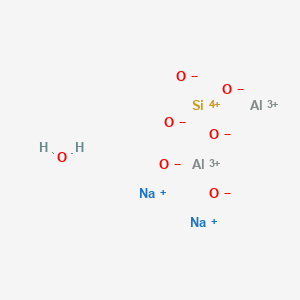
- dialuminum;disodium;hexakis(oxygen(2-));silicon(4+);hydrate
- Molecular formula
- Al2H2Na2O7Si
- Molecular weight
- 242.04 g/mol
- Exact mass
- 241.899594 Da
- Topological polar surface area
- 7.0 Ų
- Hydrogen-bond donors
- 1
- Hydrogen-bond acceptors
- 7
- Covalent units
- 12
- Defined stereocentres
- 0
Also known as
DecalsoZeolexDecalso FAlusil ETVulkasil A 1Zeolex 23AZeolex 23PZeolex 25
16 more reported names
Zeolex 35Sodium silicoaluminateZeolex 100SasilType A ZeoliteAmsr 3Degussa P820Valfor zeolite Na-a058TS43PSMAlusil SD533Zeolex 330Silicic acid, aluminum sodium saltAluminium sodium silicateAluminum silicon sodium oxideAluminosilicic acid, sodium saltNCI-C55505
Retrieved from NIH PubChem on 2026-08-31 by checksum-valid CAS matching. Chemical properties do not replace the regulatory decision on this page.