
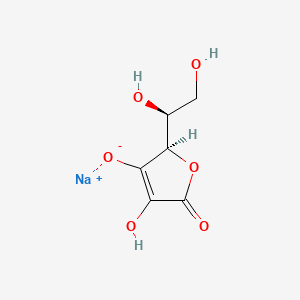
CAS 134-03-2PubChem CID 23667548
Sodium Ascorbate
Sodium ascorbate is an organic sodium salt resulting from the replacement of the proton from the 3-hydroxy group of ascorbic acid by a sodium ion. It has a role as a coenzyme, a reducing agent, a flour treatment agent, a plant metabolite, a human metabolite, a food antioxidant and a Daphnia magna metabolite. It is a vitamin C and an organic sodium salt. It contains a L-ascorbate. — ChEBI
- IUPAC name
- sodium (2R)-2-[(1S)-1,2-dihydroxyethyl]-4-hydroxy-5-oxo-2H-furan-3-olate
- Molecular formula
- C6H7NaO6
- Molecular weight
- 198.11 g/mol
- Exact mass
- 198.01403222 Da
- Topological polar surface area
- 110.0 Ų
- Hydrogen-bond donors
- 3
- Hydrogen-bond acceptors
- 6
- Covalent units
- 2
- Defined stereocentres
- 2
Also known as
L-Ascorbic acid sodium saltSodium L-ascorbateVitamin C sodiumAscorbic acid sodium saltMonosodium L-ascorbateAscorbicinSodascorbateAscorbate de sodium
16 more reported names
AscorbinCebitateNatrii ascorbasL-Ascorbic acid, monosodium saltIskia-CNatri-CVitamin C, sodium saltAscorbato sodicoAscorbic acid sodium derivative3-Oxo-L-gulofuranolactone sodiumHBL 508Ascorbato de sodioINS NO.301INS-301S033EH8359E-301
External database identifiers
- ChEBI:CHEBI:113451
- ChEMBL:CHEMBL591665
- EPA DTXSID:DTXSID0020105
Retrieved from NIH PubChem on 2026-08-31 by checksum-valid CAS matching. Chemical properties do not replace the regulatory decision on this page.