
CAS 134-01-0PubChem CID 164544
Peonidin
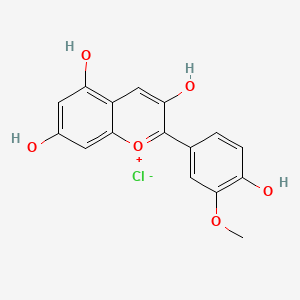
Peonidin chloride is an anthocyanidin chloride that has peonidin as the cationic component. It has a role as an antioxidant, a metabolite, an antineoplastic agent and an apoptosis inducer. It contains a peonidin. — ChEBI
- IUPAC name
- 2-(4-hydroxy-3-methoxyphenyl)chromenylium-3,5,7-triol chloride
- Molecular formula
- C16H13ClO6
- Molecular weight
- 336.72 g/mol
- Exact mass
- 336.0400658 Da
- Topological polar surface area
- 91.2 Ų
- Hydrogen-bond donors
- 4
- Hydrogen-bond acceptors
- 6
- Covalent units
- 2
- Defined stereocentres
- 0
Also known as
Peonidin chloride3,4',5,7-Tetrahydroxy-3'-methoxyflavylium chloride3,5,7-Trihydroxy-2-(4-hydroxy-3-methoxyphenyl)-1-benzopyrylium chlorideD0O766G47B2-(4-hydroxy-3-methoxyphenyl)chromenylium-3,5,7-triol;chlorideCHEBI:75033CHEBI:753143,5,7-trihydroxy-2-(4-hydroxy-3-methoxyphenyl)chromenium
16 more reported names
RefChem:1715322-(4-hydroxy-3-methoxy-phenyl)chromene-3,5,7-triol205-125-62-(4-hydroxy-3-methoxyphenyl)chromenylium-3,5,7-triolPeonidin (chloride)YGM-6 (chloride)3,5,7-trihydroxy-2-(4-hydroxy-3-methoxyphenyl)chromenylium chlorideUNII-D0O766G47BYGM-6 ChlorideEINECS 205-125-6PEONIDIN [MI]3,4',5,7-tetrahydroxy-3'-methoxy-2-phenylbenzopyrylium chloridePeonidin (chloride) (Standard)HY-N2459RHY-N24593,5,7-trihydroxy-2-(4-hydroxy-3-methoxyphenyl)chromenium chloride
External database identifiers
- ChEBI:CHEBI:75033
- ChEMBL:CHEMBL589665
- PubMed:16921400
Retrieved from NIH PubChem on 2026-09-02 by checksum-valid CAS matching. Chemical properties do not replace the regulatory decision on this page.