
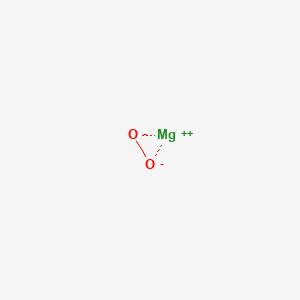
CAS 1335-26-8PubChem CID 61745
Magnesium peroxide (Mg(O2))
Magnesium peroxide appears as a white powder. Noncombustible but accelerates the burning of combustible material, if the combustible material is finely divided the mixture may be explosive. Mixtures of combustible material and the peroxide can be ignited by friction or contact with moisture. Used in medicine, and as a bleaching agent. — CAMEO Chemicals
- IUPAC name
- magnesium peroxide
- Molecular formula
- MgO2
- Molecular weight
- 56.304 g/mol
- Exact mass
- 55.9748709 Da
- Topological polar surface area
- 46.1 Ų
- Hydrogen-bond donors
- 0
- Hydrogen-bond acceptors
- 2
- Covalent units
- 2
- Defined stereocentres
- 0
Also known as
PeromagMagnesium perhydrolDrillox MMagnesium superoxolX8YVJ0TN96EktomorRefChem:58182215-627-7
11 more reported names
238-438-1Magnesium dioxidemagnesium;peroxideMagnesiumperoxydUNII-X8YVJ0TN96Magnesium peroxide (Mg(O2)a)HSDB 7986(eta~2~-Dioxidanediido)magnesiumEINECS 238-438-1UN1476Magnesium peroxide [UN1476] [Oxidizer]
External database identifiers
- EPA DTXSID:DTXSID9049667
Retrieved from NIH PubChem on 2026-09-02 by checksum-valid CAS matching. Chemical properties do not replace the regulatory decision on this page.