
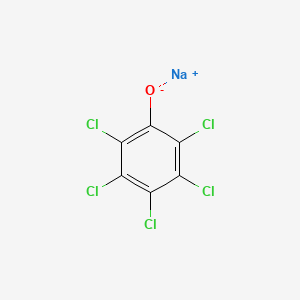
Sodium pentachlorophenolate
Sodium pentachlorophenate is a white or tan, powdered solid. It is soluble in water and may burn, but it is not easily ignited. It may be toxic by ingestion, inhalation and skin absorption. It is used as a fungicide, herbicide and as a disinfectant. — CAMEO Chemicals
- IUPAC name
- sodium 2,3,4,5,6-pentachlorophenolate
- Molecular formula
- C6Cl5NaO
- Molecular weight
- 288.3 g/mol
- Exact mass
- 287.825997 Da
- Topological polar surface area
- 23.1 Ų
- Hydrogen-bond donors
- 0
- Hydrogen-bond acceptors
- 1
- Covalent units
- 2
- Defined stereocentres
- 0
Also known as
16 more reported names
External database identifiers
- ChEMBL:CHEMBL3560394
- EPA DTXSID:DTXSID4040264
Evidence from additional scientific databases
NIH PubChem PUG-View
Attributed physical-property, hazard, environmental and use annotations.
- Boiling Point: Decomposes. (USCG, 1999) Source: CAMEO Chemicals
- Color/Form: White crystalline solid Source: Hazardous Substances Data Bank (HSDB)
- Color/Form: Tan powder, pellets Source: Hazardous Substances Data Bank (HSDB)
- Color/Form: Buff-colored flakes Source: Hazardous Substances Data Bank (HSDB)
- Density: 2.0 mg/L at 22 °C/4 °C Source: Hazardous Substances Data Bank (HSDB)
- LogP: log Kow = 1.3 at pH 10 Source: Hazardous Substances Data Bank (HSDB)
- Odor: Phenolic odor Source: Hazardous Substances Data Bank (HSDB)
- Physical Description: Sodium pentachlorophenate is a white or tan, powdered solid. It is soluble in water and may burn, but it is not easily ignited. It may be toxic by ingestion, inhalation and skin absorption. It is used as a fungicide, herbicide and as a disinfectant. Source: CAMEO Chemicals
- Physical Description: White or tan solid; [Hawley] Small slightly brown beads; [MSDSonline] Source: Haz-Map, Information on Hazardous Chemicals and Occupational Diseases
- Physical Description: WHITE OR TAN FLAKES OR POWDER WITH CHARACTERISTIC ODOUR. Source: ILO-WHO International Chemical Safety Cards (ICSCs)
- Solubility: In water, 3.30X10+5 mg/L at 25 °C Source: Hazardous Substances Data Bank (HSDB)
- Solubility: Solubility in water (g/L): 22.4 at 20 °C; 33 at 30 °C Source: Hazardous Substances Data Bank (HSDB)
- Solubility: Solubility at 25 °C (g/L): methanol 22; acetone 37 Source: Hazardous Substances Data Bank (HSDB)
- Solubility: 21% (wt/vol) at 5 °C (water), 29% (wt/vol) at 40 °C (water), 33% (wt/vol at 25 °C (water) Source: Hazardous Substances Data Bank (HSDB)
- Solubility: Soluble in ethanol and acetone; insoluble in benzene and petroleum oils Source: Hazardous Substances Data Bank (HSDB)
- Solubility: Solubility in water, g/100ml at 25 °C: 33 Source: ILO-WHO International Chemical Safety Cards (ICSCs)
- pH: Aqueous solution has alkaline reaction Source: Hazardous Substances Data Bank (HSDB)
- Carcinogen Classification: 2B, possibly carcinogenic to humans. (L135) Source: Toxin and Toxin Target Database (T3DB)
- Exposure Routes: The substance can be absorbed into the body by inhalation, through the skin and by ingestion. Source: ILO-WHO International Chemical Safety Cards (ICSCs)
- Exposure Routes: Oral (L127) ; inhalation (L127) ; dermal (L127) Source: Toxin and Toxin Target Database (T3DB)
- First Aid: Signs and Symptoms of Sodium Pentachlorophenate Exposure: Signs and symptoms of sodium pentachlorophenate exposure include skin irritation, irritation and burning of eyes, numbness and opacity of the cornea, upper respiratory tract irritation, pain in chest, coughing, sneezing, rapid breathing, difficulty in breathing, and bronchitis. Contact dermatitis may be observed after severe exposure. Profuse sweating, headache, weakness, loss of appetite, abdominal pain, nausea, cardiac dilatation, tachycardia (rapid heart beat), and cardiac failure may occur. High fever may be present, and exposed individual may experience an intense thirst, although this may be masked by nausea and vomiting. Declining alertness may progress to stupor, convulsions, and coma. Ingestion may be followed by delayed scar tissue formation, which may later cause problems with swallowing and stomach filling and emptying.; Emergency Life-Support Procedures: Acute exposure to sodium pentachlorophenate may require decontamination and life support for the victims. Emergency personnel should wear protective clothing appropriate to the type and degree of contamination. Air-purifying or supplied-air respiratory equipment Source: CAMEO Chemicals
- ERG2024, Guide 154 (Sodium pentachlorophenate): General First Aid:; · Call 911 or emergency medical service.; · Ensure that medical personnel are aware of the material(s) involved, take precautions to protect themselves and avoid contamination.; · Move victim to fresh air if it can be done safely.; · Administer oxygen if breathing is difficult.; · If victim is not breathing:; -- DO NOT perform mouth-to-mouth resuscitation; the victim may have ingested or inhaled the substance.; -- If equipped and pulse detected, wash face and mouth, then give artificial respiration using a proper respiratory medical device (bag-valve mask, pocket mask equipped with a one-way valve or other device).; -- If no pulse detected or no respiratory medical device available, provide continuous compressions. Conduct a pulse check every two minutes or monitor for any signs of spontaneous respirations.; · Remove and isolate contaminated clothing and shoes.; · For minor skin contact, avoid spreading material on unaffected skin.; · In case of contact with substance, remove immediately by flushing skin or eyes with running water for at least 20 minutes.; · For severe burns, immediate medical attention is required.; · Effects of exposure (inhalation, ingestion, Source: Emergency Response Guidebook (ERG)
- Signal: Danger Source: Regulation (EC) No 1272/2008 of the European Parliament and of the Council
- GHS Hazard Statements: H301: Toxic if swallowed [Danger Acute toxicity, oral]; H311: Toxic in contact with skin [Danger Acute toxicity, dermal]; H315: Causes skin irritation [Warning Skin corrosion/irritation]; H319: Causes serious eye irritation [Warning Serious eye damage/eye irritation]; H330: Fatal if inhaled [Danger Acute toxicity, inhalation]; H335: May cause respiratory irritation [Warning Specific target organ toxicity, single exposure; Respiratory tract irritation]; H351: Suspected of causing cancer [Warning Carcinogenicity]; H400: Very toxic to aquatic life [Warning Hazardous to the aquatic environment, acute hazard]; H410: Very toxic to aquatic life with long lasting effects [Warning Hazardous to the aquatic environment, long-term hazard] Source: Regulation (EC) No 1272/2008 of the European Parliament and of the Council
- Precautionary Statement Codes: P203, P260, P261, P262, P264, P264+P265, P270, P271, P273, P280, P284, P301+P316, P302+P352, P304+P340, P305+P351+P338, P316, P318, P319, P320, P321, P330, P332+P317, P337+P317, P361+P364, P362+P364, P391, P403+P233, P405, and P501 (click each P-code to see the statement) Source: Regulation (EC) No 1272/2008 of the European Parliament and of the Council
- Signal: Danger Source: European Chemicals Agency (ECHA)
- GHS Hazard Statements: H301+H311 (61.8%): Toxic if swallowed or in contact with skin [Danger Acute toxicity, oral; acute toxicity, dermal]; H301 (100%): Toxic if swallowed [Danger Acute toxicity, oral]; H311 (100%): Toxic in contact with skin [Danger Acute toxicity, dermal]; H315 (100%): Causes skin irritation [Warning Skin corrosion/irritation]; H319 (100%): Causes serious eye irritation [Warning Serious eye damage/eye irritation]; H330 (100%): Fatal if inhaled [Danger Acute toxicity, inhalation]; H335 (100%): May cause respiratory irritation [Warning Specific target organ toxicity, single exposure; Respiratory tract irritation]; H351 (100%): Suspected of causing cancer [Warning Carcinogenicity]; H400 (100%): Very toxic to aquatic life [Warning Hazardous to the aquatic environment, acute hazard]; H410 (100%): Very toxic to aquatic life with long lasting effects [Warning Hazardous to the aquatic environment, long-term hazard] Source: European Chemicals Agency (ECHA)
- Precautionary Statement Codes: P203, P260, P261, P262, P264, P264+P265, P270, P271, P273, P280, P284, P301+P316, P302+P352, P304+P340, P305+P351+P338, P316, P318, P319, P320, P321, P330, P332+P317, P337+P317, P361+P364, P362+P364, P391, P403+P233, P405, and P501 (click each P-code to see the statement) Source: European Chemicals Agency (ECHA)
- ECHA C&L Notifications Summary: Aggregated GHS information provided per 170 reports by companies from 4 notifications to the ECHA C&L Inventory. Each notification may be associated with multiple companies.; Information may vary between notifications depending on impurities, additives, and other factors. The percentage value in parenthesis indicates the notified classification ratio from companies that provide hazard codes. Only hazard codes with percentage values above 10% are shown. For more detailed information, please visit ECHA C&L website. Source: European Chemicals Agency (ECHA)
- Signal: Danger Source: NITE-CMC
- GHS Hazard Statements: H301: Toxic if swallowed [Danger Acute toxicity, oral]; H310: Fatal in contact with skin [Danger Acute toxicity, dermal]; H315: Causes skin irritation [Warning Skin corrosion/irritation]; H318: Causes serious eye damage [Danger Serious eye damage/eye irritation]; H330: Fatal if inhaled [Danger Acute toxicity, inhalation]; H350: May cause cancer [Danger Carcinogenicity]; H360: May damage fertility or the unborn child [Danger Reproductive toxicity]; H370: Causes damage to organs [Danger Specific target organ toxicity, single exposure]; H372: Causes damage to organs through prolonged or repeated exposure [Danger Specific target organ toxicity, repeated exposure] Source: NITE-CMC
- Precautionary Statement Codes: P203, P260, P262, P264, P264+P265, P270, P271, P280, P284, P301+P316, P302+P352, P304+P340, P305+P354+P338, P308+P316, P316, P317, P318, P319, P320, P321, P330, P332+P317, P361+P364, P362+P364, P403+P233, P405, and P501 (click each P-code to see the statement) Source: NITE-CMC
- GHS Hazard Statements: H301: Toxic if swallowed [Danger Acute toxicity, oral]; H310: Fatal in contact with skin [Danger Acute toxicity, dermal]; H315: Causes skin irritation [Warning Skin corrosion/irritation]; H319: Causes serious eye irritation [Warning Serious eye damage/eye irritation]; H330: Fatal if inhaled [Danger Acute toxicity, inhalation]; H351: Suspected of causing cancer [Warning Carcinogenicity]; H361: Suspected of damaging fertility or the unborn child [Warning Reproductive toxicity]; H371: May cause damage to organs [Warning Specific target organ toxicity, single exposure]; H372: Causes damage to organs through prolonged or repeated exposure [Danger Specific target organ toxicity, repeated exposure]; H373: May causes damage to organs through prolonged or repeated exposure [Warning Specific target organ toxicity, repeated exposure] Source: NITE-CMC
- Precautionary Statement Codes: P203, P260, P262, P264, P264+P265, P270, P271, P280, P284, P301+P316, P302+P352, P304+P340, P305+P351+P338, P308+P316, P316, P318, P319, P320, P321, P330, P332+P317, P337+P317, P361+P364, P362+P364, P403+P233, P405, and P501 (click each P-code to see the statement) Source: NITE-CMC
- Health Effects: Acute exposure to cholinesterase inhibitors can cause a cholinergic crisis characterized by severe nausea/vomiting, salivation, sweating, bradycardia, hypotension, collapse, and convulsions. Increasing muscle weakness is a possibility and may result in death if respiratory muscles are involved. Accumulation of ACh at motor nerves causes overstimulation of nicotinic expression at the neuromuscular junction. When this occurs symptoms such as muscle weakness, fatigue, muscle cramps, fasciculation, and paralysis can be seen. When there is an accumulation of ACh at autonomic ganglia this causes overstimulation of nicotinic expression in the sympathetic system. Symptoms associated with this are hypertension, and hypoglycemia. Overstimulation of nicotinic acetylcholine receptors in the central nervous system, due to accumulation of ACh, results in anxiety, headache, convulsions, ataxia, depression of respiration and circulation, tremor, general weakness, and potentially coma. When there is expression of muscarinic overstimulation due to excess acetylcholine at muscarinic acetylcholine receptors symptoms of visual disturbances, tightness in chest, wheezing due to bronchoconstriction, incre Source: Toxin and Toxin Target Database (T3DB)
- Toxicity Summary: Pentachlorophenol is a cholinesterase or acetylcholinesterase (AChE) inhibitor. A cholinesterase inhibitor (or 'anticholinesterase') suppresses the action of acetylcholinesterase. Because of its essential function, chemicals that interfere with the action of acetylcholinesterase are potent neurotoxins, causing excessive salivation and eye-watering in low doses, followed by muscle spasms and ultimately death. Nerve gases and many substances used in insecticides have been shown to act by binding a serine in the active site of acetylcholine esterase, inhibiting the enzyme completely. Acetylcholine esterase breaks down the neurotransmitter acetylcholine, which is released at nerve and muscle junctions, in order to allow the muscle or organ to relax. The result of acetylcholine esterase inhibition is that acetylcholine builds up and continues to act so that any nerve impulses are continually transmitted and muscle contractions do not stop. Among the most common acetylcholinesterase inhibitors are phosphorus-based compounds, which are designed to bind to the active site of the enzyme. The structural requirements are a phosphorus atom bearing two lipophilic groups, a leaving group (such a Source: Toxin and Toxin Target Database (T3DB)
- Environmental Bioconcentration: Rainbow trout exposed to waterborne sodium pentachlorophenate averaging 35 and 660 ng/L for about 115 days accumulated levels of pentachlorophenate that were related to the concentration and duration of exposure. Pentachlorophenate levels in organs (liver and gall bladder), the remaining fish, and the percent of total pentachlorophenate in the organs remained relatively uniform among the control fish over the 115 day period. Fish exposed to 35 ng/L contained slightly higher pentachlorophenate levels with a higher percentage found in the organs. The highest levels of pentachlorophenate occurred in fish exposed to 660 ng/L where concentration in the organs averaged 2200 ug/kg after 115 days. Thus, uptake from water is an important pathway for the accumulation of pentachlorophenate by rainbow trout. Source: Hazardous Substances Data Bank (HSDB)
- Environmental Fate: Pentachlorophenate disappeared from the water of microcosms simulating some of the characteristics of littoral zones during the first 6 wk after exposure to a single application of 41 ug/l (14)C-labeled sodium pentachlorophenate. Concn of inorganic (14)C in water samples increased during this period and subsequently declined. The total (14)C residues in the water declined approx 2% per day throughout the experiment and radioactive residues in macrophytes increased linearly between days 1 and 35, reaching concn greater than 700 times the initial concn in water. Concn of (14)C residues in macrophytes dropped rapidly after the 8th week of the experiment. Some (14)C pentachlorophenate was degraded to (14)C carbon dioxide and photosynthetic fixation of (14)C carbon dioxide occurred. At the end of the experiment, 40-43% of the radioactivity was present in benthic sediments and approx 5% was recovered in scrapings of mineral precipitates and algae from the walls of the microcosms. About 40% of the applied radioactivity was not detected in microcosm components and was presumably lost to the atmosphere during the 180 day exposure period. Source: Hazardous Substances Data Bank (HSDB)
- Sources/Uses: Used as bactericide, fungicide, and disinfectant (cooling towers, adhesives, construction materials, leather tanning, paints, petroleum drilling muds, photographic solutions, pulp and paper processing, textiles, water treatment, and industrial re-circulating water); [HSDB] Used as herbicide; [Hawley] Source: Haz-Map, Information on Hazardous Chemicals and Occupational Diseases
- Restricted Notes: Not currently registered as pesticide with the EPA for use in the US; [HSDB] Banned in the EU as pesticide for plant protection; Use severely restricted as a biocide; [eChemPortal: ESIS] Source: Haz-Map, Information on Hazardous Chemicals and Occupational Diseases
- Industrial Processes with risk of exposure: Petroleum Production and Refining [Category: Industry]; Pulp and Paper Processing [Category: Industry]; Textiles (Fiber & Fabric Manufacturing) [Category: Industry]; Painting (Pigments, Binders, and Biocides) [Category: Paint]; Working with Glues and Adhesives [Category: Other]; Using Disinfectants or Biocides [Category: Clean]; Farming (Pesticides) [Category: Industry]; Sewer and Wastewater Treatment [Category: Industry]; Leather Tanning and Processing [Category: Industry]; Photographic Processing [Category: Other] Source: Haz-Map, Information on Hazardous Chemicals and Occupational Diseases
- Uses: For pentachlorophenol, sodium salt (USEPA/OPP Pesticide Code: 063003) there are 0 labels match. /SRP: Not registered for current use in the U.S., but approved pesticide uses may change periodically and so federal, state and local authorities must be consulted for currently approved uses./ Source: Hazardous Substances Data Bank (HSDB)
- Uses: The active ingredient is no longer contained in any registered pesticide products ... "cancelled." Source: Hazardous Substances Data Bank (HSDB)
- Uses: Fungicide /non-USA/ Source: Hazardous Substances Data Bank (HSDB)
- Uses: PCP or its sodium salt have also been used as a herbicide and dessicant for forage seed crops, a herbicide for non-food vegetation control, a biocide in the post-harvest washing of fruit, and as an insecticide for use in beehives, seed plots, and greenhouses. PCP was formerly used as a herbicide in paddy and upland rice fields, particularly in Japan. /Former/ Source: Hazardous Substances Data Bank (HSDB)
- Uses: For more Uses (Complete) data for PENTACHLOROPHENOL, SODIUM SALT (8 total), please visit the HSDB record page. Source: Hazardous Substances Data Bank (HSDB)
- Uses: Pentachlorophenol is a restrictively used pesticide and is used industrially as a wood preservative for utility poles, railroad ties, and wharf pilings. (L127) Source: Toxin and Toxin Target Database (T3DB)
Mapped by: Existing checksum-valid CAS to unique PubChem CID match. Retrieved: 2026-08-31. Open source record
Scientific classifications and hazard annotations provide context and do not replace the market-specific regulatory decision shown above.
Additional source coverage and match status
| Source | Result | Checked |
|---|---|---|
| NIH PubChem PUG-View | Exact match | 2026-08-31 |
A recorded no-match is useful evidence that the source was checked; it is not a claim that the substance does not exist elsewhere.
Retrieved from NIH PubChem on 2026-09-02 by checksum-valid CAS matching. Chemical properties do not replace the regulatory decision on this page.