
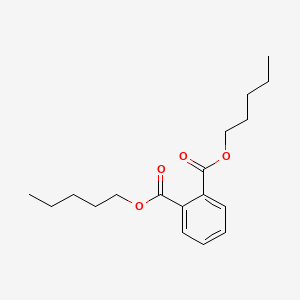
Dipentyl phthalate
Dipentyl phthalate is a phthalate ester that is the dipentyl ester of benzene-1,2-dicarboxylic acid. It has a role as a plasticiser. It is a phthalate ester and a diester. It is functionally related to a pentan-1-ol. — ChEBI
- IUPAC name
- dipentyl benzene-1,2-dicarboxylate
- Molecular formula
- C18H26O4
- Molecular weight
- 306.4 g/mol
- Exact mass
- 306.18310931 Da
- XLogP3
- 5.8
- Topological polar surface area
- 52.6 Ų
- Hydrogen-bond donors
- 0
- Hydrogen-bond acceptors
- 4
- Covalent units
- 1
- Defined stereocentres
- 0
Also known as
16 more reported names
External database identifiers
- ChEBI:CHEBI:34680
- ChEMBL:CHEMBL1503330
- EPA DTXSID:DTXSID5031131
- PubMed:40570975
- PubMed:36715143
- PubMed:33983380
- PubMed:33798595
- PubMed:33049310
- PubMed:28927721
- PubMed:28571686
- PubMed:27532513
- PubMed:26472102
- PubMed:26454885
- PubMed:25938866
- PubMed:25055962
Evidence from additional scientific databases
NIH PubChem PUG-View
Attributed physical-property, hazard, environmental and use annotations.
- Boiling Point: 648 °F at 760 mmHg (NTP, 1992) Source: CAMEO Chemicals
- Boiling Point: 342 °C Source: Hazardous Substances Data Bank (HSDB)
- Color/Form: Colorless, oily liquid Source: Hazardous Substances Data Bank (HSDB)
- Density: 1.022 at 68 °F (NTP, 1992) - Denser than water; will sink Source: CAMEO Chemicals
- Density: 1.022 at 20 °C Source: Hazardous Substances Data Bank (HSDB)
- Flash Point: 357 °F (NTP, 1992) Source: CAMEO Chemicals
- Flash Point: 357 °F; 180 °C (Closed cup) Source: Hazardous Substances Data Bank (HSDB)
- Flash Point: 245 dec F (118 °C) (Closed cup) Source: Hazardous Substances Data Bank (HSDB)
- LogP: log Kow = 5.62 Source: Hazardous Substances Data Bank (HSDB)
- Melting Point: less than -67 °F (NTP, 1992) Source: CAMEO Chemicals
- Melting Point: FP: less than -55 °C Source: Hazardous Substances Data Bank (HSDB)
- Odor: Nearly odorless Source: Hazardous Substances Data Bank (HSDB)
- Physical Description: Di-n-pentyl phthalate is a clear colorless to light yellow liquid. Practically odorless. Floats on water. (NTP, 1992) Source: CAMEO Chemicals
- Physical Description: Colorless oily liquid; [Hawley] Clear colorless to light yellow liquid; [CAMEO] Clear very faintly yellow liquid; [MSDSonline] Source: Haz-Map, Information on Hazardous Chemicals and Occupational Diseases
- Refractive Index: Index of refraction: 1.488 at 25 °C Source: Hazardous Substances Data Bank (HSDB)
- Solubility: less than 1 mg/mL at 68 °F (NTP, 1992) Source: CAMEO Chemicals
- Solubility: Phthalate esters are soluble to various extents in many common organic solvents and oils, but have a relatively low solubility in water. /Phthalate esters/ Source: Hazardous Substances Data Bank (HSDB)
- Solubility: Soluble in carbon tetrachloride, carbon disulfide Source: Hazardous Substances Data Bank (HSDB)
- Solubility: In water, 0.8 mg/L at 25 °C Source: Hazardous Substances Data Bank (HSDB)
- Vapor Pressure: 0.000196 [mmHg] Source: Haz-Map, Information on Hazardous Chemicals and Occupational Diseases
- Vapor Pressure: Vapor pressures for phthalate esters are extremely low, contributing much to their thermal stability in plastics. /Phthalate esters/ Source: Hazardous Substances Data Bank (HSDB)
- Carcinogen Classification: No indication of carcinogenicity to humans (not listed by IARC). Source: Toxin and Toxin Target Database (T3DB)
- Exposure Routes: Oral (L1903) ; inhalation (L1903) ; dermal (L1903) Source: Toxin and Toxin Target Database (T3DB)
- First Aid: EYES: First check the victim for contact lenses and remove if present. Flush victim's eyes with water or normal saline solution for 20 to 30 minutes while simultaneously calling a hospital or poison control center. Do not put any ointments, oils, or medication in the victim's eyes without specific instructions from a physician. IMMEDIATELY transport the victim after flushing eyes to a hospital even if no symptoms (such as redness or irritation) develop.; SKIN: IMMEDIATELY flood affected skin with water while removing and isolating all contaminated clothing. Gently wash all affected skin areas thoroughly with soap and water. If symptoms such as redness or irritation develop, IMMEDIATELY call a physician and be prepared to transport the victim to a hospital for treatment.; INHALATION: IMMEDIATELY leave the contaminated area; take deep breaths of fresh air. If symptoms (such as wheezing, coughing, shortness of breath, or burning in the mouth, throat, or chest) develop, call a physician and be prepared to transport the victim to a hospital. Provide proper respiratory protection to rescuers entering an unknown atmosphere. Whenever possible, Self-Contained Breathing Apparatus (SCBA) shou Source: CAMEO Chemicals
- Signal: Danger Source: Regulation (EC) No 1272/2008 of the European Parliament and of the Council
- GHS Hazard Statements: H360FD: May damage fertility; May damage the unborn child [Danger Reproductive toxicity]; H400: Very toxic to aquatic life [Warning Hazardous to the aquatic environment, acute hazard] Source: Regulation (EC) No 1272/2008 of the European Parliament and of the Council
- Precautionary Statement Codes: P203, P273, P280, P318, P391, P405, and P501 (click each P-code to see the statement) Source: Regulation (EC) No 1272/2008 of the European Parliament and of the Council
- Signal: Danger Source: European Chemicals Agency (ECHA)
- GHS Hazard Statements: H360 (99.3%): May damage fertility or the unborn child [Danger Reproductive toxicity]; H400 (100%): Very toxic to aquatic life [Warning Hazardous to the aquatic environment, acute hazard] Source: European Chemicals Agency (ECHA)
- Precautionary Statement Codes: P203, P273, P280, P318, P391, P405, and P501 (click each P-code to see the statement) Source: European Chemicals Agency (ECHA)
- ECHA C&L Notifications Summary: Aggregated GHS information provided per 271 reports by companies from 10 notifications to the ECHA C&L Inventory. Each notification may be associated with multiple companies.; Information may vary between notifications depending on impurities, additives, and other factors. The percentage value in parenthesis indicates the notified classification ratio from companies that provide hazard codes. Only hazard codes with percentage values above 10% are shown. For more detailed information, please visit ECHA C&L website. Source: European Chemicals Agency (ECHA)
- Signal: Danger Source: NITE-CMC
- GHS Hazard Statements: H360: May damage fertility or the unborn child [Danger Reproductive toxicity] Source: NITE-CMC
- Precautionary Statement Codes: P203, P280, P318, P405, and P501 (click each P-code to see the statement) Source: NITE-CMC
- Signal: Danger Source: Hazardous Chemical Information System (HCIS), Safe Work Australia
- GHS Hazard Statements: H360FD: May damage fertility; May damage the unborn child [Danger Reproductive toxicity]; H400: Very toxic to aquatic life [Warning Hazardous to the aquatic environment, acute hazard] Source: Hazardous Chemical Information System (HCIS), Safe Work Australia
- Health Effects: Phthalate esters are endocrine disruptors. Animal studies have shown that they disrupt reproductive development and can cause a number of malformations in affected young, such as reduced anogenital distance (AGD), cryptorchidism, hypospadias, and reduced fertility. The combination of effects associated with phthalates is called 'phthalate syndrome’. (A2883) Source: Toxin and Toxin Target Database (T3DB)
- NFPA Health Rating: 1 - Materials that, under emergency conditions, can cause significant irritation. Source: Hazardous Substances Data Bank (HSDB)
- NFPA Fire Rating: 1 - Materials that must be preheated before ignition can occur. Materials require considerable preheating, under all ambient temperature conditions, before ignition and combustion can occur. Source: Hazardous Substances Data Bank (HSDB)
- NFPA Instability Rating: 0 - Materials that in themselves are normally stable, even under fire conditions. Source: Hazardous Substances Data Bank (HSDB)
- Toxicity Summary: Phthalate esters are endocrine disruptors. They decrease foetal testis testosterone production and reduce the expression of steroidogenic genes by decreasing mRNA expression. Some phthalates have also been shown to reduce the expression of insulin-like peptide 3 (insl3), an important hormone secreted by the Leydig cell necessary for development of the gubernacular ligament. Animal studies have shown that these effects disrupt reproductive development and can cause a number of malformations in affected young. (A2883) Source: Toxin and Toxin Target Database (T3DB)
- Environmental Bioconcentration: An estimated BCF of 420 was calculated in fish for diamyl phthalate(SRC), using a log Kow of 5.62(1) and a regression-derived equation(2). According to a classification scheme(3), this BCF suggests the potential for bioconcentration in aquatic organisms is high, provided the compound is not metabolized by the organism(SRC). However, bioconcentration studies on compounds which are structurally similar suggest that bioconcentration may be lower than that indicated by the regression-derived equations due to the ability of aquatic organisms to readily metabolize this class of compounds(4). Source: Hazardous Substances Data Bank (HSDB)
- Environmental Fate: TERRESTRIAL FATE: Based on a classification scheme(1), an estimated Koc value of 27,000(SRC), determined from a log Kow values of 5.62(2), and a regression-derived equation(3), indicate that diamyl phthalate is expected to be immobile in soil(SRC). Volatilization of diamyl phthalate from moist soil surfaces is not expected to be an important fate process(SRC) given an estimated Henry's Law constant of 8.9X10⁻⁷ atm-cu m/mole(SRC), using a fragment constant estimation method(4). Diamyl phthalate is not expected to volatilize from dry soil surfaces(SRC) based upon an estimated vapor pressure of 2.0X10⁻⁴ mm Hg(SRC), determined from a fragment constant method(5). Biodegradation studies using pure cultures indicate that diamyl phthalate may biodegrade under aerobic conditions yielding phthalic acid and amyl alcohol(6). Although biodegradation data on diamyl phthalate are limited, biodegradation studies on a series of phthalate esters have demonstrated that, in general, phthalate esters are readily biodegraded(7). Source: Hazardous Substances Data Bank (HSDB)
- Environmental Fate: AQUATIC FATE: Based on a classification scheme(1), an estimated Koc value of 27,000(SRC), determined from a log Kow values of 5.62(2), and a regression-derived equation(3), indicate that diamyl phthalate is expected to adsorb to suspended solids and sediment(SRC). Volatilization from water surfaces is not expected(3) based upon an estimated Henry's Law constant of 8.9X10⁻⁷ atm-cu m/mole(SRC), developed using a fragment constant estimation method(4). According to a classification scheme(5), an estimated BCF of 420(SRC), from its log Kow(2) and a regression-derived equation(6), suggests the potential for bioconcentration in aquatic organisms is high, provided the compound is not metabolized by the organism(SRC). However, bioconcentration studies on compounds which are structurally similar suggest that bioconcentration may be lower than that indicated by the regression-derived equations due to the ability of aquatic organisms to readily metabolize this class of compounds(7). Estimated hydrolysis half-lives of 3.4 years and 130 days at pHs 7 and 8, respectively, suggest that hydrolysis is not expected to be an important process(8). Biodegradation studies using pure cultures indicate th Source: Hazardous Substances Data Bank (HSDB)
- Environmental Fate: ATMOSPHERIC FATE: According to a model of gas/particle partitioning of semivolatile organic compounds in the atmosphere(1), diamyl phthalate, which has an estimated vapor pressure of 2.0X10⁻⁴ mm Hg at 25 °C(SRC), determined from a fragment constant method(2), is expected to exist solely as a vapor in the ambient atmosphere. Vapor-phase diamyl phthalate is degraded in the atmosphere by reaction with photochemically-produced hydroxyl radicals(SRC); the half-life for this reaction in air is estimated to be 32 hours(SRC), calculated from its rate constant of 1.2X10⁻¹¹ cu cm/molecule-sec at 25 °C(SRC) that was derived using a structure estimation method(3). Diamyl phthalate does contain chromophores that absorb at wavelengths >290 nm(4) and therefore may be susceptible to direct photolysis by sunlight(SRC). Source: Hazardous Substances Data Bank (HSDB)
- Sources/Uses: Used as plasticizer; [Hawley] Source: Haz-Map, Information on Hazardous Chemicals and Occupational Diseases
- Uses: Plasticizer Source: Hazardous Substances Data Bank (HSDB)
- Uses: Phthalate esters are mainly used as plasticizers, primarily used to soften polyvinyl chloride. They are found in a number of products, including glues, building materials, personal care products, detergents and surfactants, packaging, children's toys, paints, pharmaceuticals, food products, and textiles. Phthalates are used in a variety of household applications such as shower curtains, vinyl upholstery, adhesives, floor tiles, food containers and wrappers, and cleaning materials. Personal care items containing phthalates include perfume, eye shadow, moisturizer, nail polish, liquid soap, and hair spray. (L1903) Source: Toxin and Toxin Target Database (T3DB)
Mapped by: Existing checksum-valid CAS to unique PubChem CID match. Retrieved: 2026-08-31. Open source record
Scientific classifications and hazard annotations provide context and do not replace the market-specific regulatory decision shown above.
Additional source coverage and match status
| Source | Result | Checked |
|---|---|---|
| NIH PubChem PUG-View | Exact match | 2026-08-31 |
A recorded no-match is useful evidence that the source was checked; it is not a claim that the substance does not exist elsewhere.
Retrieved from NIH PubChem on 2026-09-02 by checksum-valid CAS matching. Chemical properties do not replace the regulatory decision on this page.