
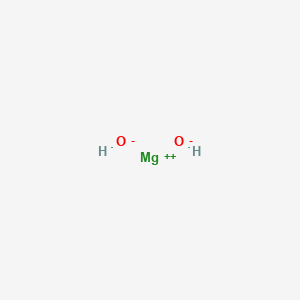
Magnesium Hydroxide
Magnesium dihydroxide is a magnesium hydroxide in which the magnesium atom is bound to two hydroxide groups. It has a role as an antacid and a flame retardant. — ChEBI
- IUPAC name
- magnesium dihydroxide
- Molecular formula
- H2MgO2
- Molecular weight
- 58.320 g/mol
- Exact mass
- 57.9905210 Da
- Topological polar surface area
- 2.0 Ų
- Hydrogen-bond donors
- 2
- Hydrogen-bond acceptors
- 2
- Covalent units
- 3
- Defined stereocentres
- 0
Also known as
16 more reported names
External database identifiers
- ChEBI:CHEBI:6637
- ChEMBL:CHEMBL1200718
- EPA DTXSID:DTXSID4049662
- PubMed:22750351
- PubMed:22075093
- PubMed:18604214
- PubMed:17404311
Evidence from additional scientific databases
NIH PubChem PUG-View
Attributed physical-property, hazard, environmental and use annotations.
- Color/Form: Amorphous powder Source: Hazardous Substances Data Bank (HSDB)
- Color/Form: White, hexagonal crystals Source: Hazardous Substances Data Bank (HSDB)
- Color/Form: Granules Source: Hazardous Substances Data Bank (HSDB)
- Density: 2.36 g/mL Source: Hazardous Substances Data Bank (HSDB)
- Density: 2.36 @25 °C Source: PAC Chemical Database, U.S. Department of Energy
- Melting Point: 350 °C (decomposes) Source: Hazardous Substances Data Bank (HSDB)
- Melting Point: 350 °C Source: PAC Chemical Database, U.S. Department of Energy
- Odor: Odorless Source: Hazardous Substances Data Bank (HSDB)
- Physical Description: CBI; Large Crystals; Other Solid; Wet Solid; Dry Powder; Liquid Source: EPA Chemical Data Reporting (CDR)
- Physical Description: Odourless, white bulky powder Source: EU Food Improvement Agents
- Physical Description: White odorless solid; [Hawley] Colorless or white solid; Hygroscopic in powdered form; [CHEMINFO] White odorless powder; [MSDSonline] Practically insoluble in water; [JECFA] Source: Haz-Map, Information on Hazardous Chemicals and Occupational Diseases
- Refractive Index: Index of refraction: 1.559, 1.580 Source: Hazardous Substances Data Bank (HSDB)
- Solubility: Practically insoluble in water and in ethanol Source: EU Food Improvement Agents
- Solubility: White, friable masses or bulky, white powder; at about 700 °C is converted to MgO; sol in about 3,300 parts CO2-free water; more sol in water containing CO2; sol in dilute acids with effervescence; insol in alcohol /Magnesium carbonate hydroxide/ Source: Hazardous Substances Data Bank (HSDB)
- Solubility: Soluble in dilute acids Source: Hazardous Substances Data Bank (HSDB)
- Solubility: 0.0009 G SOL IN 100 CC WATER @ 18 °C; 0.004 G SOL IN 100 CC WATER @ 100 °C; SOL IN AMMONIUM SALTS Source: Hazardous Substances Data Bank (HSDB)
- Solubility: Almost insoluble in alcohol Source: Hazardous Substances Data Bank (HSDB)
- pH: pH = 9.5-10.5 (aqueous slurry) Source: Hazardous Substances Data Bank (HSDB)
- GHS Hazard Statements: Not Classified; Reported as not meeting GHS hazard criteria by 630 of 736 companies Source: European Chemicals Agency (ECHA)
- ECHA C&L Notifications Summary: Aggregated GHS information provided per 736 reports by companies from 13 notifications to the ECHA C&L Inventory.; Reported as not meeting GHS hazard criteria per 630 of 736 reports by companies.; There are 10 notifications provided by 106 of 736 reports by companies with hazard statement code(s).; Information may vary between notifications depending on impurities, additives, and other factors. The percentage value in parenthesis indicates the notified classification ratio from companies that provide hazard codes. Only hazard codes with percentage values above 10% are shown. For more detailed information, please visit ECHA C&L website. Source: European Chemicals Agency (ECHA)
- Cosmetic Ingredient Review Conclusion: The CIR Expert Panel concluded that ... Magnesium Hydroxide is safe in hair straighteners and depilatories under conditions of recommended use; users should minimize skin contact. These ingredients are safe for all other present practices of use and concentration described in this safety assessment when formulated to be nonirritating. Source: Cosmetic Ingredient Review (CIR)
- Cosmetic Ingredient Review Finding(s): Safe for use in cosmetics, with qualifications Source: Cosmetic Ingredient Review (CIR)
- Consumer Uses: CBI; Other; Lubricating agent; Intermediate; Absorbent; Flux agent; Flame retardant; Soil amendments (fertilizers); Not Known or Reasonably Ascertainable; Filler Source: EPA Chemical Data Reporting (CDR)
- Industry Uses: Processing aids not otherwise specified; Antioxidant; pH regulating agent; Fuel agents; CBI; Other; Lubricating agent; Processing aids, specific to petroleum production; Intermediate; Flux agent; Absorbent; Flame retardant; Reducing agent; Filler; Not Known or Reasonably Ascertainable; Corrosion inhibitor; Soil amendments (fertilizers) Source: EPA Chemical Data Reporting (CDR)
- Cosmetic Ingredient Review Link: CIR ingredient: Magnesium Hydroxide Source: Cosmetic Ingredient Review (CIR)
- Sources/Uses: Found naturally as brucite; [Hawley] Used to make magnesium metal and compounds (dead-burned and caustic-burned magnesia and magnesium oxide, chloride, carbonate, and sulfate), and as an antacid and laxative, a clarifier in sugar refining, and as a residual fuel oil additive; Also used for uranium processing, wastewater treatment, sulfur dioxide removal from waste gases, and neutralization of acids in the chemical industry; Also used in toothpastes and dentrifrices, in foods as a drying and color-retention agent, in frozen desserts, in the pulp and paper industries, and in other products (ceramics, pharmaceuticals, plastics, and flame retardants/smoke suppressants); [HSDB] Used as an alkali and color adjunct; [JECFA] Source: Haz-Map, Information on Hazardous Chemicals and Occupational Diseases
- Industrial Processes with risk of exposure: Metal Preparation and Pouring [Category: Foundry]; Pulp and Paper Processing [Category: Industry]; Sewer and Wastewater Treatment [Category: Industry] Source: Haz-Map, Information on Hazardous Chemicals and Occupational Diseases
- Activities with risk of exposure: Ceramics making [Category: Hobbies] Source: Haz-Map, Information on Hazardous Chemicals and Occupational Diseases
- Uses: CHEM INT FOR DEAD-BURNED & CAUSTIC-BURNED MAGNESIA, MAGNESIUM CHLORIDE & MAGNESIUM CARBONATE; RAW MATERIAL FOR MAGNESIUM METAL; INGREDIENT IN TOOTHPASTE; NEUTRALIZATION OF ACIDS IN THE CHEMICAL INDUSTRY; ... CLARIFIER IN SUGAR REFINING Source: Hazardous Substances Data Bank (HSDB)
- Uses: RESIDUAL FUEL OIL ADDITIVE; SULFITE PULP; URANIUM PROCESSING; DENTRIFRICES; IN FOODS AS DRYING AGENT, COLOR RETENTION AGENT; FROZEN DESSERTS Source: Hazardous Substances Data Bank (HSDB)
- Uses: MEDICATION (VET) Source: Hazardous Substances Data Bank (HSDB)
- Uses: MEDICATION Source: Hazardous Substances Data Bank (HSDB)
- Uses: For more Uses (Complete) data for MAGNESIUM HYDROXIDE (6 total), please visit the HSDB record page. Source: Hazardous Substances Data Bank (HSDB)
- Uses: Plastics -> Typical concentration range in plastic materials -> 4.0 - 8.0% Source: NORMAN Suspect List Exchange
Mapped by: Existing checksum-valid CAS to unique PubChem CID match. Retrieved: 2026-08-31. Open source record
Scientific classifications and hazard annotations provide context and do not replace the market-specific regulatory decision shown above.
Additional source coverage and match status
| Source | Result | Checked |
|---|---|---|
| NIH PubChem PUG-View | Exact match | 2026-08-31 |
A recorded no-match is useful evidence that the source was checked; it is not a claim that the substance does not exist elsewhere.
Retrieved from NIH PubChem on 2026-08-31 by checksum-valid CAS matching. Chemical properties do not replace the regulatory decision on this page.