
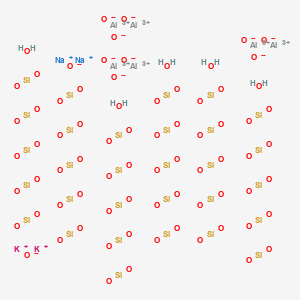
Perlite, expanded
Perlite appears as an odorless, light-gray to glassy-black solid. A naturally occurring aluminosilicate rock. May contain trace amounts of crystalline silica dust, a chronic health hazard by inhalation. — CAMEO Chemicals
- IUPAC name
- hexaaluminum;dipotassium;disodium;(dioxosilane);undecakis(oxygen(2-));pentahydrate
- Molecular formula
- Al6H10K2Na2O76Si30
- Molecular weight
- 2354.6 g/mol
- Exact mass
- 2351.795308 Da
- Topological polar surface area
- 1040.0 Ų
- Hydrogen-bond donors
- 5
- Hydrogen-bond acceptors
- 76
- Covalent units
- 56
- Defined stereocentres
- 0
Also known as
16 more reported names
Evidence from additional scientific databases
NIH PubChem PUG-View
Attributed physical-property, hazard, environmental and use annotations.
- Density: 2.2 to 2.4 (crude), 0.05 to 0.3 (expanded) (NIOSH, 2024) Source: CAMEO Chemicals
- Density: Relative density (water = 1): 2.2-2.4 (crude) Source: ILO-WHO International Chemical Safety Cards (ICSCs)
- Density: 0.13 @25 °C Source: PAC Chemical Database, U.S. Department of Energy
- Density: 2.2-2.4 (crude) 0.05-0.3 (expanded) Source: The National Institute for Occupational Safety and Health (NIOSH)
- Melting Point: greater than 2000 °F (NIOSH, 2024) Source: CAMEO Chemicals
- Melting Point: >1093 °C Source: ILO-WHO International Chemical Safety Cards (ICSCs)
- Melting Point: >2000 °F Source: The National Institute for Occupational Safety and Health (NIOSH)
- Physical Description: Perlite appears as an odorless, light-gray to glassy-black solid. A naturally occurring aluminosilicate rock. May contain trace amounts of crystalline silica dust, a chronic health hazard by inhalation. Source: CAMEO Chemicals
- Physical Description: Odorless, light-gray to glassy-black solid. [Note: Expanded perlite is a fluffy, white particulate.]; [NIOSH] Source: Haz-Map, Information on Hazardous Chemicals and Occupational Diseases
- Physical Description: WHITE-TO-GREY POWDER. ODOURLESS WHEN PURE. Source: ILO-WHO International Chemical Safety Cards (ICSCs)
- Physical Description: Odorless, light-gray to glassy-black solid. [Note: Expanded perlite is a fluffy, white particulate.] Source: The National Institute for Occupational Safety and Health (NIOSH)
- Solubility: less than 1 % (NIOSH, 2024) Source: CAMEO Chemicals
- Solubility: Solubility in water: poor Source: ILO-WHO International Chemical Safety Cards (ICSCs)
- Solubility: <1% Source: The National Institute for Occupational Safety and Health (NIOSH)
- Vapor Pressure: 0 mmHg (approx) (NIOSH, 2024) Source: CAMEO Chemicals
- Vapor Pressure: 0 mmHg (approx) Source: The National Institute for Occupational Safety and Health (NIOSH)
- Exposure Routes: Exposure mainly occurs via inhalation. Source: ILO-WHO International Chemical Safety Cards (ICSCs)
- Exposure Routes: inhalation, skin and/or eye contact Source: The National Institute for Occupational Safety and Health (NIOSH)
- First Aid: Excerpt from NIOSH Pocket Guide for Perlite:; Eye: IRRIGATE IMMEDIATELY - If this chemical contacts the eyes, immediately wash (irrigate) the eyes with large amounts of water, occasionally lifting the lower and upper lids. Get medical attention immediately.; Breathing: FRESH AIR - If a person breathes large amounts of this chemical, move the exposed person to fresh air at once. Other measures are usually unnecessary. (NIOSH, 2024) Source: CAMEO Chemicals
- First Aid: (General first aid procedures); Eye: Irrigate immediately - If this chemical contacts the eyes, immediately wash (irrigate) the eyes with large amounts of water, occasionally lifting the lower and upper lids. Get medical attention immediately.; Breathing: Fresh air Source: The National Institute for Occupational Safety and Health (NIOSH)
- Note: This chemical does not meet GHS hazard criteria for 84.9% (237 of 279) of all reports. Source: European Chemicals Agency (ECHA)
- Signal: Warning Source: European Chemicals Agency (ECHA)
- GHS Hazard Statements: H315 (14%): Causes skin irritation [Warning Skin corrosion/irritation]; H319 (14.7%): Causes serious eye irritation [Warning Serious eye damage/eye irritation]; H335 (14.7%): May cause respiratory irritation [Warning Specific target organ toxicity, single exposure; Respiratory tract irritation] Source: European Chemicals Agency (ECHA)
- Precautionary Statement Codes: P261, P264, P264+P265, P271, P280, P302+P352, P304+P340, P305+P351+P338, P319, P321, P332+P317, P337+P317, P362+P364, P403+P233, P405, and P501 (click each P-code to see the statement) Source: European Chemicals Agency (ECHA)
- ECHA C&L Notifications Summary: Aggregated GHS information provided per 279 reports by companies from 5 notifications to the ECHA C&L Inventory. Each notification may be associated with multiple companies.; Reported as not meeting GHS hazard criteria per 237 of 279 reports by companies.; There are 4 notifications provided by 42 of 279 reports by companies with hazard statement code(s).; Information may vary between notifications depending on impurities, additives, and other factors. The percentage value in parenthesis indicates the notified classification ratio from companies that provide hazard codes. Only hazard codes with percentage values above 10% are shown. For more detailed information, please visit ECHA C&L website. Source: European Chemicals Agency (ECHA)
- GHS Hazard Statements: Not Classified; Reported as not meeting GHS hazard criteria by 1 of 1 companies. For more detailed information, please visit ECHA C&L website. Source: European Chemicals Agency (ECHA)
- Target Organs: Eyes, skin, respiratory system Source: The National Institute for Occupational Safety and Health (NIOSH)
- Sources/Uses: A non-crystalline silicate that occurs naturally in volcanic ash deposits; [Harber, p. 349] Perlite consists of small beads of volcanic glass that can be popped, i.e., heated until it expands into a styrofoam-like material that is used in construction products and soil conditioners. [Hendrick, p. 171] Crystalline silica not bound to other minerals is free silica. Silicates are minerals in which silicon and oxygen are combined with other elements. [Rom, p. 364] Source: Haz-Map, Information on Hazardous Chemicals and Occupational Diseases
Mapped by: Existing checksum-valid CAS to unique PubChem CID match. Retrieved: 2026-08-31. Open source record
Scientific classifications and hazard annotations provide context and do not replace the market-specific regulatory decision shown above.
Additional source coverage and match status
| Source | Result | Checked |
|---|---|---|
| NIH PubChem PUG-View | Exact match | 2026-08-31 |
A recorded no-match is useful evidence that the source was checked; it is not a claim that the substance does not exist elsewhere.
Retrieved from NIH PubChem on 2026-08-31 by checksum-valid CAS matching. Chemical properties do not replace the regulatory decision on this page.