
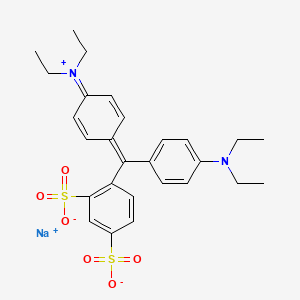
- IUPAC name
- sodium 4-[[4-(diethylamino)phenyl]-(4-diethylazaniumylidenecyclohexa-2,5-dien-1-ylidene)methyl]benzene-1,3-disulfonate
- Molecular formula
- C27H31N2NaO6S2
- Molecular weight
- 566.7 g/mol
- Exact mass
- 566.15212334 Da
- Topological polar surface area
- 137.0 Ų
- Hydrogen-bond donors
- 0
- Hydrogen-bond acceptors
- 7
- Covalent units
- 2
- Defined stereocentres
- 0
Also known as
Patent Blue VFBlue VRSAcid Blue VHexacol Blue VRSSulphanblauDisulphen BlauDisulphine VNAlphazurine 2G
16 more reported names
Hidacid Blue VLeather Blue GAmacid Blue VCarmine Blue VFCarmin Blue VSFenazo Blue XFPatent Blue VSXylene Blue VSC.I. Acid Blue 1, sodium saltC.I. Food Blue 3Erioglaucine SupraHexaco Blue VRSKiton Pure Blue V FQSodium Blue VRSBrilliant Blue GSDisulfine Blue VN
External database identifiers
- ChEBI:CHEBI:34906
- ChEMBL:CHEMBL1731183
- EPA DTXSID:DTXSID3026065
Evidence from additional scientific databases
NIH PubChem PUG-View
Exact identifier match8507
Attributed physical-property, hazard, environmental and use annotations.
- Color/Form: VIOLET POWDER Source: Hazardous Substances Data Bank (HSDB)
- Color/Form: Dark bluish-green powder Source: Hazardous Substances Data Bank (HSDB)
- Physical Description: Sulfan blue is a dark greenish-black powder. (NTP, 1992) Source: CAMEO Chemicals
- Physical Description: Liquid; Wet Solid Source: EPA Chemical Data Reporting (CDR)
- Physical Description: Violet or dark bluish-green solid; [HSDB] Violet powder; [MSDSonline] Source: Haz-Map, Information on Hazardous Chemicals and Occupational Diseases
- Solubility: Soluble (>=10 mg/ml at 70 °F) (NTP, 1992) Source: CAMEO Chemicals
- Solubility: ONE G DISSOLVES IN 20 ML WATER @ 20 °C; PARTLY SOL IN ALCOHOL Source: Hazardous Substances Data Bank (HSDB)
- Solubility: 30 mg/ml in water; 30 mg/ml in 2-methoxyethanol; 7 mg/ml in ethanol Source: Hazardous Substances Data Bank (HSDB)
- IARC Carcinogenic Agent: Blue VRS Source: International Agency for Research on Cancer (IARC)
- IARC Carcinogenic Classes: Group 3: Not classifiable as to its carcinogenicity to humans Source: International Agency for Research on Cancer (IARC)
- IARC Monographs: Volume 16: (1978) Some Aromatic Amines and Related Nitro Compounds – Hair Dyes, Colouring Agents and Miscellaneous Industrial Chemicals; Volume Sup 7: Overall Evaluations of Carcinogenicity: An Updating of IARC Monographs Volumes 1 to 42, 1987; 440 pages; ISBN 92-832-1411-0 (out of print) Source: International Agency for Research on Cancer (IARC)
- Publication Year: 1987 Source: International Agency for Research on Cancer (IARC)
- Evaluation Year: 1987 Source: International Agency for Research on Cancer (IARC)
- First Aid: EYES: First check the victim for contact lenses and remove if present. Flush victim's eyes with water or normal saline solution for 20 to 30 minutes while simultaneously calling a hospital or poison control center. Do not put any ointments, oils, or medication in the victim's eyes without specific instructions from a physician. IMMEDIATELY transport the victim after flushing eyes to a hospital even if no symptoms (such as redness or irritation) develop.; SKIN: IMMEDIATELY flood affected skin with water while removing and isolating all contaminated clothing. Gently wash all affected skin areas thoroughly with soap and water. If symptoms such as redness or irritation develop, IMMEDIATELY call a physician and be prepared to transport the victim to a hospital for treatment.; INHALATION: IMMEDIATELY leave the contaminated area; take deep breaths of fresh air. IMMEDIATELY call a physician and be prepared to transport the victim to a hospital even if no symptoms (such as wheezing, coughing, shortness of breath, or burning in the mouth, throat, or chest) develop. Provide proper respiratory protection to rescuers entering an unknown atmosphere. Whenever possible, Self-Contained Breathing Ap Source: CAMEO Chemicals
- Note: This chemical does not meet GHS hazard criteria for 91.8% (2068 of 2253) of all reports. Source: European Chemicals Agency (ECHA)
- GHS Hazard Statements: Not Classified; Reported as not meeting GHS hazard criteria by 2068 of 2253 companies (only 8.2% companies provided GHS information). For more detailed information, please visit ECHA C&L website. Source: European Chemicals Agency (ECHA)
- ECHA C&L Notifications Summary: Aggregated GHS information provided per 2253 reports by companies from 7 notifications to the ECHA C&L Inventory.; Reported as not meeting GHS hazard criteria per 2068 of 2253 reports by companies.; There are 6 notifications provided by 185 of 2253 reports by companies with hazard statement code(s).; Information may vary between notifications depending on impurities, additives, and other factors. The percentage value in parenthesis indicates the notified classification ratio from companies that provide hazard codes. Only hazard codes with percentage values above 10% are shown. For more detailed information, please visit ECHA C&L website. Source: European Chemicals Agency (ECHA)
- Environmental Bioconcentration: An estimated BCF value of 2 was calculated for C.I. Acid Blue 1(SRC), using a measured water solubility of 30,000 mg/l(1) and a recommended regression-derived equation(2). According to a classification scheme(3), this BCF value suggests that bioconcentration in aquatic organisms is low(SRC). Source: Hazardous Substances Data Bank (HSDB)
- Environmental Fate: TERRESTRIAL FATE: Based on a recommended classification scheme(1), an estimated Koc value of 15(SRC), determined from a measured water solubility(2) and a recommended regression-derived equation(3), indicates that C.I. Acid Blue 1 will have very high mobility in soil(SRC). Due to the ionic nature of C.I. Acid Blue 1, the retention of the dye by ion-exchange processes(4,SRC), particularly on clay surfaces, and adsorption at mineral surfaces such as geothite(5,SRC), may slow down or prevent leaching(SRC). As C.I. Acid Blue 1 is an ionic compound, volatilization of this compound will not be important from moist soil surfaces(4,SRC). Source: Hazardous Substances Data Bank (HSDB)
- Environmental Fate: AQUATIC FATE: Based on a recommended classification scheme(1), an estimated Koc value of 15(SRC), determined from a measured water solubility(2) and a recommended regression-derived equation(1), indicates that C.I. Acid Blue 1 should not adsorb to suspended solids and sediment in water(SRC). However, due to the ionic nature of C.I. Acid Blue 1, the retention of the dye by ion-exchange processes(3,SRC), particularly on clay surfaces, and adsorption at mineral surfaces such as geothite(4,SRC), may lead to increased adsorption on some surfaces(SRC). As C.I. Acid Blue 1 is an ionic compound, volatilization from water surfaces is not expected(3,SRC). According to a classification scheme(5), an estimated BCF value of 2(1,SRC), from a measured water solubility(2), suggests that bioconcentration in aquatic organisms is low(SRC). Source: Hazardous Substances Data Bank (HSDB)
- Environmental Fate: ATMOSPHERIC FATE: The ionic state of C.I. Acid Blue 1 makes this compound essentially non-volatile(1,SRC); therefore, this compound should exist in the particulate phase in the ambient atmosphere. Particulate-phase C.I. Acid Blue 1 may be physically removed from the air, mainly by wet deposition(SRC). Source: Hazardous Substances Data Bank (HSDB)
- Consumer Uses: Not Known or Reasonably Ascertainable Source: EPA Chemical Data Reporting (CDR)
- Sources/Uses: Used as dye (medicinal products, wool, silk, leather, jute, paper, phenol-formaldehyde resins, milled soaps, inks, methylated spirit wash, casein, and lymphography) and biological stain; [HSDB] Source: Haz-Map, Information on Hazardous Chemicals and Occupational Diseases
- Restricted Notes: Formerly used as a food dye (not currently permitted for use in food in the US, Japan, or EU, but is reportedly still used in some countries); Accepted for use in cosmetics not in contact with mucous membranes; [HSDB] Source: Haz-Map, Information on Hazardous Chemicals and Occupational Diseases
- Industrial Processes with risk of exposure: Pulp and Paper Processing [Category: Industry]; Leather Tanning and Processing [Category: Industry]; Textiles (Printing, Dyeing, or Finishing) [Category: Industry] Source: Haz-Map, Information on Hazardous Chemicals and Occupational Diseases
- Uses: COLORING MEDICINAL PRODUCTS Source: Hazardous Substances Data Bank (HSDB)
- Uses: USED TO DYE WOOL, SILK, LEATHER, JUTE; TO STAIN PAPER, TO COLOR PHENOL-FORMALDEHYDE RESINS, MILLED SOAPS; TO COLOR INKS & METHYLATED SPIRIT WASH, MASS COLORATION OF CASEIN; AS A BIOLOGICAL STAIN; HEAVY METAL SALTS OF THE FREE ACID ARE USED AS PIGMENTS; ALUMINUM SALTS USED TO COLOR PHARMACEUTICALS Source: Hazardous Substances Data Bank (HSDB)
- Uses: FOOD DYE (REPORTED NON-U.S. USE) Source: Hazardous Substances Data Bank (HSDB)
- Uses: Used to dye wool directly and silk from either a sulfuric acid or acetic acid bath. It dyes fully chromed leather a bright blue, prints wool and silk directly. Source: Hazardous Substances Data Bank (HSDB)
Mapped by: Existing checksum-valid CAS to unique PubChem CID match. Retrieved: 2026-08-31. Open source record
Scientific classifications and hazard annotations provide context and do not replace the market-specific regulatory decision shown above.
Additional source coverage and match status
| Source | Result | Checked |
|---|---|---|
| NIH PubChem PUG-View | Exact match | 2026-08-31 |
A recorded no-match is useful evidence that the source was checked; it is not a claim that the substance does not exist elsewhere.
Retrieved from NIH PubChem on 2026-08-31 by checksum-valid CAS matching. Chemical properties do not replace the regulatory decision on this page.