
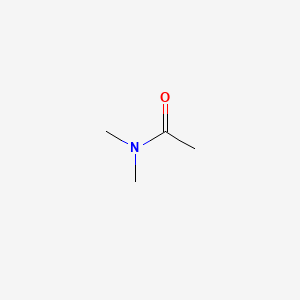
Dimethylacetamide
N,N-dimethylacetamide is a member of the class of acetamides that is acetamide in which the hydrogens attached to the N atom have been replaced by two methyl groups respectively. Metabolite observed in cancer metabolism. It has a role as a human metabolite. It is a member of acetamides and a monocarboxylic acid amide. It is functionally related to an acetamide. — ChEBI
- IUPAC name
- N,N-dimethylacetamide
- Molecular formula
- C4H9NO
- Molecular weight
- 87.12 g/mol
- Exact mass
- 87.068413911 Da
- XLogP3
- -0.8
- Topological polar surface area
- 20.3 Ų
- Hydrogen-bond donors
- 0
- Hydrogen-bond acceptors
- 1
- Covalent units
- 1
- Defined stereocentres
- 0
Also known as
16 more reported names
External database identifiers
- ChEBI:CHEBI:84254
- ChEMBL:CHEMBL11873
- EPA DTXSID:DTXSID5020499
- PubMed:22974525
- PubMed:22898020
- PubMed:22887942
- PubMed:22825787
- PubMed:22766869
- PubMed:22688909
- PubMed:22646836
- PubMed:22644709
- PubMed:22589795
- PubMed:22578629
- PubMed:22564113
- PubMed:22558349
Evidence from additional scientific databases
NIH PubChem PUG-View
Attributed physical-property, hazard, environmental and use annotations.
- Autoignition Temperature: 914 °F (USCG, 1999) Source: CAMEO Chemicals
- Autoignition Temperature: 490 °C Source: Hazardous Substances Data Bank (HSDB)
- Autoignition Temperature: 490 °C Source: ILO-WHO International Chemical Safety Cards (ICSCs)
- Boiling Point: 329 to 331 °F at 760 mmHg (NTP, 1992) Source: CAMEO Chemicals
- Boiling Point: 331 °F at 760 mmHg (USCG, 1999) Source: CAMEO Chemicals
- Boiling Point: 163-165 °C Source: Hazardous Substances Data Bank (HSDB)
- Boiling Point: 165 °C Source: ILO-WHO International Chemical Safety Cards (ICSCs)
- Boiling Point: 329 °F Source: Occupational Safety and Health Administration (OSHA)
- Boiling Point: 165 °C @760 [mm Hg] Source: PAC Chemical Database, U.S. Department of Energy
- Boiling Point: 329 °F Source: The National Institute for Occupational Safety and Health (NIOSH)
- Color/Form: Liquid Source: Hazardous Substances Data Bank (HSDB)
- Color/Form: OILY Source: Hazardous Substances Data Bank (HSDB)
- Color/Form: Colorless liquid Source: Hazardous Substances Data Bank (HSDB)
- Density: 0.943 at 68 °F (USCG, 1999) - Less dense than water; will float Source: CAMEO Chemicals
- Density: 0.937 (USCG, 1999) - Less dense than water; will float Source: CAMEO Chemicals
- Density: 0.9366 @ 25 °C/4 °C Source: Hazardous Substances Data Bank (HSDB)
- Density: Relative density (water = 1): 0.94 Source: ILO-WHO International Chemical Safety Cards (ICSCs)
- Density: 0.94 Source: Occupational Safety and Health Administration (OSHA)
- Density: 0.943 @ 20°C Source: PAC Chemical Database, U.S. Department of Energy
- Density: 0.94 Source: The National Institute for Occupational Safety and Health (NIOSH)
- Dissociation Constants: pKa = -0.19 @ < 25 °C in aqueous sulfuric acid Source: Hazardous Substances Data Bank (HSDB)
- Flash Point: 151 °F (NTP, 1992) Source: CAMEO Chemicals
- Flash Point: 145 °F (USCG, 1999) Source: CAMEO Chemicals
- Flash Point: 70 °C Source: Haz-Map, Information on Hazardous Chemicals and Occupational Diseases
- Flash Point: 70 °C (OPEN CUP) Source: Hazardous Substances Data Bank (HSDB)
- Flash Point: 63 °C c.c. Source: ILO-WHO International Chemical Safety Cards (ICSCs)
- Flash Point: 158 °F (open cup) Source: Occupational Safety and Health Administration (OSHA)
- Flash Point: (oc) 158 °F Source: The National Institute for Occupational Safety and Health (NIOSH)
- LogP: log Kow= -0.77 Source: Hazardous Substances Data Bank (HSDB)
- LogP: -0.77 Source: ILO-WHO International Chemical Safety Cards (ICSCs)
- Melting Point: -4 °F (NTP, 1992) Source: CAMEO Chemicals
- Melting Point: -4 °F (USCG, 1999) Source: CAMEO Chemicals
- Melting Point: -18.59 °C Source: Hazardous Substances Data Bank (HSDB)
- Melting Point: -20 °C Source: ILO-WHO International Chemical Safety Cards (ICSCs)
- Melting Point: -4 °F Source: Occupational Safety and Health Administration (OSHA)
- Melting Point: -20 °C Source: PAC Chemical Database, U.S. Department of Energy
- Melting Point: -4 °F Source: The National Institute for Occupational Safety and Health (NIOSH)
- Odor: AMINE Source: Hazardous Substances Data Bank (HSDB)
- Odor: Weak, ammonia- or fish-like odor Source: Hazardous Substances Data Bank (HSDB)
- Physical Description: Dimethylacetamide appears as a clear colorless liquid with a faint odor similar to ammonia. About the same density as water. Flash point 145 °F. Vapors heavier than air. May by toxic by skin absorption. May irritate eyes and skin. Source: CAMEO Chemicals
- Physical Description: N,n-dimethyl acetamide solution (40% or less) is a colorless liquid with a slight ammonia-like odor. (USCG, 1999) Source: CAMEO Chemicals
- Physical Description: Wet Solid; CBI; Liquid Source: EPA Chemical Data Reporting (CDR)
- Physical Description: Colorless liquid with a weak, ammonia- or fish-like odor; [NIOSH] Source: Haz-Map, Information on Hazardous Chemicals and Occupational Diseases
- Physical Description: OILY COLOURLESS LIQUID WITH PUNGENT ODOUR. Source: ILO-WHO International Chemical Safety Cards (ICSCs)
- Physical Description: Colorless liquid with a weak, ammonia- or fish-like odor. Source: Occupational Safety and Health Administration (OSHA)
- Physical Description: Colorless liquid with a weak, ammonia- or fish-like odor. Source: The National Institute for Occupational Safety and Health (NIOSH)
- Refractive Index: Index of refraction: 1.4230 @ 20 °C/D; 1.4358 @ 25 °C/D Source: Hazardous Substances Data Bank (HSDB)
- Solubility: greater than or equal to 100 mg/mL at 72 °F (NTP, 1992) Source: CAMEO Chemicals
- Solubility: SOL IN BENZENE Source: Hazardous Substances Data Bank (HSDB)
- Solubility: Soluble in alcohol, acetone, ether Source: Hazardous Substances Data Bank (HSDB)
- Solubility: Miscible with most org solvents Source: Hazardous Substances Data Bank (HSDB)
- Solubility: MISCIBLE WITH AROMATIC CMPD, ESTERS, KETONES, ETHERS Source: Hazardous Substances Data Bank (HSDB)
- Solubility: Miscible in water. Source: Hazardous Substances Data Bank (HSDB)
- Solubility: Solubility in water: miscible Source: ILO-WHO International Chemical Safety Cards (ICSCs)
- Solubility: Miscible Source: The National Institute for Occupational Safety and Health (NIOSH)
- Vapor Pressure: 9 mmHg at 140 °F (NTP, 1992) Source: CAMEO Chemicals
- Vapor Pressure: 2.0 [mmHg] Source: Haz-Map, Information on Hazardous Chemicals and Occupational Diseases
- Vapor Pressure: 2 mm Hg @ 25 °C Source: Hazardous Substances Data Bank (HSDB)
- Vapor Pressure: Vapor pressure, kPa at 20 °C: 0.33 Source: ILO-WHO International Chemical Safety Cards (ICSCs)
- Vapor Pressure: 2 mmHg Source: Occupational Safety and Health Administration (OSHA)
- Vapor Pressure: 1.3 [mm Hg] @25 °C Source: PAC Chemical Database, U.S. Department of Energy
- Vapor Pressure: 2 mmHg Source: The National Institute for Occupational Safety and Health (NIOSH)
- Viscosity: 0.92 cP @ 25 °C Source: Hazardous Substances Data Bank (HSDB)
- IARC Carcinogenic Agent: N,N-Dimethylacetamide Source: International Agency for Research on Cancer (IARC)
- IARC Carcinogenic Classes: Group 2B: Possibly carcinogenic to humans Source: International Agency for Research on Cancer (IARC)
- IARC Monographs: Volume 123: (2020) Some Nitrobenzenes and Other Industrial Chemicals Source: International Agency for Research on Cancer (IARC)
- Publication Year: 2020 online Source: International Agency for Research on Cancer (IARC)
- Evaluation Year: 2018 Source: International Agency for Research on Cancer (IARC)
- Exposure Routes: The substance can be absorbed into the body by inhalation and through the skin. Source: ILO-WHO International Chemical Safety Cards (ICSCs)
- Exposure Routes: inhalation, skin absorption, ingestion, skin and/or eye contact Source: The National Institute for Occupational Safety and Health (NIOSH)
- First Aid: EYES: First check the victim for contact lenses and remove if present. Flush victim's eyes with water or normal saline solution for 20 to 30 minutes while simultaneously calling a hospital or poison control center. Do not put any ointments, oils, or medication in the victim's eyes without specific instructions from a physician. IMMEDIATELY transport the victim after flushing eyes to a hospital even if no symptoms (such as redness or irritation) develop.; SKIN: IMMEDIATELY flood affected skin with water while removing and isolating all contaminated clothing. Gently wash all affected skin areas thoroughly with soap and water. If symptoms such as redness or irritation develop, IMMEDIATELY call a physician and be prepared to transport the victim to a hospital for treatment.; INHALATION: IMMEDIATELY leave the contaminated area; take deep breaths of fresh air. If symptoms (such as wheezing, coughing, shortness of breath, or burning in the mouth, throat, or chest) develop, call a physician and be prepared to transport the victim to a hospital. Provide proper respiratory protection to rescuers entering an unknown atmosphere. Whenever possible, Self-Contained Breathing Apparatus (SCBA) shou Source: CAMEO Chemicals
- First Aid: Call for medical aid.; EYES: Flush with plenty of water for 15 min., lifting lids occasionally.; SKIN: Flush with plenty of water for 15 min. Remove contaminated clothing and shoes.; INGESTION: Induce vomiting. (USCG, 1999) Source: CAMEO Chemicals
- First Aid: (General first aid procedures); Eye: Irrigate immediately - If this chemical contacts the eyes, immediately wash (irrigate) the eyes with large amounts of water, occasionally lifting the lower and upper lids. Get medical attention immediately.; Skin: Water flush immediately - If this chemical contacts the skin, immediately flush the contaminated skin with water. If this chemical penetrates the clothing, immediately remove the clothing and flush the skin with water. Get medical attention promptly.; Breathing: Respiratory support; Swallow: Medical attention immediately - If this chemical has been swallowed, get medical attention immediately. Source: The National Institute for Occupational Safety and Health (NIOSH)
- Signal: Danger Source: Regulation (EC) No 1272/2008 of the European Parliament and of the Council
- GHS Hazard Statements: H312: Harmful in contact with skin [Warning Acute toxicity, dermal]; H332: Harmful if inhaled [Warning Acute toxicity, inhalation]; H360D ***: May damage the unborn child [Danger Reproductive toxicity] Source: Regulation (EC) No 1272/2008 of the European Parliament and of the Council
- Precautionary Statement Codes: P203, P261, P271, P280, P302+P352, P304+P340, P317, P318, P321, P362+P364, P405, and P501 (click each P-code to see the statement) Source: Regulation (EC) No 1272/2008 of the European Parliament and of the Council
- Signal: Danger Source: European Chemicals Agency (ECHA)
- GHS Hazard Statements: H312+H332 (13.2%): Harmful in contact with skin or if inhaled [Warning Acute toxicity, dermal; acute toxicity, inhalation]; H312 (99.4%): Harmful in contact with skin [Warning Acute toxicity, dermal]; H319 (35.5%): Causes serious eye irritation [Warning Serious eye damage/eye irritation]; H332 (96.5%): Harmful if inhaled [Warning Acute toxicity, inhalation]; H360 (91.5%): May damage fertility or the unborn child [Danger Reproductive toxicity]; H360D (14.1%): May damage the unborn child [Danger Reproductive toxicity] Source: European Chemicals Agency (ECHA)
- Precautionary Statement Codes: P203, P261, P264+P265, P271, P280, P302+P352, P304+P340, P305+P351+P338, P317, P318, P321, P337+P317, P362+P364, P405, and P501 (click each P-code to see the statement) Source: European Chemicals Agency (ECHA)
- ECHA C&L Notifications Summary: Aggregated GHS information provided per 1024 reports by companies from 35 notifications to the ECHA C&L Inventory. Each notification may be associated with multiple companies.; Information may vary between notifications depending on impurities, additives, and other factors. The percentage value in parenthesis indicates the notified classification ratio from companies that provide hazard codes. Only hazard codes with percentage values above 10% are shown. For more detailed information, please visit ECHA C&L website. Source: European Chemicals Agency (ECHA)
- Signal: Danger Source: NITE-CMC
- GHS Hazard Statements: H227: Combustible liquid [Warning Flammable liquids]; H319: Causes serious eye irritation [Warning Serious eye damage/eye irritation]; H331: Toxic if inhaled [Danger Acute toxicity, inhalation]; H336: May cause drowsiness or dizziness [Warning Specific target organ toxicity, single exposure; Narcotic effects]; H350: May cause cancer [Danger Carcinogenicity]; H360: May damage fertility or the unborn child [Danger Reproductive toxicity]; H370: Causes damage to organs [Danger Specific target organ toxicity, single exposure]; H372: Causes damage to organs through prolonged or repeated exposure [Danger Specific target organ toxicity, repeated exposure] Source: NITE-CMC
- Precautionary Statement Codes: P203, P210, P260, P261, P264, P264+P265, P270, P271, P280, P304+P340, P305+P351+P338, P308+P316, P316, P318, P319, P321, P337+P317, P370+P378, P403, P403+P233, P405, and P501 (click each P-code to see the statement) Source: NITE-CMC
- GHS Hazard Statements: H350: May cause cancer [Danger Carcinogenicity] Source: NITE-CMC
- Precautionary Statement Codes: P203, P280, P318, P405, and P501 (click each P-code to see the statement) Source: NITE-CMC
- NFPA Health Rating: 2 - Materials that, under emergency conditions, can cause temporary incapacitation or residual injury. Source: Hazardous Substances Data Bank (HSDB)
- NFPA Fire Rating: 2 - Materials that must be moderately heated or exposed to relatively high ambient temperatures before ignition can occur. Materials would not under normal conditions form hazardous atmospheres with air, but under high ambient temperatures or under moderate heating could release vapor in sufficient quantities to produce hazardous atmospheres with air. Source: Hazardous Substances Data Bank (HSDB)
- NFPA Instability Rating: 0 - Materials that in themselves are normally stable, even under fire conditions. Source: Hazardous Substances Data Bank (HSDB)
- Target Organs: Skin, liver, central nervous system Source: The National Institute for Occupational Safety and Health (NIOSH)
- Environmental Bioconcentration: An estimated BCF of 3 was calculated for N,N-dimethylacetamide(SRC), using a log Kow of -0.77(1) and a regression-derived equation(2). According to a classification scheme(3), this BCF suggests the potential for bioconcentration in aquatic organisms is low(SRC). Source: Hazardous Substances Data Bank (HSDB)
- Environmental Fate: TERRESTRIAL FATE: Based on a classification scheme(1), an estimated Koc value of 9(SRC), determined from a log Kow of -0.77(2) and a regression-derived equation(3), indicates that N,N-dimethylacetamide is expected to have very high mobility in soil(SRC). Volatilization of N,N-dimethylacetamide from moist soil surfaces is not expected to be an important fate process(SRC) given a Henry's Law constant of 1.31X10⁻⁸ atm-cu m/mole(4). The potential for volatilization of N,N-dimethylacetamide from dry soil surfaces may exist(SRC) based upon a vapor pressure of 2 mm Hg(5). N,N-Dimethylacetamide is expected to be biodegradable in soil based on aqueous screening tests(6,7). Source: Hazardous Substances Data Bank (HSDB)
- Environmental Fate: AQUATIC FATE: Based on a classification scheme(1), an estimated Koc value of 9(SRC), determined from a log Kow of -0.77(2) and a regression-derived equation(3), indicates that N,N- dimethylacetamide is not expected to adsorb to suspended solids and sediment(SRC). Volatilization from water surfaces is not expected(3) based upon a Henry's Law constant of 1.31X10⁻⁸ atm-cu m/mole(4). According to a classification scheme(5), an estimated BCF of 3(SRC), from its log Kow(2) and a regression-derived equation(6), suggests the potential for bioconcentration in aquatic organisms is low(SRC). N,N-Dimethylacetamide, present at 100 mg/l reached 28% of its theoretical BOD in 4 weeks using an activated sludge inoculum at 30 mg/l and the Japanese MITI test(7). N,N-Dimethylacetamide, present at 30 mg/l, reached 80% of its theoretical BOD in 4 weeks using an activated sludge inoculum at 100 mg/l and the Japanese MITI test(7). In other studies, N,N-dimethylacetamide, present at 400 mg/l, reached 96% of its theoretical TOC in 5 days using industrial activated sludge(8). These results from laboratory studies suggest that N,N-dimethylacetamide will biodegrade in the aquatic environment(SRC). Source: Hazardous Substances Data Bank (HSDB)
- Environmental Fate: ATMOSPHERIC FATE: According to a model of gas/particle partitioning of semivolatile organic compounds in the atmosphere(1), N,N-dimethylacetamide, which has a vapor pressure of 2 mm Hg at 25 °C(2), is expected to exist solely as a vapor in the ambient atmosphere(SRC). Vapor-phase N,N-dimethylacetamide is degraded in the atmosphere by reaction with photochemically-produced hydroxyl radicals(SRC); the half-life for this reaction in air is 28 hours(SRC), calculated from its rate constant of 1.36X10⁻¹¹ cu cm/molecule-sec at 25 °C(3). Source: Hazardous Substances Data Bank (HSDB)
- Consumer Uses: Semiconductor and photovoltaic agent; Solvent; Intermediate; Not Known or Reasonably Ascertainable Source: EPA Chemical Data Reporting (CDR)
- Industry Uses: Not Known or Reasonably Ascertainable; Soil amendments (fertilizers); Laboratory chemicals; Intermediate; Binder; Solvent; Fuel agents; Semiconductor and photovoltaic agent Source: EPA Chemical Data Reporting (CDR)
- Sources/Uses: Used as a solvent for many organic reactions, resins, polymers, crystallization, and purification. [ACGIH] Used as a solvent in plastics, resins, and gums; Also used as a catalyst and paint remover; [Hawley] Used in synthetic fiber and resin industries; Used as a solvent in elastane fiber factories; [Reference #1] Source: Haz-Map, Information on Hazardous Chemicals and Occupational Diseases
- Industrial Processes with risk of exposure: Semiconductor Manufacturing [Category: Industry]; Plastic Composites Manufacturing [Category: Industry] Source: Haz-Map, Information on Hazardous Chemicals and Occupational Diseases
- Uses: Solvent in industrial applications Source: Hazardous Substances Data Bank (HSDB)
- Uses: Solvent for plastics, resins, gums, and electrolytes; catalyst; paint remover; high-purity solvent for crystallization and purification Source: Hazardous Substances Data Bank (HSDB)
- Uses: N,N-Dimethylacetamide is used to dissolve polyacrylonitrile, polyvinyl chloride, polyamides, polyimides, cellulose derivatives, styrenes, and linear polyesters; manufacturing of films and fibers; booster solvent in coatings and adhesives formulations. Source: Hazardous Substances Data Bank (HSDB)
- Uses: Electrolytic solvent; formation of dimethylacetamide complexes; chemical reaction medium and catalyst Source: Hazardous Substances Data Bank (HSDB)
Mapped by: Existing checksum-valid CAS to unique PubChem CID match. Retrieved: 2026-08-31. Open source record
Scientific classifications and hazard annotations provide context and do not replace the market-specific regulatory decision shown above.
Additional source coverage and match status
| Source | Result | Checked |
|---|---|---|
| NIH PubChem PUG-View | Exact match | 2026-08-31 |
A recorded no-match is useful evidence that the source was checked; it is not a claim that the substance does not exist elsewhere.
Retrieved from NIH PubChem on 2026-09-02 by checksum-valid CAS matching. Chemical properties do not replace the regulatory decision on this page.