
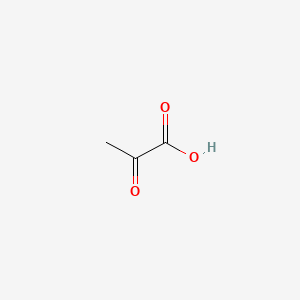
Pyruvic Acid
Pyruvic acid is a 2-oxo monocarboxylic acid that is the 2-keto derivative of propionic acid. It is a metabolite obtained during glycolysis. It has a role as a cofactor and a fundamental metabolite. It is functionally related to a propionic acid. It is a conjugate acid of a pyruvate. — ChEBI
- IUPAC name
- 2-oxopropanoic acid
- Molecular formula
- C3H4O3
- Molecular weight
- 88.06 g/mol
- Exact mass
- 88.016043985 Da
- XLogP3
- -0.3
- Topological polar surface area
- 54.4 Ų
- Hydrogen-bond donors
- 1
- Hydrogen-bond acceptors
- 3
- Covalent units
- 1
- Defined stereocentres
- 0
Also known as
16 more reported names
External database identifiers
- ChEBI:CHEBI:32816
- ChEMBL:CHEMBL1162144
- EPA DTXSID:DTXSID2021650
- PubMed:29968805
- PubMed:23112412
- PubMed:23109393
- PubMed:23107522
- PubMed:23106469
- PubMed:23105596
- PubMed:23105452
- PubMed:23105378
- PubMed:23098296
- PubMed:23094580
- PubMed:23093855
- PubMed:23091152
Evidence from additional scientific databases
NIH PubChem PUG-View
Attributed physical-property, hazard, environmental and use annotations.
- Boiling Point: 54 °C at 1.00E+01 mm Hg Source: DrugBank
- Boiling Point: 164 °C Source: Joint FAO/WHO Expert Committee on Food Additives (JECFA)
- Density: 1.260-1.281 Source: Joint FAO/WHO Expert Committee on Food Additives (JECFA)
- pKa: 2.45 (at 25 °C) Source: DrugBank
- LogP: -0.5 Source: DrugBank
- Melting Point: 13.8 °C Source: DrugBank
- Melting Point: 13.8 °C Source: Human Metabolome Database (HMDB)
- Physical Description: Liquid with an odor like acetic acid; mp = 11.8 deg C; [Merck Index] Source: Haz-Map, Information on Hazardous Chemicals and Occupational Diseases
- Physical Description: Liquid Source: Human Metabolome Database (HMDB)
- Physical Description: colourless to amber viscous liquid with a sour vinegar-like odour Source: Joint FAO/WHO Expert Committee on Food Additives (JECFA)
- Refractive Index: 1.424-1.435 Source: Joint FAO/WHO Expert Committee on Food Additives (JECFA)
- Solubility: 1000000 mg/L (at 20 °C) Source: DrugBank
- Solubility: 1000.0 mg/mL Source: Human Metabolome Database (HMDB)
- Solubility: miscible with water; soluble in organic solvents, oils Source: Joint FAO/WHO Expert Committee on Food Additives (JECFA)
- Solubility: miscible at room temperature (in ethanol) Source: Joint FAO/WHO Expert Committee on Food Additives (JECFA)
- Vapor Pressure: 1.29 [mmHg] Source: Haz-Map, Information on Hazardous Chemicals and Occupational Diseases
- Carcinogen Classification: No indication of carcinogenicity to humans (not listed by IARC). Source: Toxin and Toxin Target Database (T3DB)
- Exposure Routes: Pyruvate is absorbed from the gastrointestinal tract from whence it is transported to the liver via the portal circulation. Source: Toxin and Toxin Target Database (T3DB)
- Signal: Danger Source: European Chemicals Agency (ECHA)
- GHS Hazard Statements: H314 (100%): Causes severe skin burns and eye damage [Danger Skin corrosion/irritation]; H318 (83.2%): Causes serious eye damage [Danger Serious eye damage/eye irritation] Source: European Chemicals Agency (ECHA)
- Precautionary Statement Codes: P260, P264, P264+P265, P280, P301+P330+P331, P302+P361+P354, P304+P340, P305+P354+P338, P316, P317, P321, P363, P405, and P501 (click each P-code to see the statement) Source: European Chemicals Agency (ECHA)
- ECHA C&L Notifications Summary: Aggregated GHS information provided per 1823 reports by companies from 11 notifications to the ECHA C&L Inventory. Each notification may be associated with multiple companies.; Information may vary between notifications depending on impurities, additives, and other factors. The percentage value in parenthesis indicates the notified classification ratio from companies that provide hazard codes. Only hazard codes with percentage values above 10% are shown. For more detailed information, please visit ECHA C&L website. Source: European Chemicals Agency (ECHA)
- Toxicity Summary: Pyruvate serves as a biological fuel by being converted to acetyl coenzyme A, which enters the tricarboxylic acid or Krebs cycle where it is metabolized to produce ATP aerobically. Energy can also be obtained anaerobically from pyruvate via its conversion to lactate. Pyruvate injections or perfusions increase contractile function of hearts when metabolizing glucose or fatty acids. This inotropic effect is striking in hearts stunned by ischemia/reperfusion. The inotropic effect of pyruvate requires intracoronary infusion. Among possible mechanisms for this effect are increased generation of ATP and an increase in ATP phosphorylation potential. Another is activation of pyruvate dehydrogenase, promoting its own oxidation by inhibiting pyruvate dehydrogenase kinase. Pyruvate dehydrogenase is inactivated in ischemia myocardium. Yet another is reduction of cytosolic inorganic phosphate concentration. Pyruvate, as an antioxidant, is known to scavenge such reactive oxygen species as hydrogen peroxide and lipid peroxides. Indirectly, supraphysiological levels of pyruvate may increase cellular reduced glutathione. Source: Toxin and Toxin Target Database (T3DB)
- Sources/Uses: Intermediate in sugar metabolism and alcoholic fermentation; [Merck Index] Used as flavoring agent or adjuvant; [FDA] Source: Haz-Map, Information on Hazardous Chemicals and Occupational Diseases
- Uses: For nutritional supplementation, also for treating dietary shortage or imbalance Source: Toxin and Toxin Target Database (T3DB)
Mapped by: Existing checksum-valid CAS to unique PubChem CID match. Retrieved: 2026-08-31. Open source record
Scientific classifications and hazard annotations provide context and do not replace the market-specific regulatory decision shown above.
Additional source coverage and match status
| Source | Result | Checked |
|---|---|---|
| NIH PubChem PUG-View | Exact match | 2026-08-31 |
A recorded no-match is useful evidence that the source was checked; it is not a claim that the substance does not exist elsewhere.
Retrieved from NIH PubChem on 2026-08-31 by checksum-valid CAS matching. Chemical properties do not replace the regulatory decision on this page.