
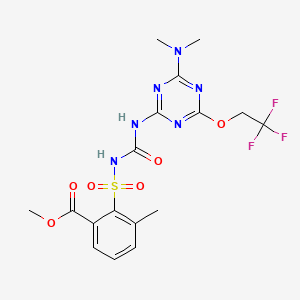
Triflusulfuron-methyl
Triflusulfuron-methyl is a methyl ester resulting from the formal condensation of the carboxy group of triflusulfuron with methanol. A proherbicide for triflusulfuron. It has a role as a proherbicide, an EC 2.2.1.6 (acetolactate synthase) inhibitor and an agrochemical. It is a methyl ester, a member of 1,3,5-triazines, an aromatic ether, a benzoate ester, an organofluorine compound, a tertiary amino compound and a N-sulfonylurea. It is functionally related to a triflusulfuron. — ChEBI
- IUPAC name
- methyl 2-[[4-(dimethylamino)-6-(2,2,2-trifluoroethoxy)-1,3,5-triazin-2-yl]carbamoylsulfamoyl]-3-methylbenzoate
- Molecular formula
- C17H19F3N6O6S
- Molecular weight
- 492.4 g/mol
- Exact mass
- 492.10388801 Da
- XLogP3
- 3.1
- Topological polar surface area
- 161.0 Ų
- Hydrogen-bond donors
- 2
- Hydrogen-bond acceptors
- 13
- Covalent units
- 1
- Defined stereocentres
- 0
Also known as
16 more reported names
External database identifiers
- ChEBI:CHEBI:82047
- ChEMBL:CHEMBL2143050
- EPA DTXSID:DTXSID2032502
- PubMed:25233012
- PubMed:21837154
Evidence from additional scientific databases
NIH PubChem PUG-View
Attributed physical-property, hazard, environmental and use annotations.
- Carcinogen Classification: No indication of carcinogenicity to humans (not listed by IARC). Source: Toxin and Toxin Target Database (T3DB)
- Signal: Warning Source: Regulation (EC) No 1272/2008 of the European Parliament and of the Council
- GHS Hazard Statements: H351: Suspected of causing cancer [Warning Carcinogenicity]; H400: Very toxic to aquatic life [Warning Hazardous to the aquatic environment, acute hazard]; H410: Very toxic to aquatic life with long lasting effects [Warning Hazardous to the aquatic environment, long-term hazard] Source: Regulation (EC) No 1272/2008 of the European Parliament and of the Council
- Precautionary Statement Codes: P203, P273, P280, P318, P391, P405, and P501 (click each P-code to see the statement) Source: Regulation (EC) No 1272/2008 of the European Parliament and of the Council
- Signal: Warning Source: Hazardous Chemical Information System (HCIS), Safe Work Australia
- GHS Hazard Statements: H351: Suspected of causing cancer [Warning Carcinogenicity]; H410: Very toxic to aquatic life with long lasting effects [Warning Hazardous to the aquatic environment, long-term hazard] Source: Hazardous Chemical Information System (HCIS), Safe Work Australia
- Precautionary Statement Codes: P203, P273, P280, P318, P391, P405, and P501 (click each P-code to see the statement) Source: Hazardous Chemical Information System (HCIS), Safe Work Australia
- Uses: This is a man-made compound that is used as a pesticide. Source: Toxin and Toxin Target Database (T3DB)
Mapped by: Existing checksum-valid CAS to unique PubChem CID match. Retrieved: 2026-08-31. Open source record
Scientific classifications and hazard annotations provide context and do not replace the market-specific regulatory decision shown above.
Additional source coverage and match status
| Source | Result | Checked |
|---|---|---|
| NIH PubChem PUG-View | Exact match | 2026-08-31 |
A recorded no-match is useful evidence that the source was checked; it is not a claim that the substance does not exist elsewhere.
Retrieved from NIH PubChem on 2026-09-02 by checksum-valid CAS matching. Chemical properties do not replace the regulatory decision on this page.