
CAS 12607-70-4PubChem CID 13090915
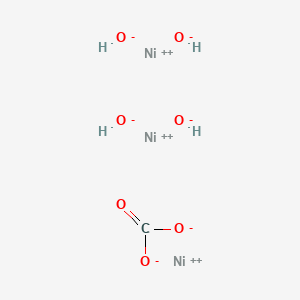
Nickel carbonate hydroxide
- IUPAC name
- tris(nickel(2+));carbonate;tetrahydroxide
- Molecular formula
- CH4Ni3O7
- Molecular weight
- 304.12 g/mol
- Exact mass
- 303.797171 Da
- Topological polar surface area
- 67.2 Ų
- Hydrogen-bond donors
- 4
- Hydrogen-bond acceptors
- 7
- Covalent units
- 8
- Defined stereocentres
- 0
Also known as
STL2W5LZ92Carbonic acid, nickel salt, basic(Carbonato(2-))tetrahydroxytrinickelNICKEL CARBONATE HYDROXIDE [MI]BASIC NICKEL(II) CARBONATE [HSDB]Nickel carbonate hydroxide (2Ni(OH)2.Ni(CO3))[carbonato(2-)]tetrahydroxytrinickelRefChem:853852
14 more reported names
Nickel, (carbonato(2))tetrahydroxytri235-715-9BASIC NICKEL(II) CARBONATECarbonato(2-)dihydroxydinickelEC 235-715-9EINECS 235-715-9EINECS 265-748-4HSDB 6154Nickel carbonate hydroxide (Ni2(CO3)2(OH)2)Nickel carbonate hydroxide (Ni3(CO3)(OH)4)Nickel, (mu-(carbonato(2-)-O:O'))dihydroxydi-NickelcarbonatehydroxideATYNVYNPWGEMMI-UHFFFAOYSA-Hnickel(2+);carbonate;tetrahydroxide
External database identifiers
- EPA DTXSID:DTXSID7051638
Evidence from additional scientific databases
NIH PubChem PUG-View
Exact identifier match13090915
Attributed physical-property, hazard, environmental and use annotations.
- Density: 2.6 @25 °C Source: PAC Chemical Database, U.S. Department of Energy
- Physical Description: Large Crystals; Dry Powder; Dry Powder; Other Solid Source: EPA Chemical Data Reporting (CDR)
- Physical Description: Tetrahydrate: Green odorless solid; [Merck Index] Light green powder; Insoluble in water; [MSDSonline] Source: Haz-Map, Information on Hazardous Chemicals and Occupational Diseases
- Solubility: Light green crystals or brown powder; mol wt 587.57; decomp before melting; insol in cold water; decomp in hot water; sol in acid, ammonium salts /Tetrahydrate/ Source: Hazardous Substances Data Bank (HSDB)
- Solubility: Odorless; insol in water; sol in ammonia, dil acids with effervescence /Tetrahydrate/ Source: Hazardous Substances Data Bank (HSDB)
- Signal: Danger Source: Regulation (EC) No 1272/2008 of the European Parliament and of the Council
- GHS Hazard Statements: H302: Harmful if swallowed [Warning Acute toxicity, oral]; H315: Causes skin irritation [Warning Skin corrosion/irritation]; H317: May cause an allergic skin reaction [Warning Sensitization, Skin]; H332: Harmful if inhaled [Warning Acute toxicity, inhalation]; H334: May cause allergy or asthma symptoms or breathing difficulties if inhaled [Danger Sensitization, respiratory]; H341: Suspected of causing genetic defects [Warning Germ cell mutagenicity]; H350i: May cause cancer by inhalation [Danger Carcinogenicity]; H360D ***: May damage the unborn child [Danger Reproductive toxicity]; H372 **: Causes damage to organs through prolonged or repeated exposure [Danger Specific target organ toxicity, repeated exposure]; H400: Very toxic to aquatic life [Warning Hazardous to the aquatic environment, acute hazard]; H410: Very toxic to aquatic life with long lasting effects [Warning Hazardous to the aquatic environment, long-term hazard] Source: Regulation (EC) No 1272/2008 of the European Parliament and of the Council
- Precautionary Statement Codes: P203, P233, P260, P261, P264, P270, P271, P272, P273, P280, P284, P301+P317, P302+P352, P304+P340, P317, P318, P319, P321, P330, P332+P317, P333+P317, P342+P316, P362+P364, P391, P403, P405, and P501 (click each P-code to see the statement) Source: Regulation (EC) No 1272/2008 of the European Parliament and of the Council
- Signal: Danger Source: European Chemicals Agency (ECHA)
- GHS Hazard Statements: H302 (100%): Harmful if swallowed [Warning Acute toxicity, oral]; H315 (100%): Causes skin irritation [Warning Skin corrosion/irritation]; H317 (100%): May cause an allergic skin reaction [Warning Sensitization, Skin]; H319 (61.1%): Causes serious eye irritation [Warning Serious eye damage/eye irritation]; H330 (61.1%): Fatal if inhaled [Danger Acute toxicity, inhalation]; H332 (38.9%): Harmful if inhaled [Warning Acute toxicity, inhalation]; H334 (100%): May cause allergy or asthma symptoms or breathing difficulties if inhaled [Danger Sensitization, respiratory]; H341 (100%): Suspected of causing genetic defects [Warning Germ cell mutagenicity]; H350 (84.5%): May cause cancer [Danger Carcinogenicity]; H350i (15.5%): May cause cancer by inhalation [Danger Carcinogenicity]; H360 (84.5%): May damage fertility or the unborn child [Danger Reproductive toxicity]; H360D (15.5%): May damage the unborn child [Danger Reproductive toxicity]; H372 (100%): Causes damage to organs through prolonged or repeated exposure [Danger Specific target organ toxicity, repeated exposure]; H400 (100%): Very toxic to aquatic life [Warning Hazardous to the aquatic environment, acute hazard]; H410 (100%): Ver Source: European Chemicals Agency (ECHA)
- Precautionary Statement Codes: P203, P233, P260, P261, P264, P264+P265, P270, P271, P272, P273, P280, P284, P301+P317, P302+P352, P304+P340, P305+P351+P338, P316, P317, P318, P319, P320, P321, P330, P332+P317, P333+P317, P337+P317, P342+P316, P362+P364, P391, P403, P403+P233, P405, and P501 (click each P-code to see the statement) Source: European Chemicals Agency (ECHA)
- ECHA C&L Notifications Summary: Aggregated GHS information provided per 226 reports by companies from 11 notifications to the ECHA C&L Inventory. Each notification may be associated with multiple companies.; Information may vary between notifications depending on impurities, additives, and other factors. The percentage value in parenthesis indicates the notified classification ratio from companies that provide hazard codes. Only hazard codes with percentage values above 10% are shown. For more detailed information, please visit ECHA C&L website. Source: European Chemicals Agency (ECHA)
- Toxicity Summary: ... Nickel carbonate is insoluble in water. ... Respiratory absorption with secondary gastrointestinal absorption of nickel (insoluble compounds) is the major route of entry during occupational exposure. Percutaneous absorption is negligible, quanitatively, but is important in the pathogenesis of contact hypersensitivity. Absorption is related to the solubility of the compound /and nickel carbonate is classified as an insoluble salt/. Nickel carbonate ... induced local mesenchymal tumors in a variety of experimental animals after im, sc, ip, intrapleural, intraocular, intraosseous, intrarenal, intra-articular, intratesticular or intra-adipose administration. Source: Hazardous Substances Data Bank (HSDB)
- Consumer Uses: Processing aids not otherwise specified Source: EPA Chemical Data Reporting (CDR)
- Industry Uses: Processing aids not otherwise specified; Plating agent; Not Known or Reasonably Ascertainable; Intermediate Source: EPA Chemical Data Reporting (CDR)
- Sources/Uses: Used in nickel plating, ceramic colors and glazes, and as a catalyst for hardening of fats; [HSDB] Source: Haz-Map, Information on Hazardous Chemicals and Occupational Diseases
- Industrial Processes with risk of exposure: Electroplating [Category: Plate] Source: Haz-Map, Information on Hazardous Chemicals and Occupational Diseases
- Activities with risk of exposure: Ceramics making [Category: Hobbies] Source: Haz-Map, Information on Hazardous Chemicals and Occupational Diseases
- Uses: Nickel plating; catalyst for hardening of fats; in ceramic colors and glazes Source: Hazardous Substances Data Bank (HSDB)
- Uses: Preparation of nickel catalysts /Tetrahydrate/ Source: Hazardous Substances Data Bank (HSDB)
Mapped by: Existing checksum-valid CAS to unique PubChem CID match. Retrieved: 2026-08-31. Open source record
Scientific classifications and hazard annotations provide context and do not replace the market-specific regulatory decision shown above.
Additional source coverage and match status
| Source | Result | Checked |
|---|---|---|
| NIH PubChem PUG-View | Exact match | 2026-08-31 |
A recorded no-match is useful evidence that the source was checked; it is not a claim that the substance does not exist elsewhere.
Retrieved from NIH PubChem on 2026-09-02 by checksum-valid CAS matching. Chemical properties do not replace the regulatory decision on this page.