
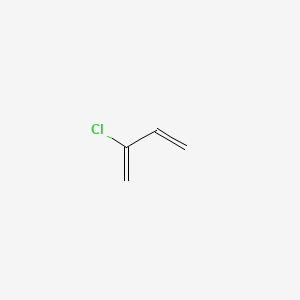
CAS 126-99-8PubChem CID 31369
Chloroprene
Chloroprene is a chloroolefin. It derives from a hydride of a buta-1,3-diene. — ChEBI
- IUPAC name
- 2-chlorobuta-1,3-diene
- Molecular formula
- C4H5Cl
- Molecular weight
- 88.53 g/mol
- Exact mass
- 88.0079779 Da
- XLogP3
- 2.3
- Topological polar surface area
- 0.0 Ų
- Hydrogen-bond donors
- 0
- Hydrogen-bond acceptors
- 0
- Covalent units
- 1
- Defined stereocentres
- 0
Also known as
2-Chloro-1,3-butadieneChlorobutadiene2-Chlorobutadiene1,3-Butadiene, 2-chloro-ChloropreenCloroprenebeta-Chloroprene2-Chlor-1,3-butadien
16 more reported names
Chloropren2-Cloro-1,3-butadiene2-Chloor-1,3-butadieen42L93DWV3ANSC-18589CHEBI:39481RefChem:125490204-818-0.beta.-ChloropreneNSC 18589Chloroprene (>96% chloroprene)Chloroprene (99.6% chloroprene)Chloropreen [Dutch]Cloroprene [Italian]2-ChloropreneChloropren [German, Polish]
External database identifiers
- ChEBI:CHEBI:39481
- ChEMBL:CHEMBL555660
- EPA DTXSID:DTXSID5020316
- PubMed:23125180
- PubMed:22271974
- PubMed:21511420
- PubMed:19847707
- PubMed:17324392
- PubMed:17234169
- PubMed:16870169
- PubMed:16750522
- PubMed:16002378
- PubMed:14976339
- PubMed:14976335
- PubMed:14565770
Evidence from additional scientific databases
NIH PubChem PUG-View
Exact identifier match31369
Attributed physical-property, hazard, environmental and use annotations.
- Autoignition Temperature: 440 °C Source: ILO-WHO International Chemical Safety Cards (ICSCs)
- Boiling Point: 138.9 °F at 760 mmHg (NTP, 1992) Source: CAMEO Chemicals
- Boiling Point: 59.4 °C Source: Hazardous Substances Data Bank (HSDB)
- Boiling Point: 59.4 °C Source: ILO-WHO International Chemical Safety Cards (ICSCs)
- Boiling Point: 139 °F Source: Occupational Safety and Health Administration (OSHA)
- Boiling Point: 59.4 °C @760 [mm Hg] Source: PAC Chemical Database, U.S. Department of Energy
- Boiling Point: 139 °F Source: The National Institute for Occupational Safety and Health (NIOSH)
- Color/Form: Colorless liquid Source: Hazardous Substances Data Bank (HSDB)
- Density: 0.9583 at 68 °F (USCG, 1999) - Less dense than water; will float Source: CAMEO Chemicals
- Density: 0.956 @ 20 °C/4 °C Source: Hazardous Substances Data Bank (HSDB)
- Density: Density of saturated air: 1.57 (air= 1) Source: Hazardous Substances Data Bank (HSDB)
- Density: Relative density (water = 1): 0.96 Source: ILO-WHO International Chemical Safety Cards (ICSCs)
- Density: 0.96 Source: Occupational Safety and Health Administration (OSHA)
- Density: .956 @ 20°C Source: PAC Chemical Database, U.S. Department of Energy
- Density: 0.96 Source: The National Institute for Occupational Safety and Health (NIOSH)
- Flash Point: -4 °F (NTP, 1992) Source: CAMEO Chemicals
- Flash Point: -4 °F Source: Haz-Map, Information on Hazardous Chemicals and Occupational Diseases
- Flash Point: -20 °C (OPEN CUP) Source: Hazardous Substances Data Bank (HSDB)
- Flash Point: -20 °C c.c. Source: ILO-WHO International Chemical Safety Cards (ICSCs)
- Flash Point: -4 °F Source: Occupational Safety and Health Administration (OSHA)
- Flash Point: -4 °F Source: The National Institute for Occupational Safety and Health (NIOSH)
- LogP: 2.2 (calculated) Source: ILO-WHO International Chemical Safety Cards (ICSCs)
- Melting Point: -202 °F (NTP, 1992) Source: CAMEO Chemicals
- Melting Point: -130 °C Source: Hazardous Substances Data Bank (HSDB)
- Melting Point: -130 °C Source: ILO-WHO International Chemical Safety Cards (ICSCs)
- Melting Point: -153 °F Source: Occupational Safety and Health Administration (OSHA)
- Melting Point: -130 °C Source: PAC Chemical Database, U.S. Department of Energy
- Melting Point: -153 °F Source: The National Institute for Occupational Safety and Health (NIOSH)
- Odor: Pungent, ether-like odor Source: Hazardous Substances Data Bank (HSDB)
- Physical Description: Chloroprene, stabilized appears as a clear colorless liquid. Flash point is very low. May polymerize exothermically if heated or contaminated. If polymerization takes place inside a container, the container may rupture violently. Less dense than water. Vapors heavier than air. Used to make neoprene rubber. Source: CAMEO Chemicals
- Physical Description: Liquid Source: EPA Chemical Data Reporting (CDR)
- Physical Description: Colorless liquid with a pungent, ether-like odor; [NIOSH] Source: Haz-Map, Information on Hazardous Chemicals and Occupational Diseases
- Physical Description: COLOURLESS LIQUID WITH PUNGENT ODOUR. Source: ILO-WHO International Chemical Safety Cards (ICSCs)
- Physical Description: Colorless liquid with a pungent, ether-like odor. Source: Occupational Safety and Health Administration (OSHA)
- Physical Description: Colorless liquid with a pungent, ether-like odor. Source: The National Institute for Occupational Safety and Health (NIOSH)
- Refractive Index: Index of refraction: 1.4583 @ 20 °C/D Source: Hazardous Substances Data Bank (HSDB)
- Solubility: Slightly soluble (NTP, 1992) Source: CAMEO Chemicals
- Solubility: Miscible in ethyl ether, acetone, and benzene; slightly soluble in water. Source: Hazardous Substances Data Bank (HSDB)
- Solubility: Soluble in alcohol, diethyl ether Source: Hazardous Substances Data Bank (HSDB)
- Solubility: Solubility in water, g/100ml at 20 °C: 0.03 (very poor) Source: ILO-WHO International Chemical Safety Cards (ICSCs)
- Solubility: Slight Source: The National Institute for Occupational Safety and Health (NIOSH)
- Vapor Pressure: 118 mmHg at 50 °F ; 188 mmHg at 68 °F (NTP, 1992) Source: CAMEO Chemicals
- Vapor Pressure: 215.0 [mmHg] Source: Haz-Map, Information on Hazardous Chemicals and Occupational Diseases
- Vapor Pressure: 215 mm Hg @ 25 °C Source: Hazardous Substances Data Bank (HSDB)
- Vapor Pressure: Vapor pressure, kPa at 20 °C: 23.2 Source: ILO-WHO International Chemical Safety Cards (ICSCs)
- Vapor Pressure: 188 mmHg Source: Occupational Safety and Health Administration (OSHA)
- Vapor Pressure: 75 [mm Hg] @0.3 °C Source: PAC Chemical Database, U.S. Department of Energy
- Vapor Pressure: 188 mmHg Source: The National Institute for Occupational Safety and Health (NIOSH)
- IARC Carcinogenic Agent: Chloroprene Source: International Agency for Research on Cancer (IARC)
- IARC Carcinogenic Classes: Group 2B: Possibly carcinogenic to humans Source: International Agency for Research on Cancer (IARC)
- IARC Monographs: Volume Sup 7: Overall Evaluations of Carcinogenicity: An Updating of IARC Monographs Volumes 1 to 42, 1987; 440 pages; ISBN 92-832-1411-0 (out of print); Volume 71: (1999) Re-evaluation of Some Organic Chemicals, Hydrazine and Hydrogen Peroxide (Part 1, Part 2, Part 3) Source: International Agency for Research on Cancer (IARC)
- Publication Year: 1999 Source: International Agency for Research on Cancer (IARC)
- Evaluation Year: 1998 Source: International Agency for Research on Cancer (IARC)
- Substance: Chloroprene Source: NTP Technical Reports
- NTP Technical Report: TR-467: Toxicology and Carcinogenesis Studies of Chloroprene (CASRN 126-99-8) in F344/N Rats and B6C3F1 Mice (Inhalation Studies) (1998 ) Source: NTP Technical Reports
- Peer Review Date: 12/11/96 Source: NTP Technical Reports
- Conclusion for Male Rat: Clear Evidence Source: NTP Technical Reports
- Conclusion for Female Rat: Clear Evidence Source: NTP Technical Reports
- Conclusion for Male Mice: Clear Evidence Source: NTP Technical Reports
- Conclusion for Female Mice: Clear Evidence Source: NTP Technical Reports
- Exposure Routes: The substance can be absorbed into the body by inhalation of its vapour, through the skin and by ingestion. Source: ILO-WHO International Chemical Safety Cards (ICSCs)
- Exposure Routes: inhalation, skin absorption, ingestion, skin and/or eye contact Source: The National Institute for Occupational Safety and Health (NIOSH)
- First Aid: EYES: First check the victim for contact lenses and remove if present. Flush victim's eyes with water or normal saline solution for 20 to 30 minutes while simultaneously calling a hospital or poison control center. Do not put any ointments, oils, or medication in the victim's eyes without specific instructions from a physician. IMMEDIATELY transport the victim after flushing eyes to a hospital even if no symptoms (such as redness or irritation) develop.; SKIN: IMMEDIATELY flood affected skin with water while removing and isolating all contaminated clothing. Gently wash all affected skin areas thoroughly with soap and water. If symptoms such as redness or irritation develop, IMMEDIATELY call a physician and be prepared to transport the victim to a hospital for treatment.; INHALATION: IMMEDIATELY leave the contaminated area; take deep breaths of fresh air. If symptoms (such as wheezing, coughing, shortness of breath, or burning in the mouth, throat, or chest) develop, call a physician and be prepared to transport the victim to a hospital. Provide proper respiratory protection to rescuers entering an unknown atmosphere. Whenever possible, Self-Contained Breathing Apparatus (SCBA) shou Source: CAMEO Chemicals
- ERG2024, Guide 131P (Chloroprene, stabilized): General First Aid:; · Call 911 or emergency medical service.; · Ensure that medical personnel are aware of the material(s) involved, take precautions to protect themselves and avoid contamination.; · Move victim to fresh air if it can be done safely.; · Administer oxygen if breathing is difficult.; · If victim is not breathing:; -- DO NOT perform mouth-to-mouth resuscitation; the victim may have ingested or inhaled the substance.; -- If equipped and pulse detected, wash face and mouth, then give artificial respiration using a proper respiratory medical device (bag-valve mask, pocket mask equipped with a one-way valve or other device).; -- If no pulse detected or no respiratory medical device available, provide continuous compressions. Conduct a pulse check every two minutes or monitor for any signs of spontaneous respirations.; · Remove and isolate contaminated clothing and shoes.; · For minor skin contact, avoid spreading material on unaffected skin.; · In case of contact with substance, remove immediately by flushing skin or eyes with running water for at least 20 minutes.; · For severe burns, immediate medical attention is required.; · Effects of exposure (inhalation, ingestion, Source: Emergency Response Guidebook (ERG)
- First Aid: (General first aid procedures); Eye: Irrigate immediately - If this chemical contacts the eyes, immediately wash (irrigate) the eyes with large amounts of water, occasionally lifting the lower and upper lids. Get medical attention immediately.; Skin: Soap wash immediately - If this chemical contacts the skin, immediately wash the contaminated skin with soap and water. If this chemical penetrates the clothing, immediately remove the clothing, wash the skin with soap and water, and get medical attention promptly.; Breathing: Respiratory support; Swallow: Medical attention immediately - If this chemical has been swallowed, get medical attention immediately. Source: The National Institute for Occupational Safety and Health (NIOSH)
- Signal: Danger Source: Regulation (EC) No 1272/2008 of the European Parliament and of the Council
- GHS Hazard Statements: H225: Highly Flammable liquid and vapor [Danger Flammable liquids]; H302: Harmful if swallowed [Warning Acute toxicity, oral]; H315: Causes skin irritation [Warning Skin corrosion/irritation]; H319: Causes serious eye irritation [Warning Serious eye damage/eye irritation]; H332: Harmful if inhaled [Warning Acute toxicity, inhalation]; H335: May cause respiratory irritation [Warning Specific target organ toxicity, single exposure; Respiratory tract irritation]; H350: May cause cancer [Danger Carcinogenicity]; H373 **: May causes damage to organs through prolonged or repeated exposure [Warning Specific target organ toxicity, repeated exposure] Source: Regulation (EC) No 1272/2008 of the European Parliament and of the Council
- Precautionary Statement Codes: P203, P210, P233, P240, P241, P242, P243, P260, P261, P264, P264+P265, P270, P271, P280, P301+P317, P302+P352, P303+P361+P353, P304+P340, P305+P351+P338, P317, P318, P319, P321, P330, P332+P317, P337+P317, P362+P364, P370+P378, P403+P233, P403+P235, P405, and P501 (click each P-code to see the statement) Source: Regulation (EC) No 1272/2008 of the European Parliament and of the Council
- Signal: Danger Source: European Chemicals Agency (ECHA)
- GHS Hazard Statements: H225 (100%): Highly Flammable liquid and vapor [Danger Flammable liquids]; H301 (72.1%): Toxic if swallowed [Danger Acute toxicity, oral]; H302+H332 (18.1%): Harmful if swallowed or if inhaled [Warning Acute toxicity, oral; acute toxicity, inhalation]; H302 (27.9%): Harmful if swallowed [Warning Acute toxicity, oral]; H315 (100%): Causes skin irritation [Warning Skin corrosion/irritation]; H319 (100%): Causes serious eye irritation [Warning Serious eye damage/eye irritation]; H332 (100%): Harmful if inhaled [Warning Acute toxicity, inhalation]; H335 (100%): May cause respiratory irritation [Warning Specific target organ toxicity, single exposure; Respiratory tract irritation]; H350 (100%): May cause cancer [Danger Carcinogenicity]; H371 (18.1%): May cause damage to organs [Warning Specific target organ toxicity, single exposure]; H373 (100%): May causes damage to organs through prolonged or repeated exposure [Warning Specific target organ toxicity, repeated exposure]; H411 (89.8%): Toxic to aquatic life with long lasting effects [Hazardous to the aquatic environment, long-term hazard] Source: European Chemicals Agency (ECHA)
- Precautionary Statement Codes: P203, P210, P233, P240, P241, P242, P243, P260, P261, P264, P264+P265, P270, P271, P273, P280, P301+P316, P301+P317, P302+P352, P303+P361+P353, P304+P340, P305+P351+P338, P308+P316, P317, P318, P319, P321, P330, P332+P317, P337+P317, P362+P364, P370+P378, P391, P403+P233, P403+P235, P405, and P501 (click each P-code to see the statement) Source: European Chemicals Agency (ECHA)
- ECHA C&L Notifications Summary: Aggregated GHS information provided per 215 reports by companies from 12 notifications to the ECHA C&L Inventory. Each notification may be associated with multiple companies.; Information may vary between notifications depending on impurities, additives, and other factors. The percentage value in parenthesis indicates the notified classification ratio from companies that provide hazard codes. Only hazard codes with percentage values above 10% are shown. For more detailed information, please visit ECHA C&L website. Source: European Chemicals Agency (ECHA)
- Signal: Danger Source: NITE-CMC
- GHS Hazard Statements: H225: Highly Flammable liquid and vapor [Danger Flammable liquids]; H301: Toxic if swallowed [Danger Acute toxicity, oral]; H310: Fatal in contact with skin [Danger Acute toxicity, dermal]; H315: Causes skin irritation [Warning Skin corrosion/irritation]; H319: Causes serious eye irritation [Warning Serious eye damage/eye irritation]; H331: Toxic if inhaled [Danger Acute toxicity, inhalation]; H351: Suspected of causing cancer [Warning Carcinogenicity]; H361: Suspected of damaging fertility or the unborn child [Warning Reproductive toxicity]; H370: Causes damage to organs [Danger Specific target organ toxicity, single exposure]; H372: Causes damage to organs through prolonged or repeated exposure [Danger Specific target organ toxicity, repeated exposure] Source: NITE-CMC
- Precautionary Statement Codes: P203, P210, P233, P240, P241, P242, P243, P260, P261, P262, P264, P264+P265, P270, P271, P280, P301+P316, P302+P352, P303+P361+P353, P304+P340, P305+P351+P338, P308+P316, P316, P318, P319, P321, P330, P332+P317, P337+P317, P361+P364, P362+P364, P370+P378, P403+P233, P403+P235, P405, and P501 (click each P-code to see the statement) Source: NITE-CMC
- GHS Hazard Statements: H225: Highly Flammable liquid and vapor [Danger Flammable liquids]; H301: Toxic if swallowed [Danger Acute toxicity, oral]; H311: Toxic in contact with skin [Danger Acute toxicity, dermal]; H315: Causes skin irritation [Warning Skin corrosion/irritation]; H319: Causes serious eye irritation [Warning Serious eye damage/eye irritation]; H331: Toxic if inhaled [Danger Acute toxicity, inhalation]; H340: May cause genetic defects [Danger Germ cell mutagenicity]; H350: May cause cancer [Danger Carcinogenicity]; H360: May damage fertility or the unborn child [Danger Reproductive toxicity]; H370: Causes damage to organs [Danger Specific target organ toxicity, single exposure]; H372: Causes damage to organs through prolonged or repeated exposure [Danger Specific target organ toxicity, repeated exposure]; H373: May causes damage to organs through prolonged or repeated exposure [Warning Specific target organ toxicity, repeated exposure] Source: NITE-CMC
- Signal: Danger Source: Hazardous Chemical Information System (HCIS), Safe Work Australia
- NFPA Health Rating: 2 - Materials that, under emergency conditions, can cause temporary incapacitation or residual injury. Source: Hazardous Substances Data Bank (HSDB)
- NFPA Fire Rating: 3 - Liquids and solids that can be ignited under almost all ambient temperature conditions. Materials produce hazardous atmospheres with air under almost all ambient temperatures or, though unaffected by ambient temperatures, are readily ignited under almost all conditions. Source: Hazardous Substances Data Bank (HSDB)
- NFPA Instability Rating: 0 - Materials that in themselves are normally stable, even under fire conditions. Source: Hazardous Substances Data Bank (HSDB)
- Target Organs: Immune; Nervous; Respiratory Source: EPA Integrated Risk Information System (IRIS)
- Target Organs: Eyes, skin, respiratory system, reproductive system Source: The National Institute for Occupational Safety and Health (NIOSH)
- Environmental Bioconcentration: An estimated BCF of 18 was calculated for 2-chloro-1,3-butadiene(SRC), using an estimated log Kow of 2.53(1) and a regression-derived equation(2). According to a classification scheme(3), this BCF suggests the potential for bioconcentration in aquatic organisms is low (SRC). Source: Hazardous Substances Data Bank (HSDB)
- Environmental Fate: TERRESTRIAL FATE: Based on a classification scheme(1), an estimated Koc value of 68(SRC), determined from a structure estimation method(2), indicates that 2-chloro-1,3-butadiene is expected to have high mobility in soil(SRC). Volatilization of 2-chloro-1,3-butadiene from moist soil surfaces is expected to be an important fate process(SRC) given an estimated Henry's Law constant of 0.056 atm-cu m/mole (SRC), using a fragment constant estimation method(3). The potential for volatilization of 2-chloro-1,3-butadiene from dry soil surfaces may exist(SRC) based upon a vapor pressure of 215 mm Hg(4). 2-Chloro-1,3-butadiene will not be susceptible to chemical hydrolysis(SRC). Source: Hazardous Substances Data Bank (HSDB)
- Environmental Fate: AQUATIC FATE: Based on a classification scheme(1), an estimated Koc value of 68(SRC), determined from a structure estimation method(2), indicates that 2-chloro-1,3-butadiene is not expected to adsorb to suspended solids and sediment(SRC). Volatilization from water surfaces is expected(3) based upon an estimated Henry's Law constant of 0.056 atm-cu m/mole(SRC), developed using a fragment constant estimation method(4). Using this Henry's Law constant and an estimation method(3), volatilization half-lives for a model river and model lake are 3 hours and 4 days, respectively(SRC). According to a classification scheme(5), an estimated BCF of 18(SRC), from an estimated log Kow of 2.53(6) and a regression-derived equation(7), suggests the potential for bioconcentration in aquatic organisms is low. 2-Chloro-1,3-butadiene is not expected to undergo chemical hydrolysis(SRC) because of the lack of hydrolyzable functional groups(3). Source: Hazardous Substances Data Bank (HSDB)
- Environmental Fate: ATMOSPHERIC FATE: According to a model of gas/particle partitioning of semivolatile organic compounds in the atmosphere(1), 2-chloro-1,3-butadiene, which has a vapor pressure of 2.15X10+2 mm Hg at 25 °C, is expected to exist solely as a vapor in the ambient atmosphere. Vapor-phase 2-chloro-1,3-butadiene is degraded in the atmosphere by reaction with photochemically-produced hydroxyl radicals, ozone molecules and nitrate radicals(SRC). The half-life for the reaction in air with hydroxyl radicals is estimated to be 18 hours(SRC), calculated from its rate constant of 22X10-12 cu cm/molecule-sec at 25 °C(SRC), determined using a structure estimation method(2). The rate constant for the vapor-phase reaction of 2-chloro-1,3-butadiene with ozone has been estimated as 0.12X10⁻¹⁷ cu cm/molecule-sec at 25 °C(SRC) using a structure estimation method(2). This corresponds to an atmospheric half-life of about 10 days(SRC) at an atmospheric concentration of 7X10+11 ozone molecules per cu cm(3). The gas phase reaction of 2-chloro-1,3-butadiene with nitrate radicals may be an important atmospheric removal process in urban areas at night(4), but the rate of this reaction is not known. Source: Hazardous Substances Data Bank (HSDB)
- Industry Uses: Intermediate; Monomers Source: EPA Chemical Data Reporting (CDR)
- Uses: Chloroprene is a flammable liquid with a pungent odor. It is used primarily in the manufacture of polychloroprene (Neoprene TM, duprene) which is a polychloroprene elastomer that is used to make diverse products including adhesives, automotive and industrial parts (e.g., belts and hoses), wire and cable covers, adhesives, caulks, flame-resistant cushioning and other applications requiring chemical, oil, and/or weather resistance. Source: EPA Hazardous Air Pollutants
- Sources/Uses: Used to manufacture synthetic rubber (neoprene and polychloroprene latex); [ACGIH] Source: Haz-Map, Information on Hazardous Chemicals and Occupational Diseases
- Uses: ... Used as a chemical intermediate in the manufacture of artificial rubber. Source: Hazardous Substances Data Bank (HSDB)
- Uses: ... AS COMPONENT OF ADHESIVES THAT ARE INTENDED FOR USE IN FOOD PACKAGING. Source: Hazardous Substances Data Bank (HSDB)
- Uses: Manufacture of neoprene. Source: Hazardous Substances Data Bank (HSDB)
Mapped by: Existing checksum-valid CAS to unique PubChem CID match. Retrieved: 2026-08-31. Open source record
Scientific classifications and hazard annotations provide context and do not replace the market-specific regulatory decision shown above.
Additional source coverage and match status
| Source | Result | Checked |
|---|---|---|
| NIH PubChem PUG-View | Exact match | 2026-08-31 |
A recorded no-match is useful evidence that the source was checked; it is not a claim that the substance does not exist elsewhere.
Retrieved from NIH PubChem on 2026-09-02 by checksum-valid CAS matching. Chemical properties do not replace the regulatory decision on this page.