
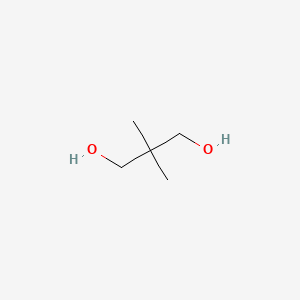
CAS 126-30-7PubChem CID 31344
Neopentyl glycol
2,2-dimethylpropane-1,3-diol is a white crystalline solid. Melting point 130 °C. — CAMEO Chemicals
- IUPAC name
- 2,2-dimethylpropane-1,3-diol
- Molecular formula
- C5H12O2
- Molecular weight
- 104.15 g/mol
- Exact mass
- 104.083729621 Da
- XLogP3
- 0.0
- Topological polar surface area
- 40.5 Ų
- Hydrogen-bond donors
- 2
- Hydrogen-bond acceptors
- 2
- Covalent units
- 1
- Defined stereocentres
- 0
Also known as
2,2-DIMETHYL-1,3-PROPANEDIOLDimethylolpropaneNeopentanediolNeopentylene glycol1,3-Propanediol, 2,2-dimethyl-NeopentylglycolNeolDimethyltrimethylene glycol
16 more reported names
Hydroxypivalyl alcohol2,2-Dimethyltrimethylene glycolNexcoat 6002,2-Dimethyl-1,3 propanediolQI80HXD6S5ORISTAR NPGNSC-63661,3-Dihydroxy-2,2-dimethylpropaneNSC-55836NEOPENTYLGLYCOL ECAILLESCHEBI:143768dimethylol propaneRefChem:165329204-781-0NPG GlycolNSC 55836
External database identifiers
- ChEBI:CHEBI:143768
- ChEMBL:CHEMBL3184801
- EPA DTXSID:DTXSID8027036
- PubMed:22284520
- PubMed:21582842
- PubMed:19812849
- PubMed:19562142
- PubMed:18484730
- PubMed:18262201
- PubMed:17636869
- PubMed:16819845
- PubMed:11825085
Evidence from additional scientific databases
NIH PubChem PUG-View
Exact identifier match31344
Attributed physical-property, hazard, environmental and use annotations.
- Autoignition Temperature: 730 °F (USCG, 1999) Source: CAMEO Chemicals
- Autoignition Temperature: 750 °F (399 °C) Source: Hazardous Substances Data Bank (HSDB)
- Autoignition Temperature: 388 °C Source: ILO-WHO International Chemical Safety Cards (ICSCs)
- Boiling Point: 406.4 °F at 760 mmHg (USCG, 1999) Source: CAMEO Chemicals
- Boiling Point: 207 °C Source: Hazardous Substances Data Bank (HSDB)
- Boiling Point: 210 °C Source: ILO-WHO International Chemical Safety Cards (ICSCs)
- Boiling Point: 206 °C @760 [mm Hg] Source: PAC Chemical Database, U.S. Department of Energy
- Color/Form: Needles from benzene Source: Hazardous Substances Data Bank (HSDB)
- Color/Form: Crystalline solid Source: Hazardous Substances Data Bank (HSDB)
- Density: 1.1 g/cu cm Source: Hazardous Substances Data Bank (HSDB)
- Density: 1.1 g/cm³ Source: ILO-WHO International Chemical Safety Cards (ICSCs)
- Density: Relative density of the vapour/air-mixture at 20 °C (air = 1): 1.0 Source: ILO-WHO International Chemical Safety Cards (ICSCs)
- Density: 1.06 @25 °C Source: PAC Chemical Database, U.S. Department of Energy
- Flash Point: 225 °F (USCG, 1999) Source: CAMEO Chemicals
- Flash Point: 265 °F (129 °C) (open cup) Source: Hazardous Substances Data Bank (HSDB)
- Flash Point: 107 °C Source: ILO-WHO International Chemical Safety Cards (ICSCs)
- LogP: log Kow = 0.12 Source: Hazardous Substances Data Bank (HSDB)
- LogP: -0.84 Source: ILO-WHO International Chemical Safety Cards (ICSCs)
- Melting Point: 260.6 °F (USCG, 1999) Source: CAMEO Chemicals
- Melting Point: 129.3 °C Source: Hazardous Substances Data Bank (HSDB)
- Melting Point: 127 °C Source: ILO-WHO International Chemical Safety Cards (ICSCs)
- Odor: Sweetish Source: Hazardous Substances Data Bank (HSDB)
- Physical Description: 2,2-dimethylpropane-1,3-diol is a white crystalline solid. Melting point 130 °C. Source: CAMEO Chemicals
- Physical Description: Liquid; Dry Powder; Liquid; Dry Powder; Other Solid; Large Crystals; CBI Source: EPA Chemical Data Reporting (CDR)
- Physical Description: Colorless to white hygroscopic solid; [ICSC] White hygroscopic crystals with a mild odor; [Alfa Aesar MSDS] Source: Haz-Map, Information on Hazardous Chemicals and Occupational Diseases
- Physical Description: COLOURLESS-TO-WHITE HYGROSCOPIC CRYSTALS. Source: ILO-WHO International Chemical Safety Cards (ICSCs)
- Solubility: In water, 83 g/100 mL at 20 °C Source: Hazardous Substances Data Bank (HSDB)
- Solubility: Solubility in water approximately 65% wet weight Source: Hazardous Substances Data Bank (HSDB)
- Solubility: Soluble in water Source: Hazardous Substances Data Bank (HSDB)
- Solubility: Freely soluble in alcohol, ether Source: Hazardous Substances Data Bank (HSDB)
- Solubility: For more Solubility (Complete) data for Neopentyl glycol (6 total), please visit the HSDB record page. Source: Hazardous Substances Data Bank (HSDB)
- Solubility: Solubility in water, g/100ml at 20 °C: 83 Source: ILO-WHO International Chemical Safety Cards (ICSCs)
- Vapor Pressure: 0.22 [mmHg] Source: Haz-Map, Information on Hazardous Chemicals and Occupational Diseases
- Vapor Pressure: 1.27X10⁻² mm Hg at 25 °C Source: Hazardous Substances Data Bank (HSDB)
- Vapor Pressure: Vapor pressure, Pa at 20 °C: 30 Source: ILO-WHO International Chemical Safety Cards (ICSCs)
- Exposure Routes: The substance can be absorbed into the body by inhalation of its aerosol and by ingestion. Source: ILO-WHO International Chemical Safety Cards (ICSCs)
- First Aid: EYES: Flush with copious amounts of water.; SKIN: Wash with soap and copious amounts of water. (USCG, 1999) Source: CAMEO Chemicals
- Note: This chemical does not meet GHS hazard criteria for 1.9% (19 of 1013) of reports. Source: European Chemicals Agency (ECHA)
- Signal: Danger Source: European Chemicals Agency (ECHA)
- GHS Hazard Statements: H315 (21.1%): Causes skin irritation [Warning Skin corrosion/irritation]; H318 (74.9%): Causes serious eye damage [Danger Serious eye damage/eye irritation]; H319 (22%): Causes serious eye irritation [Warning Serious eye damage/eye irritation] Source: European Chemicals Agency (ECHA)
- Precautionary Statement Codes: P264, P264+P265, P280, P302+P352, P305+P351+P338, P305+P354+P338, P317, P321, P332+P317, P337+P317, and P362+P364 (click each P-code to see the statement) Source: European Chemicals Agency (ECHA)
- ECHA C&L Notifications Summary: Aggregated GHS information provided per 1013 reports by companies from 9 notifications to the ECHA C&L Inventory. Each notification may be associated with multiple companies.; Reported as not meeting GHS hazard criteria per 19 of 1013 reports by companies.; There are 8 notifications provided by 994 of 1013 reports by companies with hazard statement code(s).; Information may vary between notifications depending on impurities, additives, and other factors. The percentage value in parenthesis indicates the notified classification ratio from companies that provide hazard codes. Only hazard codes with percentage values above 10% are shown. For more detailed information, please visit ECHA C&L website. Source: European Chemicals Agency (ECHA)
- Signal: Danger Source: Hazardous Substances Data Bank (HSDB)
- GHS Hazard Statements: H318: Causes serious eye damage [Danger Serious eye damage/eye irritation] Source: Hazardous Substances Data Bank (HSDB)
- Precautionary Statement Codes: P264+P265, P280, P305+P354+P338, and P317 (click each P-code to see the statement) Source: Hazardous Substances Data Bank (HSDB)
- NFPA Health Rating: 1 - Materials that, under emergency conditions, can cause significant irritation. Source: Hazardous Substances Data Bank (HSDB)
- NFPA Fire Rating: 1 - Materials that must be preheated before ignition can occur. Materials require considerable preheating, under all ambient temperature conditions, before ignition and combustion can occur. Source: Hazardous Substances Data Bank (HSDB)
- NFPA Instability Rating: 0 - Materials that in themselves are normally stable, even under fire conditions. Source: Hazardous Substances Data Bank (HSDB)
- Toxicity Summary: IDENTIFICATION AND USE: Neopentyl glycol (NPG) is a solid. It is used in chemical synthesis, and in polyester manufacture. An insect repellent. HUMAN STUDIES: There are no data available. ANIMAL STUDIES: NPG was not irriating to skin in rabbits, and non sensitizing to the skin in the Murine Local Lymph Node Assay. NPG was practically non-toxic in acute studies in rats and guinea pigs. No treatment-related, adverse findings were observed at clinical examinations, clinical pathology and pathology up to a dose level of 1000 mg/kg bw/d in 90 day oral gavage studies in rats. In other rat study reproductive performance of the parent generation and development of the F1 generation were not affected after oral application of dose levels up to 1000 mg/kg bw/day. In male rats single i.p. injection of 2000 mg/kg bw resulted in a mid level of ataxia but no loss of righting reflex. NPG had no mutagenic activity in Salmonella typhimurium TA 100, TA 1535, TA 98, TA 1537, or in Escherichia coli WP2 uvrA tested with and without metabolic activation at dose levels up to 5000 ug/plate. NPG was not mutagenic in the HPRT locus assay under in vitro conditions in CHO cells in the absence and the presence Source: Hazardous Substances Data Bank (HSDB)
- Environmental Bioconcentration: A BCF range of 0.3-0.5 was calculated in fish for neopentyl glycol at 10 ppm using carp (Cyprinus carpio) which were exposed over an 6-week period(1). According to a classification scheme(2), this BCF suggests the potential for bioconcentration in aquatic organisms is low(SRC). Source: Hazardous Substances Data Bank (HSDB)
- Environmental Fate: TERRESTRIAL FATE: Based on a classification scheme(1), an estimated Koc value of 1(SRC), determined from a structure estimation method(2), indicates that neopentyl glycol is expected to have very high mobility in soil(SRC). Volatilization of neopentyl glycol from moist soil surfaces is not expected to be an important fate process(SRC) given an estimated Henry's Law constant of 3.1X1-07 atm-cu m/mole(SRC), developed using a fragment constant estimation method(2). Neopentyl glycol is not expected to volatilize from dry soil surfaces(SRC) based upon a vapor pressure of 1.27X10⁻² mm Hg at 25 °C(3). Utilizing the Japanese MITI test, 1.2% of the Theoretical BOD was reached in 2 weeks(4) indicating that biodegradation is not an important environmental fate process in soil(SRC). Source: Hazardous Substances Data Bank (HSDB)
- Environmental Fate: AQUATIC FATE: Based on a classification scheme(1), an estimated Koc value of 1(SRC), determined from a structure estimation method(2), indicates that neopentyl glycol is not expected to adsorb to suspended solids and sediment(SRC). Volatilization from water surfaces is expected(3) based upon an estimated Henry's Law constant of 3.1X10⁻⁷ atm-cu m/mole(SRC), developed using a fragment constant estimation method(2). Using this Henry's Law constant and an estimation method(3), volatilization half-lives for a model river and model lake are 122 and 890 days, respectively(SRC). According to a classification scheme(4), a BCF range of 0.3-0.5(5) suggests bioconcentration in aquatic organisms is low(SRC). Utilizing the Japanese MITI test, 1.2% of the Theoretical BOD was reached in 2 weeks(5) indicating that biodegradation is not an important environmental fate process in water(SRC). Source: Hazardous Substances Data Bank (HSDB)
- Environmental Fate: ATMOSPHERIC FATE: According to a model of gas/particle partitioning of semivolatile organic compounds in the atmosphere(1), neopentyl glycol, which has a estimated vapor pressure of 1.27X10⁻² mm Hg at 25 °C(2), is expected to exist solely as a vapor in the ambient atmosphere. Vapor-phase neopentyl glycol is degraded in the atmosphere by reaction with photochemically-produced hydroxyl radicals(SRC); the half-life for this reaction in air is estimated to be 44 hrs(SRC), calculated from its rate constant of 8.7X10⁻¹² cu cm/molecule-sec at 25 °C(SRC) that was derived using a structure estimation method(3). Neopentyl glycol does not contain chromophores that absorb at wavelengths >290 nm(4) and, therefore, is not expected to be susceptible to direct photolysis by sunlight(SRC). Source: Hazardous Substances Data Bank (HSDB)
- Consumer Uses: Plasticizer; Not Known or Reasonably Ascertainable; Intermediate Source: EPA Chemical Data Reporting (CDR)
- Industry Uses: Intermediate; Stabilizing agent; Filler; Not Known or Reasonably Ascertainable; Monomers Source: EPA Chemical Data Reporting (CDR)
- Sources/Uses: Used to make plasticizers and polyesters and as modifier of alkyd resins; [Merck Index] Used in chemical synthesis and in the polymers industry; [IUCLID] Used to make large scale and fine chemicals, rubber products, plastic products, textiles, leather, fur, wood and wood products, pulp-paper and paper products, non-metallic mineral products (i.e. plasters and cement), in printing and reproduction of recorded media, building and construction work, scientific research and development, and consumer construction chemicals; [ECHA REACH Registrations] Source: Haz-Map, Information on Hazardous Chemicals and Occupational Diseases
- Industrial Processes with risk of exposure: Pulp and Paper Processing [Category: Industry]; Textiles (Fiber & Fabric Manufacturing) [Category: Industry]; Leather Tanning and Processing [Category: Industry]; Fur Dressing and Dyeing [Category: Industry] Source: Haz-Map, Information on Hazardous Chemicals and Occupational Diseases
- Uses: In the manufacture of plasticizers, polyesters, as modifier of alkyd resins. Source: Hazardous Substances Data Bank (HSDB)
- Uses: Used in polyester manufacture. An insect repellent. Source: Hazardous Substances Data Bank (HSDB)
- Uses: Application: 2,2-Dimethyl-1,3-propanediol may be used in the synthesis of: 2,2-dimethyl-1,3-propanediol cyclic phosphorochloridate; 2,2-dimethyl-1,3-propanediol cyclic phenylphosphonate; [1',3'-(2',2'-dimethylpropylene)]-2-iodo-3-octyl-5-thienylboronate; cyclic carbonate; 2,2-dimethyl-1,3-propanediol bis(cyclic-2,2-dimethyltrimethylene phosphite) Source: Hazardous Substances Data Bank (HSDB)
- Uses: Synthetic lubricants. Source: Hazardous Substances Data Bank (HSDB)
- Uses: Neopentyl glycol is the main glycol in powder polyester formulations ... These polyesters are used, for example, in the automotive, domestic appliance, and general industries. Neopentyl glycol is also widely used in solvent borne polyester paints for coil coatings, cans, automotive paints, aerospace and transportation applications, and for other stoving enamels. Source: Hazardous Substances Data Bank (HSDB)
Mapped by: Existing checksum-valid CAS to unique PubChem CID match. Retrieved: 2026-08-31. Open source record
Scientific classifications and hazard annotations provide context and do not replace the market-specific regulatory decision shown above.
Additional source coverage and match status
| Source | Result | Checked |
|---|---|---|
| NIH PubChem PUG-View | Exact match | 2026-08-31 |
A recorded no-match is useful evidence that the source was checked; it is not a claim that the substance does not exist elsewhere.
Retrieved from NIH PubChem on 2026-08-31 by checksum-valid CAS matching. Chemical properties do not replace the regulatory decision on this page.