
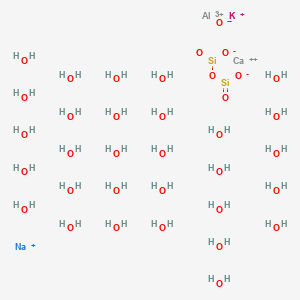
Erionite
Erionite can cause cancer according to an independent committee of scientific and health experts. — California Office of Environmental Health Hazard Assessment (OEHHA)
- IUPAC name
- aluminum;calcium;potassium;sodium;oxido-[oxido(oxo)silyl]oxy-oxosilane;oxygen(2-);triacontahydrate
- Molecular formula
- AlCaH60KNaO36Si2+3
- Molecular weight
- 821.77 g/mol
- Exact mass
- 821.1378863 Da
- Topological polar surface area
- 120.0 Ų
- Hydrogen-bond donors
- 30
- Hydrogen-bond acceptors
- 36
- Covalent units
- 36
- Defined stereocentres
- 0
Also known as
Evidence from additional scientific databases
NIH PubChem PUG-View
Attributed physical-property, hazard, environmental and use annotations.
- Color/Form: Hexagonal, cage-like structure composed of a framework of linked (Si,Al)O4 tetrahedra Source: Hazardous Substances Data Bank (HSDB)
- Color/Form: White prismatic crystals in radiating groups and occurs in a fibrous form Source: Hazardous Substances Data Bank (HSDB)
- Color/Form: Color varies from white to clear and it looks like transparent, glass-like fibers Source: Hazardous Substances Data Bank (HSDB)
- Density: Specific gravity: 2.02 to 2.08 Source: Hazardous Substances Data Bank (HSDB)
- Physical Description: White fibrous crystals; [NTP] Source: Haz-Map, Information on Hazardous Chemicals and Occupational Diseases
- IARC Carcinogenic Agent: Erionite Source: International Agency for Research on Cancer (IARC)
- IARC Carcinogenic Classes: Group 1: Carcinogenic to humans Source: International Agency for Research on Cancer (IARC)
- IARC Monographs: Volume 42: (1987) Silica and Some Silicates; Volume Sup 7: Overall Evaluations of Carcinogenicity: An Updating of IARC Monographs Volumes 1 to 42, 1987; 440 pages; ISBN 92-832-1411-0 (out of print); Volume 100C: (2012) Arsenic, Metals, Fibres, and Dusts Source: International Agency for Research on Cancer (IARC)
- Publication Year: 2012 Source: International Agency for Research on Cancer (IARC)
- Evaluation Year: 2009 Source: International Agency for Research on Cancer (IARC)
- Signal: Danger Source: Regulation (EC) No 1272/2008 of the European Parliament and of the Council
- GHS Hazard Statements: H350: May cause cancer [Danger Carcinogenicity] Source: Regulation (EC) No 1272/2008 of the European Parliament and of the Council
- Precautionary Statement Codes: P203, P280, P318, P405, and P501 (click each P-code to see the statement) Source: Regulation (EC) No 1272/2008 of the European Parliament and of the Council
- Signal: Danger Source: European Chemicals Agency (ECHA)
- GHS Hazard Statements: H350 (100%): May cause cancer [Danger Carcinogenicity] Source: European Chemicals Agency (ECHA)
- Precautionary Statement Codes: P203, P280, P318, P405, and P501 (click each P-code to see the statement) Source: European Chemicals Agency (ECHA)
- ECHA C&L Notifications Summary: Aggregated GHS information provided per 22 reports by companies from 1 notifications to the ECHA C&L Inventory.; Information may vary between notifications depending on impurities, additives, and other factors. The percentage value in parenthesis indicates the notified classification ratio from companies that provide hazard codes. Only hazard codes with percentage values above 10% are shown. For more detailed information, please visit ECHA C&L website. Source: European Chemicals Agency (ECHA)
- ECHA C&L Notifications Summary: The GHS information provided by 1 company from 1 notification to the ECHA C&L Inventory. Source: European Chemicals Agency (ECHA)
- Signal: Danger Source: NITE-CMC
- GHS Hazard Statements: H350: May cause cancer [Danger Carcinogenicity]; H372: Causes damage to organs through prolonged or repeated exposure [Danger Specific target organ toxicity, repeated exposure] Source: NITE-CMC
- Precautionary Statement Codes: P203, P260, P264, P270, P280, P318, P319, P405, and P501 (click each P-code to see the statement) Source: NITE-CMC
- Signal: Danger Source: Hazardous Chemical Information System (HCIS), Safe Work Australia
- Sources/Uses: Occupational exposures occur during mining, milling and processing of some zeolites as well as during agricultural work in areas in which soils are contaminated with erionite. [IARC] Zeolites are used in water softeners, detergents, cracking catalysts, adsorbents, desiccants, and solar collectors; [Hawley] Zeolites are used for pet litter, soil conditioners, animal feed, waste-water treatment, gas absorbents, etc. Erionite deposits exist in Arizona, Nevada, Oregon, and Utah. [NTP] Workers may be exposed in waste treatment, agricultural waste, air pollution control systems, cement aggregates, and building materials; [Siemiatycki, p. 326] Source: Haz-Map, Information on Hazardous Chemicals and Occupational Diseases
- Restricted Notes: Erionite is no longer commercially mined; [NTP] Source: Haz-Map, Information on Hazardous Chemicals and Occupational Diseases
- Industrial Processes with risk of exposure: Farming (Respiratory Hazards) [Category: Industry] Source: Haz-Map, Information on Hazardous Chemicals and Occupational Diseases
- Uses: Erionite is no longer mined or marketed for commercial purposes. Although other natural zeolites have many commercial uses (pet litter, soil conditioners, animal feed, waste-water treatment, gas absorbents, etc.) because of their unique properties, very few data are available specifically for erionite. It reportedly was used in the past as a noble metal-impregnated catalyst in a hydrocarbon-cracking process and was studied for use in fertilizers and to control odors in livestock production. Erionite-rich blocks have been used to build houses in parts of the western U.S., but this was a minor and unintentional use of the mineral. Source: Hazardous Substances Data Bank (HSDB)
Mapped by: Existing checksum-valid CAS to unique PubChem CID match. Retrieved: 2026-08-31. Open source record
Scientific classifications and hazard annotations provide context and do not replace the market-specific regulatory decision shown above.
Additional source coverage and match status
| Source | Result | Checked |
|---|---|---|
| NIH PubChem PUG-View | Exact match | 2026-08-31 |
A recorded no-match is useful evidence that the source was checked; it is not a claim that the substance does not exist elsewhere.
Retrieved from NIH PubChem on 2026-09-02 by checksum-valid CAS matching. Chemical properties do not replace the regulatory decision on this page.