
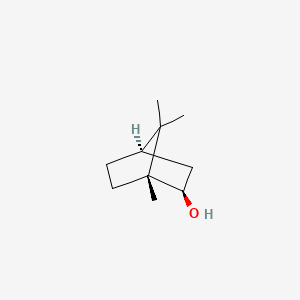
Isoborneol
(−)-isoborneol has been reported in Citrus reticulata, Artemisia annua, and other organisms with data available. — LOTUS - the natural products occurrence database
- IUPAC name
- (1R,2R,4R)-1,7,7-trimethylbicyclo[2.2.1]heptan-2-ol
- Molecular formula
- C10H18O
- Molecular weight
- 154.25 g/mol
- Exact mass
- 154.135765193 Da
- XLogP3
- 2.7
- Topological polar surface area
- 20.2 Ų
- Hydrogen-bond donors
- 1
- Hydrogen-bond acceptors
- 1
- Covalent units
- 1
- Defined stereocentres
- 3
Also known as
16 more reported names
External database identifiers
- ChEMBL:CHEMBL3560760
- EPA DTXSID:DTXSID2042060
Evidence from additional scientific databases
NIH PubChem PUG-View
Attributed physical-property, hazard, environmental and use annotations.
- Boiling Point: Sublimes Source: Hazardous Substances Data Bank (HSDB)
- Color/Form: White solid Source: Hazardous Substances Data Bank (HSDB)
- Color/Form: Tablets from petroleum ether Source: Hazardous Substances Data Bank (HSDB)
- Density: 1.10 g/cm cu at 20 °C Source: Hazardous Substances Data Bank (HSDB)
- LogP: log Kow = 3.24 Source: Hazardous Substances Data Bank (HSDB)
- Melting Point: 216 °C Source: Hazardous Substances Data Bank (HSDB)
- Melting Point: Crystals from petroleum ether. sublimes on heating, MP: 212 °C (in a sealed tube). Practically insoluble in water. Readily soluble in alcohol, ether, chloroform /dl-Isoborneol/ Source: Hazardous Substances Data Bank (HSDB)
- Melting Point: Crystals from petroleum ether. MP: 214 °C. Approx optical rotation: +34.3 deg in alcohol solution /d-Isoborneol/ Source: Hazardous Substances Data Bank (HSDB)
- Melting Point: Crystals from petroleum ether. MP: 214 °C; Approx optical rotation -34.3 deg in alcohol solution /l-Isoborneol/ Source: Hazardous Substances Data Bank (HSDB)
- Melting Point: 212 °C Source: Human Metabolome Database (HMDB)
- Odor: Camphor odor Source: Hazardous Substances Data Bank (HSDB)
- Physical Description: Liquid; CBI; Other Solid Source: EPA Chemical Data Reporting (CDR)
- Physical Description: White solid; [Hawley] Source: Haz-Map, Information on Hazardous Chemicals and Occupational Diseases
- Physical Description: Solid Source: Human Metabolome Database (HMDB)
- Physical Description: White to off-white crystals; piney camphoraceous aroma Source: Joint FAO/WHO Expert Committee on Food Additives (JECFA)
- Solubility: In water, 7.38X10⁻⁴ mg/L at 25 °C /l-Isoborneol/ Source: Hazardous Substances Data Bank (HSDB)
- Solubility: In water, 7.4X10⁻⁴ mg/L at 25 °C /d-Isoborneol/ Source: Hazardous Substances Data Bank (HSDB)
- Solubility: Insoluble in water Source: Hazardous Substances Data Bank (HSDB)
- Solubility: More soluble in most solvents than borneol Source: Hazardous Substances Data Bank (HSDB)
- Solubility: Very soluble in ethanol, diethyl ether, chloroform; soluble in benzene Source: Hazardous Substances Data Bank (HSDB)
- Solubility: Slightly soluble in proylene glycol; Very slightly soluble in water; Insoluble in vegatable oils Source: Joint FAO/WHO Expert Committee on Food Additives (JECFA)
- Solubility: Soluble (in ethanol) Source: Joint FAO/WHO Expert Committee on Food Additives (JECFA)
- Vapor Pressure: 0.03 [mmHg] Source: Haz-Map, Information on Hazardous Chemicals and Occupational Diseases
- Signal: Danger Source: European Chemicals Agency (ECHA)
- GHS Hazard Statements: H228 (99.6%): Flammable solid [Danger Flammable solids]; H315 (11.4%): Causes skin irritation [Warning Skin corrosion/irritation] Source: European Chemicals Agency (ECHA)
- Precautionary Statement Codes: P210, P240, P241, P264, P280, P302+P352, P321, P332+P317, P362+P364, and P370+P378 (click each P-code to see the statement) Source: European Chemicals Agency (ECHA)
- ECHA C&L Notifications Summary: Aggregated GHS information provided per 1747 reports by companies from 8 notifications to the ECHA C&L Inventory. Each notification may be associated with multiple companies.; Information may vary between notifications depending on impurities, additives, and other factors. The percentage value in parenthesis indicates the notified classification ratio from companies that provide hazard codes. Only hazard codes with percentage values above 10% are shown. For more detailed information, please visit ECHA C&L website. Source: European Chemicals Agency (ECHA)
- Signal: Danger Source: Hazardous Substances Data Bank (HSDB)
- GHS Hazard Statements: H228: Flammable solid [Danger Flammable solids]; H315: Causes skin irritation [Warning Skin corrosion/irritation] Source: Hazardous Substances Data Bank (HSDB)
- Precautionary Statement Codes: P210, P240, P241, P264, P280, P302+P352, P321, P332+P317, P362+P364, and P370+P378 (click each P-code to see the statement) Source: Hazardous Substances Data Bank (HSDB)
- Toxicity Summary: IDENTIFICATION AND USE: Isoborneol is a white solid. It is used as a flavor ingredient in food and beverages. It is also used in perfumery and in preparation of chemical esters.HUMAN STUDIES: In a human maximization test, no reactions indicative of sensitization were observed with 10% isoborneol in petrolatum. Isoborneol did not exhibit significant cytotoxicity at concentrations ranging between 0.016% and 0.08% when tested against human cell lines. ANIMAL STUDIES: Isoborneol did not exhibit significant cytotoxicity at concentrations ranging between 0.016% and 0.08% when tested against monkey cell lines. Read across chemicals l-borneol and isobornyl acetate were evaluated for genotoxicity, repeated dose toxicity, developmental and reproductive toxicity. In the13-week subchronic toxicity study for isobornyl acetate conducted in rats the NOEL was determined to be 15 mg/kg/day, based on increased urinary cell excretion.The NOAEL for reproductive toxicity in the parental generation was determined to be 300 mg/kg/day for isobornyl acetate. l-borneol was not mutagenic in the Ames test. Isoborneol, was assessed for genotoxic potential in the Bluescreen assay and was found negative for geno Source: Hazardous Substances Data Bank (HSDB)
- Environmental Bioconcentration: An estimated BCF of 64 was calculated in fish for isoborneol(SRC), using a log Kow of 3.24(1) and a regression-derived equation(1). According to a classification scheme(2), this BCF suggests the potential for bioconcentration in aquatic organisms is moderate(SRC). Source: Hazardous Substances Data Bank (HSDB)
- Environmental Fate: TERRESTRIAL FATE: Based on a classification scheme(1), an estimated Koc value of 200(SRC), determined from a log Kow of 3.24(2) and a regression-derived equation(3), indicates that isoborneol is expected to have moderate mobility in soil(SRC). Volatilization of isoborneol from moist soil surfaces is expected to be an important fate process(SRC) given an estimated Henry's Law constant of 6.7X10⁻⁶ atm-cu m/mole(SRC), using a fragment constant estimation method(4). Isoborneol has an estimated vapor pressure of 3.5X10⁻² mm Hg(SRC), determined from a fragment constant method(3) and exists as a liquid under environmental conditions; therefore, isoborneol may volatilize from dry soil(SRC). Based on analogy to borneol, isoborneol is expected to biodegrade rapidly. Borneol reached 97% of theoretical BOD using activated sludge in the Japanese MITI test(5) which suggests that biodegradation is an important environmental fate process in soil(SRC). Source: Hazardous Substances Data Bank (HSDB)
- Environmental Fate: AQUATIC FATE: Based on a classification scheme(1), an estimated Koc value of 200(SRC), determined from a log Kow of 3.24(2) and a regression-derived equation(3), indicates that isoborneol may adsorb to suspended solids and sediment(SRC). Volatilization from water surfaces is expected(4) based upon an estimated Henry's Law constant of 6.7X10⁻⁶ atm-cu m/mole(SRC), developed using a fragment constant estimation method(5). Using this Henry's Law constant and an estimation method(4), volatilization half-lives for a model river and model lake are 7 days and 54 days, respectively(SRC). According to a classification scheme(6), an estimated BCF of 64(SRC), from its log Kow(2) and a regression-derived equation(3), suggests the potential for bioconcentration in aquatic organisms is moderate(SRC). Based on analogy to borneol, isoborneol is expected to biodegrade rapidly. Borneol reached 97% of theoretical BOD using activated sludge in the Japanese MITI test(7) which suggests that biodegradation is an important environmental fate process in water(SRC). Source: Hazardous Substances Data Bank (HSDB)
- Environmental Fate: ATMOSPHERIC FATE: According to a model of gas/particle partitioning of semivolatile organic compounds in the atmosphere(1), isoborneol, which has an estimated vapor pressure of 3.5X10⁻² mm Hg at 25 °C(SRC), determined from a fragment constant method(2), is expected to exist solely as a vapor in the ambient atmosphere. Vapor-phase isoborneol is degraded in the atmosphere by reaction with photochemically-produced hydroxyl radicals(SRC); the half-life for this reaction in air is estimated to be 34 hours(SRC), calculated from its rate constant of 1.1X10⁻¹¹ cu cm/molecule-sec at 25 °C(SRC) that was derived using a structure estimation method(3). Isoborneol does not contain chromophores that absorb at wavelengths >290 nm(4) and, therefore, is not expected to be susceptible to direct photolysis by sunlight(SRC). Source: Hazardous Substances Data Bank (HSDB)
- Consumer Uses: Fragrance Source: EPA Chemical Data Reporting (CDR)
- Industry Uses: Other; Fragrance Source: EPA Chemical Data Reporting (CDR)
- Sources/Uses: Used as a synthetic flavor; In over-the-counter preparations containing <11% camphor, it has been used as a moth repellent, cold sore topical medication, muscle liniment, and steam-inhaled cough suppressant; [HSDB] Used in perfumes; [Hawley] Source: Haz-Map, Information on Hazardous Chemicals and Occupational Diseases
- Uses: For isoborneol (USEPA/OPP Pesticide Code: 047089) there are 0 labels match. /SRP: Not registered for current use in the U.S., but approved pesticide uses may change periodically and so federal, state and local authorities must be consulted for currently approved uses./ Source: Hazardous Substances Data Bank (HSDB)
- Uses: Reported uses (ppm):; Table: Reported uses (ppm): (Flavor and Extract Manufacturers' Association) [Table#4225] Source: Hazardous Substances Data Bank (HSDB)
- Uses: Perfumery, chemical esters. Source: Hazardous Substances Data Bank (HSDB)
- Uses: The repellence of the plant-derived bicyclic monoterpenoid isoborneol on subterranean termites was assessed in short-term laboratory bioassays. Depending on concentration, application of isoborneol to different soil types was efficient in creating repellent soil barriers, which were not penetrated by workers of Reticulitermes santonensis De Feytaud or R. flavipes Kollar within 2 wk after adding the substance to the substrate. Isoborneol-treated barriers did not affect termite survival. The bioavailability of the active ingredient decreased with increasing clay content of the soil. Evaporation of isoborneol from treated soil increased with increasing particle size of the substrate and could be reduced by covering the soil surface. Source: Hazardous Substances Data Bank (HSDB)
- Uses: MEDICATION Source: Hazardous Substances Data Bank (HSDB)
Mapped by: Existing checksum-valid CAS to unique PubChem CID match. Retrieved: 2026-08-31. Open source record
Scientific classifications and hazard annotations provide context and do not replace the market-specific regulatory decision shown above.
Additional source coverage and match status
| Source | Result | Checked |
|---|---|---|
| NIH PubChem PUG-View | Exact match | 2026-08-31 |
A recorded no-match is useful evidence that the source was checked; it is not a claim that the substance does not exist elsewhere.
Retrieved from NIH PubChem on 2026-08-31 by checksum-valid CAS matching. Chemical properties do not replace the regulatory decision on this page.