
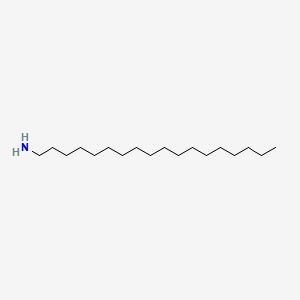
Octadecylamine
Octadecan-1-amine is an 18-carbon primary aliphatic amine. It has a role as a film-forming compound. — ChEBI
- IUPAC name
- octadecan-1-amine
- Molecular formula
- C18H39N
- Molecular weight
- 269.5 g/mol
- Exact mass
- 269.308250248 Da
- XLogP3
- 8.5
- Topological polar surface area
- 26.0 Ų
- Hydrogen-bond donors
- 1
- Hydrogen-bond acceptors
- 1
- Covalent units
- 1
- Defined stereocentres
- 0
Also known as
16 more reported names
External database identifiers
- ChEBI:CHEBI:63866
- ChEMBL:CHEMBL55860
- EPA DTXSID:DTXSID1025801
- PubMed:23057722
- PubMed:23044268
- PubMed:22983592
- PubMed:22931455
- PubMed:22871060
- PubMed:22826874
- PubMed:22806266
- PubMed:22794298
- PubMed:22771924
- PubMed:22748771
- PubMed:22687440
- PubMed:22679362
Evidence from additional scientific databases
NIH PubChem PUG-View
Attributed physical-property, hazard, environmental and use annotations.
- Boiling Point: 660 °F at 760 mmHg (NTP, 1992) Source: CAMEO Chemicals
- Boiling Point: 346.8 °C @ 760 mm Hg Source: Hazardous Substances Data Bank (HSDB)
- Boiling Point: 346.8 °C Source: ILO-WHO International Chemical Safety Cards (ICSCs)
- Density: 0.8618 at 68 °F (NTP, 1992) - Less dense than water; will float Source: CAMEO Chemicals
- Density: 0.8618 @ 20 °C/4 °C Source: Hazardous Substances Data Bank (HSDB)
- Density: 0.86 g/cm³ Source: ILO-WHO International Chemical Safety Cards (ICSCs)
- Dissociation Constants: pKa = 10.65 Source: Hazardous Substances Data Bank (HSDB)
- Flash Point: 300 °F (NTP, 1992) Source: CAMEO Chemicals
- Flash Point: 148 °C c.c. Source: ILO-WHO International Chemical Safety Cards (ICSCs)
- LogP: 7.7 Source: ILO-WHO International Chemical Safety Cards (ICSCs)
- Melting Point: 120 to 126 °F (NTP, 1992) Source: CAMEO Chemicals
- Melting Point: 52.9 °C Source: Hazardous Substances Data Bank (HSDB)
- Melting Point: 49 - 52 °C Source: Human Metabolome Database (HMDB)
- Melting Point: 52.9 °C Source: ILO-WHO International Chemical Safety Cards (ICSCs)
- Physical Description: Octadecylamine appears as a white solid. Insoluble in water and less dense than water. Hence floats on water. Contact may irritate skin, eyes and mucous membranes. May be toxic by ingestion. Used to make other chemicals. Source: CAMEO Chemicals
- Physical Description: Dry Powder; Other Solid; Large Crystals; CBI; Liquid Source: EPA Chemical Data Reporting (CDR)
- Physical Description: White solid; [ICSC] White crystalline solid; [MSDSonline] Colorless solid with on odor of amines; [ECHA] Source: Haz-Map, Information on Hazardous Chemicals and Occupational Diseases
- Physical Description: Solid Source: Human Metabolome Database (HMDB)
- Physical Description: WHITE FLAKES WITH CHARACTERISTIC ODOUR. Source: ILO-WHO International Chemical Safety Cards (ICSCs)
- Refractive Index: Index of refraction: 1.4522 @ 20 °C Source: Hazardous Substances Data Bank (HSDB)
- Solubility: less than 1 mg/mL at 72 °F (NTP, 1992) Source: CAMEO Chemicals
- Solubility: Insol in water; sol in alcohol, ether, benzene; very sol in chloroform; miscible in acetone Source: Hazardous Substances Data Bank (HSDB)
- Solubility: Solubility in water: very poor Source: ILO-WHO International Chemical Safety Cards (ICSCs)
- Vapor Pressure: 0.0000438 [mmHg] Source: Haz-Map, Information on Hazardous Chemicals and Occupational Diseases
- Exposure Routes: The substance can be absorbed into the body by ingestion. Source: ILO-WHO International Chemical Safety Cards (ICSCs)
- First Aid: EYES: First check the victim for contact lenses and remove if present. Flush victim's eyes with water or normal saline solution for 20 to 30 minutes while simultaneously calling a hospital or poison control center. Do not put any ointments, oils, or medication in the victim's eyes without specific instructions from a physician. IMMEDIATELY transport the victim after flushing eyes to a hospital even if no symptoms (such as redness or irritation) develop.; SKIN: IMMEDIATELY flood affected skin with water while removing and isolating all contaminated clothing. Gently wash all affected skin areas thoroughly with soap and water. IMMEDIATELY call a hospital or poison control center even if no symptoms (such as redness or irritation) develop. IMMEDIATELY transport the victim to a hospital for treatment after washing the affected areas.; INHALATION: IMMEDIATELY leave the contaminated area; take deep breaths of fresh air. If symptoms (such as wheezing, coughing, shortness of breath, or burning in the mouth, throat, or chest) develop, call a physician and be prepared to transport the victim to a hospital. Provide proper respiratory protection to rescuers entering an unknown atmosphere. Whene Source: CAMEO Chemicals
- Signal: Danger Source: Regulation (EC) No 1272/2008 of the European Parliament and of the Council
- GHS Hazard Statements: H304: May be fatal if swallowed and enters airways [Danger Aspiration hazard]; H315: Causes skin irritation [Warning Skin corrosion/irritation]; H318: Causes serious eye damage [Danger Serious eye damage/eye irritation]; H373: May causes damage to organs through prolonged or repeated exposure [Warning Specific target organ toxicity, repeated exposure]; H400: Very toxic to aquatic life [Warning Hazardous to the aquatic environment, acute hazard]; H410: Very toxic to aquatic life with long lasting effects [Warning Hazardous to the aquatic environment, long-term hazard] Source: Regulation (EC) No 1272/2008 of the European Parliament and of the Council
- Precautionary Statement Codes: P260, P264, P264+P265, P273, P280, P301+P316, P302+P352, P305+P354+P338, P317, P319, P321, P331, P332+P317, P362+P364, P391, P405, and P501 (click each P-code to see the statement) Source: Regulation (EC) No 1272/2008 of the European Parliament and of the Council
- Note: This chemical does not meet GHS hazard criteria for 0.8% (7 of 907) of reports. Source: European Chemicals Agency (ECHA)
- Signal: Danger Source: European Chemicals Agency (ECHA)
- GHS Hazard Statements: H302 (49.3%): Harmful if swallowed [Warning Acute toxicity, oral]; H304 (32.2%): May be fatal if swallowed and enters airways [Danger Aspiration hazard]; H314 (48.6%): Causes severe skin burns and eye damage [Danger Skin corrosion/irritation]; H315 (50.6%): Causes skin irritation [Warning Skin corrosion/irritation]; H318 (97.5%): Causes serious eye damage [Danger Serious eye damage/eye irritation]; H373 (42%): May causes damage to organs through prolonged or repeated exposure [Warning Specific target organ toxicity, repeated exposure]; H400 (46%): Very toxic to aquatic life [Warning Hazardous to the aquatic environment, acute hazard]; H410 (32.3%): Very toxic to aquatic life with long lasting effects [Warning Hazardous to the aquatic environment, long-term hazard] Source: European Chemicals Agency (ECHA)
- Precautionary Statement Codes: P260, P264, P264+P265, P270, P273, P280, P301+P316, P301+P317, P301+P330+P331, P302+P352, P302+P361+P354, P304+P340, P305+P354+P338, P316, P317, P319, P321, P330, P331, P332+P317, P362+P364, P363, P391, P405, and P501 (click each P-code to see the statement) Source: European Chemicals Agency (ECHA)
- ECHA C&L Notifications Summary: Aggregated GHS information provided per 907 reports by companies from 34 notifications to the ECHA C&L Inventory. Each notification may be associated with multiple companies.; Reported as not meeting GHS hazard criteria per 7 of 907 reports by companies.; There are 33 notifications provided by 900 of 907 reports by companies with hazard statement code(s).; Information may vary between notifications depending on impurities, additives, and other factors. The percentage value in parenthesis indicates the notified classification ratio from companies that provide hazard codes. Only hazard codes with percentage values above 10% are shown. For more detailed information, please visit ECHA C&L website. Source: European Chemicals Agency (ECHA)
- Signal: Danger Source: NITE-CMC
- GHS Hazard Statements: H318: Causes serious eye damage [Danger Serious eye damage/eye irritation]; H400: Very toxic to aquatic life [Warning Hazardous to the aquatic environment, acute hazard]; H410: Very toxic to aquatic life with long lasting effects [Warning Hazardous to the aquatic environment, long-term hazard] Source: NITE-CMC
- Precautionary Statement Codes: P264+P265, P273, P280, P305+P354+P338, P317, P391, and P501 (click each P-code to see the statement) Source: NITE-CMC
- Signal: Warning Source: NITE-CMC
- Cosmetic Ingredient Review Conclusion: The safety of Lauramine and Stearamine has not been documented and substantiated. The CIR Expert Panel cannot conclude whether these ingredients are safe for use in cosmetic products until the appropriate safety data have been obtained and evaluated. Source: Cosmetic Ingredient Review (CIR)
- Cosmetic Ingredient Review Finding(s): The available data are insufficient to support safety Source: Cosmetic Ingredient Review (CIR)
- Environmental Bioconcentration: An estimated log BCF of 5.6 was calculated for octadecylamine(SRC), using an estimated log Kow of 7.7(1,SRC) and a regression-derived equation(2). According to a classification scheme(3), this BCF suggests the potential for bioconcentration in aquatic organisms is low(SRC). Source: Hazardous Substances Data Bank (HSDB)
- Environmental Fate: TERRESTRIAL FATE: Based on a classification scheme(1), an estimated log Koc value of 5.5(SRC), determined from an estimated log Kow of 7.7(2,SRC) and a regression-derived equation(3), indicates that octadecylamine is expected to be immobile in soil(SRC). A pKa value of 10.65(4) indicates that the protonated form will be the dominant species in moist soil surfaces and cationic molecules generally adsorb strongly to soils(SRC). Volatilization of octadecylamine from moist soil surfaces is not expected to be an important fate process since the protonated form is expected to be the dominant species based on the pKa value(4). Volatilization of octadecylamine from dry soil surfaces is not expected(SRC) based upon the estimated vapor pressure of 4.4X10⁻⁵ mm Hg at 25 °C(5). A 32% of theoretical BOD in an activated sludge inoculum was observed over a 15-day incubation period(6), suggesting that biodegradation may be rapid in the environment(SRC). Source: Hazardous Substances Data Bank (HSDB)
- Environmental Fate: AQUATIC FATE: Based on a classification scheme(1), an estimated log Koc value of 5.5(SRC), determined from an estimated log Kow of 7.7(2,SRC) and a regression-derived equation(3), indicates that octadecylamine is expected to adsorb to suspended solids and sediment in water(SRC). A pKa value of 10.65(4) indicates that the protonated form will be the dominant species in water and volatilization from water surfaces is not expected to be an important fate process(SRC). According to a classification scheme(5), an estimated log BCF of 5.6(3,SRC), from its estimated log Kow(2,SRC), suggests the potential for bioconcentration in aquatic organisms is very high(SRC). A 32% of theoretical BOD in an activated sludge inoculum was observed over a 15-day incubation period(6), suggesting that biodegradation may be rapid in the environment(SRC). Source: Hazardous Substances Data Bank (HSDB)
- Environmental Fate: ATMOSPHERIC FATE: According to a model of gas/particle partitioning of semivolatile organic compounds in the atmosphere(1), octadecylamine, which has an estimated vapor pressure of 4.4X10⁻⁵ mm Hg at 25 °C(2), is expected to exist in both the vapor and particulate phases in the ambient atmosphere. Vapor-phase octadecylamine is degraded in the atmosphere by reaction with photochemically-produced hydroxyl radicals(SRC); the half-life for this reaction in air is estimated to be 10 hours(SRC) from its estimated rate constant of 3.4X10⁻¹¹ cu cm/molecule-sec at 25 °C(SRC), determined from a structure estimation method(3). Particulate-phase octadecylamine will be removed from the atmosphere by wet and dry depostion(SRC). Source: Hazardous Substances Data Bank (HSDB)
- Industry Uses: Emulsifier; Not Known or Reasonably Ascertainable; Surface modifier; Lubricating agent; CBI; Surfactant (surface active agent); Processing aids not otherwise specified Source: EPA Chemical Data Reporting (CDR)
- Cosmetic Ingredient Review Link: CIR ingredient: Stearamine Source: Cosmetic Ingredient Review (CIR)
- Sources/Uses: Used as a corrosion inhibitor (steam systems), mold releasing agent (manufacturing of battery cases), anti-caking and flotation agent, anti-stripping agent (asphalt emulsions for highways), and chemical intermediate; Also used for various applications in the petroleum industry; [HSDB] Used for metal extraction, refining, and processing of metals; [IUCLID] Source: Haz-Map, Information on Hazardous Chemicals and Occupational Diseases
- Industrial Processes with risk of exposure: Petroleum Production and Refining [Category: Industry]; Battery Manufacturing [Category: Industry]; Metal Extraction and Refining [Category: Industry] Source: Haz-Map, Information on Hazardous Chemicals and Occupational Diseases
- Uses: ANTICORROSIVE AGENT Source: Hazardous Substances Data Bank (HSDB)
- Uses: MOLD RELEASE AGENT IN MFR OF BATTERY CASES; CORROSION INHIBITOR IN STEAM PLANTS; CHEMICAL INTERMEDIATE FOR OCTADECYL ISOCYANATE; CHEMICAL INTERMEDIATE FOR OTHER SURFACE-ACTIVE AGENTS; ANTICAKING AGENT; FLOTATION AGENT; AGENT IN VARIOUS ASPECTS OF PETROLEUM INDUSTRY; ANTISTRIPPING AGENT IN ASPHALT EMULSIONS FOR HIGHWAYS Source: Hazardous Substances Data Bank (HSDB)
- Uses: Surface protection against condensate corrosion in steam systems. Source: Hazardous Substances Data Bank (HSDB)
Mapped by: Existing checksum-valid CAS to unique PubChem CID match. Retrieved: 2026-08-31. Open source record
Scientific classifications and hazard annotations provide context and do not replace the market-specific regulatory decision shown above.
Additional source coverage and match status
| Source | Result | Checked |
|---|---|---|
| NIH PubChem PUG-View | Exact match | 2026-08-31 |
A recorded no-match is useful evidence that the source was checked; it is not a claim that the substance does not exist elsewhere.
Retrieved from NIH PubChem on 2026-08-31 by checksum-valid CAS matching. Chemical properties do not replace the regulatory decision on this page.