
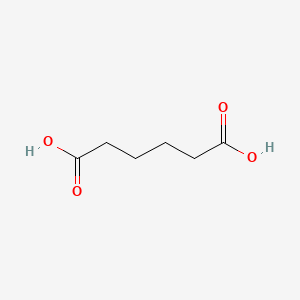
Adipic Acid
Adipic acid is an alpha,-dicarboxylic acid that is the 1,4-dicarboxy derivative of butane. It has a role as a food acidity regulator and a human xenobiotic metabolite. It is a dicarboxylic fatty acid and an alpha,omega-dicarboxylic acid. It is a conjugate acid of an adipate(1-). — ChEBI
- IUPAC name
- hexanedioic acid
- Molecular formula
- C6H10O4
- Molecular weight
- 146.14 g/mol
- Exact mass
- 146.05790880 Da
- XLogP3
- 0.1
- Topological polar surface area
- 74.6 Ų
- Hydrogen-bond donors
- 2
- Hydrogen-bond acceptors
- 4
- Covalent units
- 1
- Defined stereocentres
- 0
Also known as
16 more reported names
External database identifiers
- ChEBI:CHEBI:30832
- ChEMBL:CHEMBL1157
- EPA DTXSID:DTXSID7021605
- PubMed:29968805
- PubMed:22821849
- PubMed:22819047
- PubMed:22675455
- PubMed:22593687
- PubMed:22573970
- PubMed:22525490
- PubMed:22484264
- PubMed:22389769
- PubMed:22309255
- PubMed:22249720
- PubMed:22180807
Evidence from additional scientific databases
NIH PubChem PUG-View
Attributed physical-property, hazard, environmental and use annotations.
- Autoignition Temperature: 788 °F; 450 °F (USCG, 1999) Source: CAMEO Chemicals
- Autoignition Temperature: 788 °F, 420 °C Source: Hazardous Substances Data Bank (HSDB)
- Autoignition Temperature: 422 °C Source: ILO-WHO International Chemical Safety Cards (ICSCs)
- Boiling Point: 337.5 °C at 760 mm Hg: 265 °C at 100 mm Hg: 240.5 °C at 40 mm Hg: 222 °Cat 20 mm Hg: 205.5 °C at 10 mm Hg; 191 °C at 5 mm Hg; 159.5 °C at 1.0 mm Hg Source: Hazardous Substances Data Bank (HSDB)
- Boiling Point: 265.00 °C. @ 100.00 mm Hg Source: Human Metabolome Database (HMDB)
- Boiling Point: 338 °C Source: ILO-WHO International Chemical Safety Cards (ICSCs)
- Color/Form: Monoclinic prisms from ethyl acetate, water, or acetone and petroleum ether Source: Hazardous Substances Data Bank (HSDB)
- Color/Form: White monoclinic prisms Source: Hazardous Substances Data Bank (HSDB)
- Color/Form: White crystalline solid Source: Hazardous Substances Data Bank (HSDB)
- Color/Form: Colorless Source: Hazardous Substances Data Bank (HSDB)
- Density: 1.36 at 68 °F (USCG, 1999) - Denser than water; will sink Source: CAMEO Chemicals
- Density: 1.360 g/cu cm at 25 °C Source: Hazardous Substances Data Bank (HSDB)
- Density: Bulk density: 640-800 kg/cu m Source: Hazardous Substances Data Bank (HSDB)
- Density: 1.36 g/cm³ Source: ILO-WHO International Chemical Safety Cards (ICSCs)
- Density: 1.36 Source: Occupational Safety and Health Administration (OSHA)
- Dissociation Constants: K1 = 3.90X10⁻⁵ at 25 °C; K2 = 5.29X10⁻⁶ at 25 °C Source: Hazardous Substances Data Bank (HSDB)
- Dissociation Constants: pKa1 = 4.43; pKa2 = 5.41 Source: Hazardous Substances Data Bank (HSDB)
- Dissociation Constants: pKa1 = 4.44 at 25 °C; pKa2 = 5.44 at 25 °C Source: Hazardous Substances Data Bank (HSDB)
- Dissociation Constants: pKa1 = 4.418; pKa2 = 5.412 at 25 °C Source: Hazardous Substances Data Bank (HSDB)
- Flash Point: 376 °F Combustible solid (USCG, 1999) Source: CAMEO Chemicals
- Flash Point: 385 °F, 196 °C (closed cup) Source: Hazardous Substances Data Bank (HSDB)
- Flash Point: 196 °C c.c. Source: ILO-WHO International Chemical Safety Cards (ICSCs)
- Flash Point: 376 °F Source: Occupational Safety and Health Administration (OSHA)
- LogP: log Kow = 0.08 Source: Hazardous Substances Data Bank (HSDB)
- LogP: 0.08 Source: Human Metabolome Database (HMDB)
- LogP: 0.08 Source: ILO-WHO International Chemical Safety Cards (ICSCs)
- Melting Point: 304 °F (USCG, 1999) Source: CAMEO Chemicals
- Melting Point: 151,5-154,0 °C Source: EU Food Improvement Agents
- Melting Point: 151.5 °C Source: Hazardous Substances Data Bank (HSDB)
- Melting Point: 151 - 154 °C Source: Human Metabolome Database (HMDB)
- Melting Point: 152 °C Source: ILO-WHO International Chemical Safety Cards (ICSCs)
- Melting Point: 304 °F Source: Occupational Safety and Health Administration (OSHA)
- Odor: Odorless Source: Hazardous Substances Data Bank (HSDB)
- Physical Description: Adipic acid is a white crystalline solid. It is insoluble in water. The primary hazard is the threat to the environment. Immediate steps should be taken to limit its spread to the environment. It is used to make plastics and foams and for other uses. Source: CAMEO Chemicals
- Physical Description: Other Solid; Dry Powder; Large Crystals; Other Solid; CBI; Large Crystals; Liquid; Other Solid; Dry Powder; Liquid; Liquid Source: EPA Chemical Data Reporting (CDR)
- Physical Description: White odourless crystals or crystalline powder Source: EU Food Improvement Agents
- Physical Description: Colorless to white crystals; [CHEMINFO] Source: Haz-Map, Information on Hazardous Chemicals and Occupational Diseases
- Physical Description: Solid Source: Human Metabolome Database (HMDB)
- Physical Description: ODOURLESS COLOURLESS CRYSTALLINE POWDER. Source: ILO-WHO International Chemical Safety Cards (ICSCs)
- Physical Description: white crystals or crystalline powder; practically odourless; aqueous phase has a pleasant sour taste Source: Joint FAO/WHO Expert Committee on Food Additives (JECFA)
- Physical Description: White crystalline solid Source: Occupational Safety and Health Administration (OSHA)
- Solubility: Slightly soluble in water. Freely soluble in ethanol Source: EU Food Improvement Agents
- Solubility: In water, 3.00X10+4 mg/L at 30 °C Source: Hazardous Substances Data Bank (HSDB)
- Solubility: In water, 0.633/100 parts (wt/wt) ether at 19 °C Source: Hazardous Substances Data Bank (HSDB)
- Solubility: In water, 160 g/100 mL boiling water Source: Hazardous Substances Data Bank (HSDB)
- Solubility: 1.4 g/100 mL water at 10 °C Source: Hazardous Substances Data Bank (HSDB)
- Solubility: For more Solubility (Complete) data for ADIPIC ACID (7 total), please visit the HSDB record page. Source: Hazardous Substances Data Bank (HSDB)
- Solubility: 30.8 mg/mL at 34 °C Source: Human Metabolome Database (HMDB)
- Solubility: Solubility in water, g/100ml at 15 °C: 1.4 (moderate) Source: ILO-WHO International Chemical Safety Cards (ICSCs)
- Solubility: slightly soluble in water; soluble in alcohol and acetone Source: Joint FAO/WHO Expert Committee on Food Additives (JECFA)
- Solubility: (in ethanol) Source: Joint FAO/WHO Expert Committee on Food Additives (JECFA)
- Vapor Pressure: 3.02X10⁻⁵ Pa at 25 °C (2.27X10⁻⁷ mm Hg) Source: Hazardous Substances Data Bank (HSDB)
- Vapor Pressure: Vapor pressure, Pa at 18.5 °C: 10 Source: ILO-WHO International Chemical Safety Cards (ICSCs)
- Viscosity: Viscosity of melt: 4.54 cP at 160 °C; 2.64 cP at 193 °C Source: Hazardous Substances Data Bank (HSDB)
- pH: pH of saturated aqueous solution at 25 °C = 2.7; pH of 0.1% solution at 25 °C = 3.2 Source: Hazardous Substances Data Bank (HSDB)
- Exposure Routes: The substance can be absorbed into the body by inhalation of its aerosol. Source: ILO-WHO International Chemical Safety Cards (ICSCs)
- First Aid: INHALATION: remove victim to fresh air; get medical attention if irritation persists.; EYES: flush with water for at least 15 min.; SKIN: flush with water. (USCG, 1999) Source: CAMEO Chemicals
- Signal: Warning Source: Regulation (EC) No 1272/2008 of the European Parliament and of the Council
- GHS Hazard Statements: H319: Causes serious eye irritation [Warning Serious eye damage/eye irritation] Source: Regulation (EC) No 1272/2008 of the European Parliament and of the Council
- Precautionary Statement Codes: P264+P265, P280, P305+P351+P338, and P337+P317 (click each P-code to see the statement) Source: Regulation (EC) No 1272/2008 of the European Parliament and of the Council
- Note: This chemical does not meet GHS hazard criteria for < 0.1% (2 of 5531) of reports. Source: European Chemicals Agency (ECHA)
- Signal: Warning Source: European Chemicals Agency (ECHA)
- GHS Hazard Statements: H319 (95.6%): Causes serious eye irritation [Warning Serious eye damage/eye irritation] Source: European Chemicals Agency (ECHA)
- Precautionary Statement Codes: P264+P265, P280, P305+P351+P338, and P337+P317 (click each P-code to see the statement) Source: European Chemicals Agency (ECHA)
- ECHA C&L Notifications Summary: Aggregated GHS information provided per 5531 reports by companies from 10 notifications to the ECHA C&L Inventory.; Reported as not meeting GHS hazard criteria per 2 of 5531 reports by companies.; There are 9 notifications provided by 5529 of 5531 reports by companies with hazard statement code(s).; Information may vary between notifications depending on impurities, additives, and other factors. The percentage value in parenthesis indicates the notified classification ratio from companies that provide hazard codes. Only hazard codes with percentage values above 10% are shown. For more detailed information, please visit ECHA C&L website. Source: European Chemicals Agency (ECHA)
- Signal: Danger Source: NITE-CMC
- GHS Hazard Statements: H318: Causes serious eye damage [Danger Serious eye damage/eye irritation]; H402: Harmful to aquatic life [Hazardous to the aquatic environment, acute hazard] Source: NITE-CMC
- Precautionary Statement Codes: P264+P265, P273, P280, P305+P354+P338, P317, and P501 (click each P-code to see the statement) Source: NITE-CMC
- Signal: Warning Source: NITE-CMC
- NFPA Health Rating: 0 - Materials that, under emergency conditions, would offer no hazard beyond that of ordinary combustible materials. Source: Hazardous Substances Data Bank (HSDB)
- NFPA Fire Rating: 1 - Materials that must be preheated before ignition can occur. Materials require considerable preheating, under all ambient temperature conditions, before ignition and combustion can occur. Source: Hazardous Substances Data Bank (HSDB)
- NFPA Instability Rating: 0 - Materials that in themselves are normally stable, even under fire conditions. Source: Hazardous Substances Data Bank (HSDB)
- Cosmetic Ingredient Review Finding(s): Safe in the present practices of use and concentration. Ingredient, concentration, and use information are available in documents discoverable at https://cir-reports.cir-safety.org Source: Cosmetic Ingredient Review (CIR)
- Toxicity Summary: IDENTIFICATION AND USE: Adipic acid is white crystalline solid. The major markets for adipic acid include use as feedstocks for nylon 6,6 resins and fibers, polyester polyols and plasticzers. Nylon 6,6 fibers and engineering resins accounted for approximately 85% of total adipic acid consumption in 2011. Polyester polyols and plasticizers, which combined accounted for 24-32% of global adipic acid consumption in 2010 . Other applications documented for adipic acid are as a lubricant additive in coatings, and foams, and in shoe soles, as tanning agent in leather industry, pH regulator in processes such as in the production of cleaning agents, pelletizing agent in disinfectant pills for drinking water, additive in flue gas sulfurization, in the coating of dishwashing machine tablets and as an additive in chemicals. Adipic acid has been identified as being used in hydraulic fracturing as a gelling agent. HUMAN EXPOSURE AND TOXICITY: Adipic acid exhibits an asthma hazard index of 0.75 using the chemical asthma hazard assessment program. Substances with indices of >0.5 have a high probability of being an asthmagen. Threshold for irritation of the human eye was 20 mg/cu m. ANIMAL STUDIES: Source: Hazardous Substances Data Bank (HSDB)
- Environmental Bioconcentration: An estimated BCF of 3 was calculated in fish for adipic acid(SRC), using a log Kow of 0.08(1) and a regression-derived equation(2). According to a classification scheme(3), this BCF suggests the potential for bioconcentration in aquatic organisms is low(SRC). Source: Hazardous Substances Data Bank (HSDB)
- Environmental Fate: TERRESTRIAL FATE: Based on a classification scheme(1), an estimated Koc value of 24(SRC), determined from a structure estimation method(2), indicates that adipic acid is expected to have very high mobility in soil(SRC). The pKa values of adipic acid's two acid groups are 4.44 and 5.44(3), indicating that this compound will exist almost entirely in the anion form and anions generally do not adsorb more strongly to soils containing organic carbon and clay than their neutral counterparts(4). Volatilization of adipic acid from moist soil surfaces is not expected to be an important fate process(SRC) given an estimated Henry's Law constant of 1.8X10⁻¹² atm-cu m/mole(SRC) based upon its vapor pressure, 2.27X10⁻⁷ mm Hg(5), and water solubility, 2.43X10+4 mg/L(6). Adipic acid is not expected to volatilize from dry soil surfaces based on its vapor pressure(5). Biodegradation screening tests indicate that adipic acid is readily biodegradable in soil and water(7). An 84% conversion of adipic acid's carbon content to carbon dioxide was observed after 30 days aerobic incubation in a soil flask test(8). Source: Hazardous Substances Data Bank (HSDB)
- Environmental Fate: AQUATIC FATE: Based on a classification scheme(1), an estimated Koc value of 24(SRC), determined from a structure estimation method(2), indicates that adipic acid is not expected to adsorb to suspended solids and sediment(SRC). Volatilization from water surfaces is not expected(3) based upon an estimated Henry's Law constant of 1.8X10⁻¹² atm-cu m/mole(SRC), derived from its vapor pressure, 2.27X10⁻⁷ mm Hg(4), and water solubility, 2.43X10+4 mg/L(5). According to a classification scheme(6), an estimated BCF of 3(SRC), from its log Kow of 0.08(7) and a regression-derived equation(2), suggests the potential for bioconcentration in aquatic organisms is low(SRC). Biodegradation screening tests indicate that adipic acid is readily biodegradable in soil and water(8). Adipic acid was rapidly degraded in a river die-away test using Main River (Germany) water with 50% and 90% degradation being achieved in 3.5 and 7 days, respectively, at concentration levels of 700 mg/L(9). Adipic acid is not expected to undergo hydrolysis in the environment due to the lack of functional groups that hydrolyze under environmental conditions(3). Source: Hazardous Substances Data Bank (HSDB)
- Environmental Fate: ATMOSPHERIC FATE: According to a model of gas/particle partitioning of semivolatile organic compounds in the atmosphere(1), adipic acid, which has a vapor pressure of 2.27.4X10-7 mm Hg at 25 °C(2), will exist in both the vapor and particulate phases in the ambient atmosphere. Vapor-phase adipic acid is degraded in the atmosphere by reaction with photochemically-produced hydroxyl radicals(SRC); the half-life for this reaction in air is estimated to be 2.9 days(SRC), calculated from its rate constant of 5.6X10⁻¹² cu cm/molecule-sec at 25 °C that was derived using a structure estimation method(3). Particulate-phase adipic acid may be physically removed from the air by wet and dry deposition(SRC). Adipic acid has been detected in snow, sleet and rain precipitation(4). Source: Hazardous Substances Data Bank (HSDB)
- Consumer Uses: Surfactant (surface active agent); Anti-freeze agent; Solvent; Other; Intermediate; Not Known or Reasonably Ascertainable Source: EPA Chemical Data Reporting (CDR)
- Industry Uses: Other; Lubricating agent; Solvent; Anti-freeze agent; pH regulating agent; Processing aids not otherwise specified; Tanning agents not otherwise specified; Monomers; Sealant (barrier); Not Known or Reasonably Ascertainable; Plasticizer; Coalescing agent; Solids separation (precipitating) agent, not otherwise specified; Flocculating agent; Processing aids, specific to petroleum production; Flotation agent; Intermediate Source: EPA Chemical Data Reporting (CDR)
- Cosmetic Ingredient Review Link: CIR ingredient: Adipic Acid Source: Cosmetic Ingredient Review (CIR)
- Sources/Uses: Used to make nylon, polyurethane foams, lubricants, and plasticizers; Used in adhesives, baking powder, and food flavoring; [ACGIH] Source: Haz-Map, Information on Hazardous Chemicals and Occupational Diseases
- Uses: The major markets for adipic acid include use as feedstocks for nylon 6,6 resins and fibers, polyester polyols and plasticzers. Source: Hazardous Substances Data Bank (HSDB)
- Uses: ... Applications documented for adipic acid are as a lubricant additive in coatings, and foams, and in shoe soles, as tanning agent in leather industry, pH regulator in processes such as in the production of cleaning agents, pelletizing agent in disinfectant pills for drinking water, additive in flue gas sulfurization, in the coating of dishwashing machine tablets and as an additive in chemicals Source: Hazardous Substances Data Bank (HSDB)
- Uses: ... As an acidulant in dry powdered food mixtures, especially in those products having delicate flavors & where addition of a tang to the flavor is undesirable. Source: Hazardous Substances Data Bank (HSDB)
- Uses: /Adipic acid/ addition to foods imparts a smooth, tart taste. In grape-flavored products, it adds a lingering supplementary flavor and gives an excellent set to food powders containing gelatin ... For concentrations /of adipic acid ranging/ from 0.5-2.4 g/100 mL, the pH ... varies less than half a unit. ... pH is low enough to inhibit browning of most fruits and other foodstuffs. Source: Hazardous Substances Data Bank (HSDB)
- Uses: For more Uses (Complete) data for ADIPIC ACID (12 total), please visit the HSDB record page. Source: Hazardous Substances Data Bank (HSDB)
Mapped by: Existing checksum-valid CAS to unique PubChem CID match. Retrieved: 2026-08-31. Open source record
Scientific classifications and hazard annotations provide context and do not replace the market-specific regulatory decision shown above.
Additional source coverage and match status
| Source | Result | Checked |
|---|---|---|
| NIH PubChem PUG-View | Exact match | 2026-08-31 |
A recorded no-match is useful evidence that the source was checked; it is not a claim that the substance does not exist elsewhere.
Retrieved from NIH PubChem on 2026-08-31 by checksum-valid CAS matching. Chemical properties do not replace the regulatory decision on this page.