
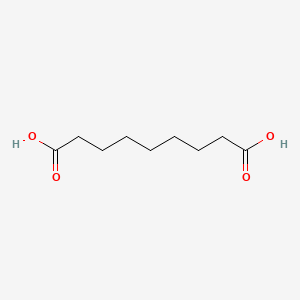
Azelaic Acid
Nonanedioic acid is an alpha,-dicarboxylic acid that is heptane substituted at positions 1 and 7 by carboxy groups. It has a role as an antibacterial agent, an antineoplastic agent, a dermatologic drug and a plant metabolite. It is a dicarboxylic fatty acid and an alpha,omega-dicarboxylic acid. It is a conjugate acid of an azelaate and an azelaate(2-). — ChEBI
- IUPAC name
- nonanedioic acid
- Molecular formula
- C9H16O4
- Molecular weight
- 188.22 g/mol
- Exact mass
- 188.10485899 Da
- XLogP3
- 1.6
- Topological polar surface area
- 74.6 Ų
- Hydrogen-bond donors
- 2
- Hydrogen-bond acceptors
- 4
- Covalent units
- 1
- Defined stereocentres
- 0
Also known as
16 more reported names
External database identifiers
- ChEBI:CHEBI:48131
- ChEMBL:CHEMBL1238
- EPA DTXSID:DTXSID8021640
- PubMed:22920095
- PubMed:22849351
- PubMed:22822212
- PubMed:22779176
- PubMed:22777226
- PubMed:22772611
- PubMed:22747347
- PubMed:22693913
- PubMed:22675394
- PubMed:22675387
- PubMed:22675033
- PubMed:22645576
Evidence from additional scientific databases
NIH PubChem PUG-View
Attributed physical-property, hazard, environmental and use annotations.
- Boiling Point: 286.5 °C at 1.00E+02 mm Hg Source: DrugBank
- Boiling Point: 357.1 °C; 287 °C at 100 mm Hg Source: Hazardous Substances Data Bank (HSDB)
- Boiling Point: BP: 365 °C (decomposes) Source: Hazardous Substances Data Bank (HSDB)
- Boiling Point: Distills above 360 °C with partial anhydride formation. BP: 286.5 °C at 100 mm Hg; 265 °C at 50 mm Hg; 237 °C at 15 mm Hg; 225 dg C at 10 mm Hg Source: Hazardous Substances Data Bank (HSDB)
- Color/Form: Monoclinic prismatic needles Source: Hazardous Substances Data Bank (HSDB)
- Color/Form: Yellowish to white crystalline powder Source: Hazardous Substances Data Bank (HSDB)
- Color/Form: Leaflets or needles Source: Hazardous Substances Data Bank (HSDB)
- Density: 1.225 g/cu cm at 25 °C Source: Hazardous Substances Data Bank (HSDB)
- pKa: 4.55 (at 25 °C) Source: DrugBank
- Dissociation Constants: pKa = 4.55 Source: Hazardous Substances Data Bank (HSDB)
- Flash Point: 210 °C (closed cup) Source: Hazardous Substances Data Bank (HSDB)
- LogP: 1.57 Source: DrugBank
- LogP: log Kow = 1.57 Source: Hazardous Substances Data Bank (HSDB)
- LogP: 1.57 Source: Human Metabolome Database (HMDB)
- Melting Point: 106.5 °C Source: DrugBank
- Melting Point: 160.5 °C Source: Hazardous Substances Data Bank (HSDB)
- Melting Point: 106.5 °C Source: Human Metabolome Database (HMDB)
- Physical Description: Dry Powder; Other Solid; Large Crystals Source: EPA Chemical Data Reporting (CDR)
- Physical Description: Yellowish to white solid; [HSDB] White flakes; [Acros Organics MSDS] Source: Haz-Map, Information on Hazardous Chemicals and Occupational Diseases
- Physical Description: Solid Source: Human Metabolome Database (HMDB)
- Refractive Index: Index of refraction = 1.4303 at 111 °C Source: Hazardous Substances Data Bank (HSDB)
- Solubility: 2400 mg/L (at 20 °C) Source: DrugBank
- Solubility: Slightly soluble in ethy ether, benzene, DMSO; soluble in ethanol Source: Hazardous Substances Data Bank (HSDB)
- Solubility: Soluble in hot water, alcohol and organic solvents Source: Hazardous Substances Data Bank (HSDB)
- Solubility: One liter of water dissolves 1.0 g at 1.0 °C; 2.4 g at 20 °C; 8.2 g at 50 °C; 22 g at 50 °C ... 1000 g ether dissolves 18.8 g at 11 °C and 26.8 g at 15 °C Source: Hazardous Substances Data Bank (HSDB)
- Solubility: In water, 2.40X10+3 mg/L at 20 °C Source: Hazardous Substances Data Bank (HSDB)
- Solubility: 2.4 mg/mL Source: Human Metabolome Database (HMDB)
- Vapor Pressure: 0.00000001 [mmHg] Source: Haz-Map, Information on Hazardous Chemicals and Occupational Diseases
- Vapor Pressure: 1.07X10⁻⁸ mm Hg at 25 °C Source: Hazardous Substances Data Bank (HSDB)
- Carcinogen Classification: No indication of carcinogenicity to humans (not listed by IARC). Source: Toxin and Toxin Target Database (T3DB)
- Exposure Routes: Approximately 4% of the topically applied azelaic acid is systemically absorbed. Source: Toxin and Toxin Target Database (T3DB)
- Note: This chemical does not meet GHS hazard criteria for 6.5% (71 of 1087) of reports. Source: European Chemicals Agency (ECHA)
- Signal: Warning Source: European Chemicals Agency (ECHA)
- GHS Hazard Statements: H315 (40.2%): Causes skin irritation [Warning Skin corrosion/irritation]; H319 (93.4%): Causes serious eye irritation [Warning Serious eye damage/eye irritation] Source: European Chemicals Agency (ECHA)
- Precautionary Statement Codes: P264, P264+P265, P280, P302+P352, P305+P351+P338, P321, P332+P317, P337+P317, and P362+P364 (click each P-code to see the statement) Source: European Chemicals Agency (ECHA)
- ECHA C&L Notifications Summary: Aggregated GHS information provided per 1087 reports by companies from 13 notifications to the ECHA C&L Inventory. Each notification may be associated with multiple companies.; Reported as not meeting GHS hazard criteria per 71 of 1087 reports by companies.; There are 11 notifications provided by 1016 of 1087 reports by companies with hazard statement code(s).; Information may vary between notifications depending on impurities, additives, and other factors. The percentage value in parenthesis indicates the notified classification ratio from companies that provide hazard codes. Only hazard codes with percentage values above 10% are shown. For more detailed information, please visit ECHA C&L website. Source: European Chemicals Agency (ECHA)
- Cosmetic Ingredient Review Finding(s): Safe in the present practices of use and concentration. Ingredient, concentration, and use information are available in documents discoverable at https://cir-reports.cir-safety.org Source: Cosmetic Ingredient Review (CIR)
- Toxicity Summary: The exact mechanism of action of azelaic acid is not known. It is thought that azelaic acid manifests its antibacterial effects by inhibiting the synthesis of cellular protein in anaerobic and aerobic bacteria, especially Staphylococcus epidermidis and Propionibacterium acnes. In aerobic bacteria, azelaic acid reversibly inhibits several oxidoreductive enzymes including tyrosinase, mitochondrial enzymes of the respiratory chain, thioredoxin reductase, 5-alpha-reductase, and DNA polymerases. In anaerobic bacteria, azelaic acid impedes glycolysis. Along with these actions, azelaic acid also improves acne vulgaris by normalizing the keratin process and decreasing microcomedo formation. Azelaic acid may be effective against both inflamed and noninflamed lesions. Specifically, azelaic acid reduces the thickness of the stratum corneum, shrinks keratohyalin granules by reducing the amount and distribution of filaggrin (a component of keratohyalin) in epidermal layers, and lowers the number of keratohyalin granules. Source: Toxin and Toxin Target Database (T3DB)
- Environmental Bioconcentration: An estimated BCF of 3 was calculated in fish for 1,7-heptanecarboxylic acid(SRC), using a log Kow of 1.57(1) and a regression-derived equation(2). According to a classification scheme(3), this BCF suggests the potential for bioconcentration in aquatic organisms is low(SRC). Source: Hazardous Substances Data Bank (HSDB)
- Environmental Fate: TERRESTRIAL FATE: Based on a classification scheme(1), an estimated Koc value of 170(SRC), determined from a log Kow of 1.57(2) and a regression-derived equation(3), indicates that 1,7-heptanecarboxylic acid is expected to have moderate mobility in soil(SRC). The pKa of 1,7-heptanecarboxylic acid is 4.55(4), indicating that this compound will exist almost entirely in the anion form in the environment and anions generally do not adsorb more strongly to soils containing organic carbon and clay than their neutral counterparts(5). Volatilization from moist soil is not expected because the acid exists as an anion and anions do not volatilize. 1,7-Heptanecarboxylic acid is not expected to volatilize from dry soil surfaces(SRC) based upon a vapor pressure of 1.07X10⁻⁸ mm Hg(6). Biodegradation data were not available(SRC, 2008) but straight chain carboxylic acids are expected to readily biodergade(7). Source: Hazardous Substances Data Bank (HSDB)
- Environmental Fate: AQUATIC FATE: Based on a classification scheme(1), an estimated Koc value of 170(SRC), determined from a log Kow of 1.57(2) and a regression-derived equation(3), indicates that 1,7-heptanecarboxylic acid is expected to adsorb to suspended solids and sediment(SRC). A pKa of 4.55(4) indicates 1,7-heptanecarboxylic acid will exist almost entirely in the anion form at pH values of 5 to 9 and therefore volatilization from water surfaces is not expected to be an important fate process(5). According to a classification scheme(6), an estimated BCF of 3(SRC), from its log Kow(2) and a regression-derived equation(7), suggests the potential for bioconcentration in aquatic organisms is low(SRC). Biodegradation data were not available(SRC, 2008) but straight chain carboxylic acids are expected to readily biodergade(8). Source: Hazardous Substances Data Bank (HSDB)
- Environmental Fate: ATMOSPHERIC FATE: According to a model of gas/particle partitioning of semivolatile organic compounds in the atmosphere(1), 1,7-heptanecarboxylic acid, which has a vapor pressure of 1.07X10⁻⁸ mm Hg at 25 °C(2), will exist in both the vapor and particulate phases in the ambient atmosphere. Vapor-phase 1,7-heptanecarboxylic acid is degraded in the atmosphere by reaction with photochemically-produced hydroxyl radicals(SRC); the half-life for this reaction in air is estimated to be 40 hrs(SRC), calculated from its rate constant of 9.8X10⁻¹² cu cm/molecule-sec at 25 °C(SRC) that was derived using a structure estimation method(3). Particulate-phase 1,7-heptanecarboxylic acid may be removed from the air by wet or dry deposition(SRC). 1,7-Heptanecarboxylic acid does not contain chromophores that absorb at wavelengths >290 nm(4) and therefore is not expected to be susceptible to direct photolysis by sunlight(SRC). Source: Hazardous Substances Data Bank (HSDB)
- Consumer Uses: Not Known or Reasonably Ascertainable Source: EPA Chemical Data Reporting (CDR)
- Industry Uses: Monomers; Lubricating agent; Wetting agent (non-aqueous); Binder; Intermediate; Not Known or Reasonably Ascertainable; Corrosion inhibitor; Plasticizer Source: EPA Chemical Data Reporting (CDR)
- Cosmetic Ingredient Review Link: CIR ingredient: Azelaic Acid Source: Cosmetic Ingredient Review (CIR)
- Sources/Uses: Found in rancid oleic acid; [Merck Index] Used in organic syntheses, lacquers, alkyd resins, low-temperature plasticizers, adhesives, polyamides, urethane elastomers, and for the treatment of acne; [HSDB] Natural component of foods such as whole grain cereals and animal products; [REPROTOX] Source: Haz-Map, Information on Hazardous Chemicals and Occupational Diseases
- Industrial Processes with risk of exposure: Painting (Pigments, Binders, and Biocides) [Category: Paint]; Working with Glues and Adhesives [Category: Other]; Plastic Composites Manufacturing [Category: Industry] Source: Haz-Map, Information on Hazardous Chemicals and Occupational Diseases
- Uses: Azelaic acid is used in lacquers, alkyd resins, plasticizers, adhesives, polyamides, urethane elastomers, and organic syntheses. Azelaic acid is also used in treating of acne. Source: Hazardous Substances Data Bank (HSDB)
- Uses: Organic synthesis, lacquers, product of hydrotropic salts, alkyd resins, polyamides, polyester adhesives, low-temperature plasticizers, urethane elastomers Source: Hazardous Substances Data Bank (HSDB)
- Uses: Use (kg; approx.) in Germany (2009): >1000; Consumption (g per capita; approx.) in Germany (2009): 0.0122; Calculated removal (%): 92.2 Source: NORMAN Suspect List Exchange
- Uses: For the topical treatment of mild-to-moderate inflammatory acne vulgaris. Source: Toxin and Toxin Target Database (T3DB)
Mapped by: Existing checksum-valid CAS to unique PubChem CID match. Retrieved: 2026-08-31. Open source record
Scientific classifications and hazard annotations provide context and do not replace the market-specific regulatory decision shown above.
Additional source coverage and match status
| Source | Result | Checked |
|---|---|---|
| NIH PubChem PUG-View | Exact match | 2026-08-31 |
A recorded no-match is useful evidence that the source was checked; it is not a claim that the substance does not exist elsewhere.
Retrieved from NIH PubChem on 2026-08-31 by checksum-valid CAS matching. Chemical properties do not replace the regulatory decision on this page.