
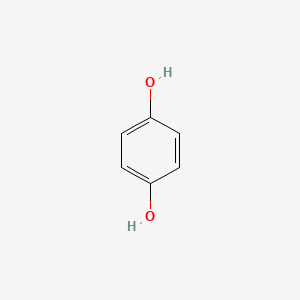
Hydroquinone
Hydroquinone is a benzenediol comprising benzene core carrying two hydroxy substituents para to each other. It has a role as an antioxidant, a cofactor, a carcinogenic agent, a mouse metabolite, a human xenobiotic metabolite, an Escherichia coli metabolite and a skin lightening agent. It is a benzenediol and a member of hydroquinones. — ChEBI
- IUPAC name
- benzene-1,4-diol
- Molecular formula
- C6H6O2
- Molecular weight
- 110.11 g/mol
- Exact mass
- 110.036779430 Da
- XLogP3
- 0.6
- Topological polar surface area
- 40.5 Ų
- Hydrogen-bond donors
- 2
- Hydrogen-bond acceptors
- 2
- Covalent units
- 1
- Defined stereocentres
- 0
Also known as
16 more reported names
External database identifiers
Evidence from additional scientific databases
NIH PubChem PUG-View
Attributed physical-property, hazard, environmental and use annotations.
- Autoignition Temperature: 960 °F (USCG, 1999) Source: CAMEO Chemicals
- Autoignition Temperature: 960 °F (516 °C) Source: Hazardous Substances Data Bank (HSDB)
- Autoignition Temperature: 515 °C Source: ILO-WHO International Chemical Safety Cards (ICSCs)
- Boiling Point: 545 to 549 °F at 760 mmHg (EPA, 1998) Source: CAMEO Chemicals
- Boiling Point: 285-287 Source: DrugBank
- Boiling Point: 285-287 °C Source: Hazardous Substances Data Bank (HSDB)
- Boiling Point: 286.00 to 288.00 °C. @ 760.00 mm Hg Source: Human Metabolome Database (HMDB)
- Boiling Point: 287 °C Source: ILO-WHO International Chemical Safety Cards (ICSCs)
- Boiling Point: 545 °F Source: Occupational Safety and Health Administration (OSHA)
- Boiling Point: 285 °C @760 [mm Hg] Source: PAC Chemical Database, U.S. Department of Energy
- Boiling Point: 545 °F Source: The National Institute for Occupational Safety and Health (NIOSH)
- Color/Form: White crystals Source: Hazardous Substances Data Bank (HSDB)
- Color/Form: Monoclinic prisms (sublimation); needles from water; prisms from methanol Source: Hazardous Substances Data Bank (HSDB)
- Color/Form: Light-tan, light-gray, or colorless crystals Source: Hazardous Substances Data Bank (HSDB)
- Density: 1.332 at 59 °F (EPA, 1998) - Denser than water; will sink Source: CAMEO Chemicals
- Density: 1.330 g/cu cm at 20 °C Source: Hazardous Substances Data Bank (HSDB)
- Density: Density of "saturated" air = 1.011 (150 °C) (air = 1) ... Crystals remain relatively stable in air if dry ... Reacts with molecular oxygen undergoing autooxidation in aqueous media Source: Hazardous Substances Data Bank (HSDB)
- Density: Relative density (water = 1): 1.3 Source: ILO-WHO International Chemical Safety Cards (ICSCs)
- Density: 1.332 at 59 °F Source: Occupational Safety and Health Administration (OSHA)
- Density: 1.358 @ 20°C Source: PAC Chemical Database, U.S. Department of Energy
- Density: 1.33 Source: The National Institute for Occupational Safety and Health (NIOSH)
- Dissociation Constants: pKa = 10.85 at 25 °C Source: Hazardous Substances Data Bank (HSDB)
- Dissociation Constants: pKa = 9.96 Source: Hazardous Substances Data Bank (HSDB)
- Flash Point: 329 °F (EPA, 1998) Source: CAMEO Chemicals
- Flash Point: 329 °F Source: Haz-Map, Information on Hazardous Chemicals and Occupational Diseases
- Flash Point: 329 °F (CLOSED CUP) Source: Hazardous Substances Data Bank (HSDB)
- Flash Point: 165 °C (329 °F) (Closed cup) Source: Hazardous Substances Data Bank (HSDB)
- Flash Point: 329 °F (165 °C) (Closed cup) Source: Hazardous Substances Data Bank (HSDB)
- Flash Point: 165 °C Source: ILO-WHO International Chemical Safety Cards (ICSCs)
- Flash Point: 329 °F Source: Occupational Safety and Health Administration (OSHA)
- Flash Point: 329 °F (Molten) Source: The National Institute for Occupational Safety and Health (NIOSH)
- LogP: 0.59 Source: DrugBank
- LogP: log Kow = 0.59 Source: Hazardous Substances Data Bank (HSDB)
- LogP: 0.59 Source: Human Metabolome Database (HMDB)
- LogP: 0.59 Source: ILO-WHO International Chemical Safety Cards (ICSCs)
- Melting Point: 338 to 340 °F (EPA, 1998) Source: CAMEO Chemicals
- Melting Point: 170-171 Source: DrugBank
- Melting Point: 170-171 °C Source: Hazardous Substances Data Bank (HSDB)
- Melting Point: MP: 173 °C; BP 288 °C Source: Hazardous Substances Data Bank (HSDB)
- Melting Point: Heat of fusion at melting point = 2.71X10+7 J/kmol Source: Hazardous Substances Data Bank (HSDB)
- Melting Point: 172.3 °C Source: Human Metabolome Database (HMDB)
- Melting Point: 172 °C Source: ILO-WHO International Chemical Safety Cards (ICSCs)
- Melting Point: 338 °F Source: Occupational Safety and Health Administration (OSHA)
- Melting Point: 172 °C Source: PAC Chemical Database, U.S. Department of Energy
- Melting Point: 338 °F Source: The National Institute for Occupational Safety and Health (NIOSH)
- Odor: Odorless Source: Hazardous Substances Data Bank (HSDB)
- Physical Description: Hydroquinone appears as light colored crystals or solutions. May irritate the skin, eyes and mucous membranes. Mildly toxic by ingestion or skin absorption. Source: CAMEO Chemicals
- Physical Description: Large Crystals; Other Solid; Dry Powder; Liquid Source: EPA Chemical Data Reporting (CDR)
- Physical Description: Light-tan, light-gray, or colorless crystals; [NIOSH] Source: Haz-Map, Information on Hazardous Chemicals and Occupational Diseases
- Physical Description: Solid Source: Human Metabolome Database (HMDB)
- Physical Description: COLOURLESS CRYSTALS. Source: ILO-WHO International Chemical Safety Cards (ICSCs)
- Physical Description: Light-tan, light-gray, or colorless crystals. Source: Occupational Safety and Health Administration (OSHA)
- Physical Description: Light-tan, light-gray, or colorless crystals. Source: The National Institute for Occupational Safety and Health (NIOSH)
- Refractive Index: Index of refraction = 1.632 at 25 °C Source: Hazardous Substances Data Bank (HSDB)
- Solubility: 10 to 50 mg/mL at 68 °F (NTP, 1992) Source: CAMEO Chemicals
- Solubility: 6.72g/L at 20 deg C Source: DrugBank
- Solubility: In water, 72,000 mg/L at 25 °C Source: Hazardous Substances Data Bank (HSDB)
- Solubility: In water, 6.72 g/L at 20 °C. Also water solubility = 3.85 g/L at 0 °C; 5.12 g/L at 10 °C; 5.40 g/L at 15 °C; 8.76 g/L at 30 °C; 11.5 g/L at 40 °C; 25/9 g/L at 60 °C; 46.8 g/L at 80 °C; 66.4 g/L at 100 °C Source: Hazardous Substances Data Bank (HSDB)
- Solubility: 7% soluble in water at 25 °C Source: Hazardous Substances Data Bank (HSDB)
- Solubility: Grams of hydroquinone per 100 g solvent (30 °C); ethanol 46.4; acetone 28.4; water 8.3; benzene 0.06; tetrachloromethane 0.01 Source: Hazardous Substances Data Bank (HSDB)
- Solubility: For more Solubility (Complete) data for HYDROQUINONE (6 total), please visit the HSDB record page. Source: Hazardous Substances Data Bank (HSDB)
- Solubility: 72.0 mg/mL at 25 °C Source: Human Metabolome Database (HMDB)
- Solubility: Solubility in water, g/100ml at 15 °C: 5.9 Source: ILO-WHO International Chemical Safety Cards (ICSCs)
- Solubility: 7% Source: The National Institute for Occupational Safety and Health (NIOSH)
- Vapor Pressure: 4 mmHg at 302 °F (EPA, 1998) Source: CAMEO Chemicals
- Vapor Pressure: 0.000019 [mmHg] Source: Haz-Map, Information on Hazardous Chemicals and Occupational Diseases
- Vapor Pressure: 1.9X10⁻⁵ mm Hg at 25 °C Source: Hazardous Substances Data Bank (HSDB)
- Vapor Pressure: Vapor pressure, Pa at 20 °C: 0.12 Source: ILO-WHO International Chemical Safety Cards (ICSCs)
- Vapor Pressure: 4 mmHg at 302 °F Source: Occupational Safety and Health Administration (OSHA)
- Vapor Pressure: 0.00001 mmHg Source: The National Institute for Occupational Safety and Health (NIOSH)
- IARC Carcinogenic Agent: Hydroquinone Source: International Agency for Research on Cancer (IARC)
- IARC Carcinogenic Classes: Group 3: Not classifiable as to its carcinogenicity to humans Source: International Agency for Research on Cancer (IARC)
- IARC Monographs: Volume 15: (1977) Some Fumigants, the Herbicides 2,4-D and 2,4,5-T, Chlorinated Dibenzodioxins and Miscellaneous Industrial Chemicals; Volume Sup 7: Overall Evaluations of Carcinogenicity: An Updating of IARC Monographs Volumes 1 to 42, 1987; 440 pages; ISBN 92-832-1411-0 (out of print); Volume 71: (1999) Re-evaluation of Some Organic Chemicals, Hydrazine and Hydrogen Peroxide (Part 1, Part 2, Part 3) Source: International Agency for Research on Cancer (IARC)
- Publication Year: 1999 Source: International Agency for Research on Cancer (IARC)
- Evaluation Year: 1998 Source: International Agency for Research on Cancer (IARC)
- Substance: Hydroquinone Source: NTP Technical Reports
- NTP Technical Report: TR-366: Toxicology and Carcinogenesis Studies of Hydroquinone (CASRN 123-31-9) in F344/N Rats and B6C3F1 Mice (Gavage Studies) (1989 ) Source: NTP Technical Reports
- Peer Review Date: 10/03/88 Source: NTP Technical Reports
- Conclusion for Male Rat: Some Evidence Source: NTP Technical Reports
- Conclusion for Female Rat: Some Evidence Source: NTP Technical Reports
- Conclusion for Male Mice: No Evidence Source: NTP Technical Reports
- Conclusion for Female Mice: Some Evidence Source: NTP Technical Reports
- Exposure Routes: The substance can be absorbed into the body by inhalation, through the skin and by ingestion. Source: ILO-WHO International Chemical Safety Cards (ICSCs)
- Exposure Routes: inhalation, ingestion, skin and/or eye contact Source: The National Institute for Occupational Safety and Health (NIOSH)
- First Aid: Signs and Symptoms of Acute Hydroquinone Exposure: Signs and symptoms of acute exposure to hydroquinone may be severe and include dyspnea (shortness of breath), a sense of suffocation, increased respiratory rate, and respiratory failure. Pallor (paleness of the skin), cyanosis (blue tint to skin and mucous membranes), and cardiovascular collapse may occur. Neurologic effects include headache, tinnitus (ringing in the ears), dizziness, delirium, muscle twitching, tremor, and convulsions. Nausea, vomiting, and the production of green to brown-green urine may also occur. Hydroquinone may be irritating and corrosive to the skin, eyes, and mucous membranes. Jaundice (yellow tint to skin) may be noticed.; Emergency Life-Support Procedures: Acute exposure to hydroquinone may require decontamination and life support for the victims. Emergency personnel should wear protective clothing appropriate to the type and degree of contamination. Air-purifying or supplied-air respiratory equipment should also be worn, as necessary. Rescue vehicles should carry supplies such as plastic sheeting and disposable plastic bags to assist in preventing spread of contamination.; Inhalation Exposure:; 1. Move Source: CAMEO Chemicals
- First Aid: (General first aid procedures); Eye: Irrigate immediately - If this chemical contacts the eyes, immediately wash (irrigate) the eyes with large amounts of water, occasionally lifting the lower and upper lids. Get medical attention immediately.; Skin: Water flush - If this chemical contacts the skin, flush the contaminated skin with water. Where there is evidence of skin irritation, get medical attention.; Breathing: Respiratory support; Swallow: Medical attention immediately - If this chemical has been swallowed, get medical attention immediately. Source: The National Institute for Occupational Safety and Health (NIOSH)
- Signal: Danger Source: Regulation (EC) No 1272/2008 of the European Parliament and of the Council
- GHS Hazard Statements: H302: Harmful if swallowed [Warning Acute toxicity, oral]; H317: May cause an allergic skin reaction [Warning Sensitization, Skin]; H318: Causes serious eye damage [Danger Serious eye damage/eye irritation]; H341: Suspected of causing genetic defects [Warning Germ cell mutagenicity]; H351: Suspected of causing cancer [Warning Carcinogenicity]; H400: Very toxic to aquatic life [Warning Hazardous to the aquatic environment, acute hazard] Source: Regulation (EC) No 1272/2008 of the European Parliament and of the Council
- Precautionary Statement Codes: P203, P261, P264, P264+P265, P270, P272, P273, P280, P301+P317, P302+P352, P305+P354+P338, P317, P318, P321, P330, P333+P317, P362+P364, P391, P405, and P501 (click each P-code to see the statement) Source: Regulation (EC) No 1272/2008 of the European Parliament and of the Council
- Note: This chemical does not meet GHS hazard criteria for < 0.1% (1 of 2485) of reports. Source: European Chemicals Agency (ECHA)
- Signal: Danger Source: European Chemicals Agency (ECHA)
- GHS Hazard Statements: H302+H312 (17.7%): Harmful if swallowed or in contact with skin [Warning Acute toxicity, oral; acute toxicity, dermal]; H302 (99.7%): Harmful if swallowed [Warning Acute toxicity, oral]; H312 (17.7%): Harmful in contact with skin [Warning Acute toxicity, dermal]; H317 (> 99.9%): May cause an allergic skin reaction [Warning Sensitization, Skin]; H318 (99.9%): Causes serious eye damage [Danger Serious eye damage/eye irritation]; H341 (99.9%): Suspected of causing genetic defects [Warning Germ cell mutagenicity]; H351 (> 99.9%): Suspected of causing cancer [Warning Carcinogenicity]; H400 (> 99.9%): Very toxic to aquatic life [Warning Hazardous to the aquatic environment, acute hazard]; H410 (21.2%): Very toxic to aquatic life with long lasting effects [Warning Hazardous to the aquatic environment, long-term hazard] Source: European Chemicals Agency (ECHA)
- Precautionary Statement Codes: P203, P261, P264, P264+P265, P270, P272, P273, P280, P301+P317, P302+P352, P305+P354+P338, P317, P318, P321, P330, P333+P317, P362+P364, P391, P405, and P501 (click each P-code to see the statement) Source: European Chemicals Agency (ECHA)
- ECHA C&L Notifications Summary: Aggregated GHS information provided per 2485 reports by companies from 36 notifications to the ECHA C&L Inventory. Each notification may be associated with multiple companies.; Reported as not meeting GHS hazard criteria per 1 of 2485 reports by companies.; There are 35 notifications provided by 2484 of 2485 reports by companies with hazard statement code(s).; Information may vary between notifications depending on impurities, additives, and other factors. The percentage value in parenthesis indicates the notified classification ratio from companies that provide hazard codes. Only hazard codes with percentage values above 10% are shown. For more detailed information, please visit ECHA C&L website. Source: European Chemicals Agency (ECHA)
- Signal: Danger Source: NITE-CMC
- GHS Hazard Statements: H302: Harmful if swallowed [Warning Acute toxicity, oral]; H317: May cause an allergic skin reaction [Warning Sensitization, Skin]; H318: Causes serious eye damage [Danger Serious eye damage/eye irritation]; H340: May cause genetic defects [Danger Germ cell mutagenicity]; H351: Suspected of causing cancer [Warning Carcinogenicity]; H370: Causes damage to organs [Danger Specific target organ toxicity, single exposure]; H373: May causes damage to organs through prolonged or repeated exposure [Warning Specific target organ toxicity, repeated exposure]; H400: Very toxic to aquatic life [Warning Hazardous to the aquatic environment, acute hazard]; H410: Very toxic to aquatic life with long lasting effects [Warning Hazardous to the aquatic environment, long-term hazard] Source: NITE-CMC
- Precautionary Statement Codes: P203, P260, P261, P264, P264+P265, P270, P272, P273, P280, P301+P317, P302+P352, P305+P354+P338, P308+P316, P317, P318, P319, P321, P330, P333+P317, P362+P364, P391, P405, and P501 (click each P-code to see the statement) Source: NITE-CMC
- GHS Hazard Statements: H316: Causes mild skin irritation [Warning Skin corrosion/irritation]; H318: Causes serious eye damage [Danger Serious eye damage/eye irritation]; H336: May cause drowsiness or dizziness [Warning Specific target organ toxicity, single exposure; Narcotic effects]; H341: Suspected of causing genetic defects [Warning Germ cell mutagenicity]; H373: May causes damage to organs through prolonged or repeated exposure [Warning Specific target organ toxicity, repeated exposure] Source: NITE-CMC
- NFPA Health Rating: 2 - Materials that, under emergency conditions, can cause temporary incapacitation or residual injury. Source: Hazardous Substances Data Bank (HSDB)
- NFPA Fire Rating: 1 - Materials that must be preheated before ignition can occur. Materials require considerable preheating, under all ambient temperature conditions, before ignition and combustion can occur. Source: Hazardous Substances Data Bank (HSDB)
- NFPA Instability Rating: 0 - Materials that in themselves are normally stable, even under fire conditions. Source: Hazardous Substances Data Bank (HSDB)
- Target Organs: Eyes, skin, respiratory system, central nervous system Source: The National Institute for Occupational Safety and Health (NIOSH)
- Cosmetic Ingredient Review Conclusion: The CIR Expert Panel concluded that hydroquinone is safe at concentrations of less than or equal to 1% for cosmetic formulations designed for discontinuous, brief use followed by rinsing from the skin and hair. Hydroquinone is safe for use in nail adhesives and in artificial nail coatings, as a polymerization inhibitor, that are cured by LED light. Hydroquinone is unsafe for use in other leave-on cosmetic products. Source: Cosmetic Ingredient Review (CIR)
- Cosmetic Ingredient Review Finding(s): The ingredient is unsafe for use in cosmetics Source: Cosmetic Ingredient Review (CIR)
- Toxicity Summary: IDENTIFICATION AND USE: Hydroquinone (HQ) is an aromatic compound in the form of light tan to gray crystals. It is a high-volume commodity chemical used as a reducing agent, antioxidant, polymerization inhibitor, chemical stabilizer, chemical intermediate, and photographic reducer and developer. It is also used in skin lighteners, in cosmetics, hair dye, glue, and a medication to treat dyschromias. HUMAN EXPOSURE: A great deal of research has been conducted with HQ because it is a metabolite of benzene. In workers engaged in the manufacture, HQ dust oxidizes to brown benzoquinone. This material causes pigmentation of the eye and, in some cases, permanent corneal damage. There are reported cases of keratitis and discoloration of the conjunctiva among men exposed to concentrations ranging from 10 to 30 mg of vapor or dust of HQ per cubic meter of air. Ingestion of 1 g by an adult has caused dizziness, sense of suffocation, increased rate of respiration, vomiting, pallor, muscular twitching, headache, dyspnea, cyanosis and collapse and eventually death due to respiratory failure. Upon ingestion urine is green or brownish-green in color and continues to darken on standing. Five hundred Source: Hazardous Substances Data Bank (HSDB)
- Toxicity Summary: No significant toxicity has been found with the topical use of the hydroquinone cream.; Some studies report malignancies in animals treated for an extended period with large oral doses.; Hydroquinone in the Environment; In the environment, hydroquinone is a chemical and can be toxic in human and industrial activities by promoting the generation of reactive oxygen species, oxidative stress, and hence the potential for DNA damage. It is a major benzene metabolite and is known to be hepatotoxic and carcinogenic in these settings. Some studies suggest it can promote tumor cell growth and suppress the immune response. It is used in photography and is present in dyes, paints, varnishes oils, and motor fuels. In its oxidized form, it is more toxic and less degradable. It demonstrates high toxicity to aquatic organisms and rodents and may induce leukemia, renal tubular cell tumors, and liver cancer. It has also been found to influence immune cell responses and cause an increase in an allergic reaction by increasing interleukin-4 production and immunoglobulin E levels. Source: StatPearls
- Environmental Bioconcentration: An estimated BCF of 3 was calculated in fish for hydroquinone(SRC), using a log Kow of 0.59(1) and a regression-derived equation(2). According to a classification scheme(3), this BCF suggests the potential for bioconcentration in aquatic organisms is low(SRC). A bioaccumulation factor of 40 was measured using Golden ide fish (Leuciscus idus melanotus) exposed for 3 days to 0.05 mg/L hydroquinone(4,5). Experimental 24-hour bioaccumulation factors in alga were 40 and 65 for hydroquinone(4-6). Source: Hazardous Substances Data Bank (HSDB)
- Environmental Fate: TERRESTRIAL FATE: Based on a classification scheme(1), an estimated Koc value of 240(SRC), determined from a strucure estimation method(2), indicates that hydroquinone is expected to have moderate mobility in soil(SRC). Volatilization of hydroquinone from moist soil surfaces is not expected to be an important fate process(SRC) given an estimated Henry's Law constant of 4.7X10⁻¹¹ atm-cu m/mole(SRC), derived from its vapor pressure, 2.4X10⁻⁵ mm Hg(3), and water solubility, 7.2X10+4 mg/L(4). Hydroquinone is not expected to volatilize from dry soil surfaces(SRC) based upon its vapor pressure(3). The compound may be removed from soil by oxidation processes(5,6) or by direct photolysis on the surface(7,8). In a survey of standardized tests, hydroquinone was found to biodegrade in the coupled units test, the Zahn-Wellens test, the MITI test, the Sturm test, the AFNOR test, the OECD screening test and the closed bottle test, although its biodegradation is likely to be strongly concentration-dependent. It may be inhibitory at high concentration(9,10). Source: Hazardous Substances Data Bank (HSDB)
- Environmental Fate: AQUATIC FATE: Based on a classification scheme(1), an estimated Koc value of 240(SRC), determined from a structure estimation method(2), indicates that hydroquinone is expected to adsorb to suspended solids and sediment(SRC). Volatilization from water surfaces is not expected(3) based upon an estimated Henry's Law constant of 4.7X10⁻¹¹ atm-cu m/mole(SRC), derived from its vapor pressure, 2.4X10⁻⁵ mm Hg(4), and water solubility, 7.2X10+4 mg/L(5). According to a classification scheme(6), an estimated BCF of 3(SRC), from its log Kow(7) and a regression-derived equation(2), suggests the potential for bioconcentration in aquatic organisms is low(SRC). In a survey of standardized tests, hydroquinone was found to biodegrade in the coupled units test, the Zahn-Wellens test, the MITI test, the Sturm test, the AFNOR test, the OECD screening test and the closed bottle test, although its biodegradation is likely to be strongly concentration-dependent. It may be inhibitory at high concentration(8,9). Source: Hazardous Substances Data Bank (HSDB)
- Environmental Fate: ATMOSPHERIC FATE: According to a model of gas/particle partitioning of semivolatile organic compounds in the atmosphere(1), hydroquinone, which has a vapor pressure of 2.4X10⁻⁵ mm Hg at 25 °C(2), will exist in both the vapor and particulate phases in the ambient atmosphere. Vapor-phase hydroquinone is degraded in the atmosphere by reaction with photochemically-produced hydroxyl radicals(SRC); the half-life for this reaction in air is estimated to be 17 hrs(SRC), calculated from its rate constant of 2.3X10⁻¹¹ cu cm/molecule-sec at 25 °C(SRC) that was derived using a structure estimation method(3). Particulate-phase hydroquinone may be removed from the air by wet and dry deposition(SRC). The water solubility of hydroquinone, 72,000 mg/L at 25 °C(4), indicates that it may undergo atmospheric removal by wet deposition processes(SRC). It may also be removed from the atmosphere by a gas-phase reaction with nitrate radicals, an important nighttime oxidant(3). Hydroquinone contains chromophores that absorb at wavelengths >290 nm(5) and, therefore, may be susceptible to direct photolysis by sunlight(SRC). Source: Hazardous Substances Data Bank (HSDB)
- Consumer Uses: Not Known or Reasonably Ascertainable; Photosensitive agent Source: EPA Chemical Data Reporting (CDR)
- Industry Uses: Polymerization promoter; Solvent; Antioxidant; Not Known or Reasonably Ascertainable; Corrosion inhibitor; Intermediate; Photosensitive agent Source: EPA Chemical Data Reporting (CDR)
- Cosmetic Ingredient Review Link: CIR ingredient: Hydroquinone Source: Cosmetic Ingredient Review (CIR)
- Uses: Hydroquinone is used as a developing agent in black-and-white photography, lithography, and x-ray films. It is also used as an intermediate to produce antioxidants for rubber and food. It is added to a number of industrial monomers to inhibit polymerization during shipping, storage, and processing. Source: EPA Hazardous Air Pollutants
- Sources/Uses: Used as a developer (photographic & lithographic), stabilizer in paints and oils, polymerization inhibitor, and chemical intermediate. [ACGIH] Used as a photo developer, oil and fat antioxidant, chemical intermediate, topical medication, and inhibitor of vinyl acetate and acrylic polymerization; [HSDB] Source: Haz-Map, Information on Hazardous Chemicals and Occupational Diseases
- Industrial Processes with risk of exposure: Plastic Composites Manufacturing [Category: Industry]; Photographic Processing [Category: Other] Source: Haz-Map, Information on Hazardous Chemicals and Occupational Diseases
- Uses: The largest demand for hydroquinone is as a photographic developer, principally for black-and-white film, lithography, photochemical machining, microfilm, and X-ray film. ... The second largest consumer of hydroquinone is the rubber industry, which requires hydroquinone for the production of antioxidants and antiozonants. Source: Hazardous Substances Data Bank (HSDB)
- Uses: ... Used extensively in the vinyl monomer industry to inhibit free-radical polymerization during both processing and storage ... Used as stabilizers for unsaturated polyester resins. Source: Hazardous Substances Data Bank (HSDB)
- Uses: Hydroquinone is an aromatic compound that functions in cosmetics as an antioxidant, fragrance, reducing agent, or polymerization inhibitor... Source: Hazardous Substances Data Bank (HSDB)
- Uses: Hydroquinone (U.S.P. grade) ... /is/ used in topical formulations as /a/ skin bleaching and depigmenting agent. Source: Hazardous Substances Data Bank (HSDB)
- Uses: For more Uses (Complete) data for HYDROQUINONE (12 total), please visit the HSDB record page. Source: Hazardous Substances Data Bank (HSDB)
- Uses: Hydroquinone has a variety of uses principally associated with its action as a reducing agent which is soluble in water. It is a major component in most photographic developers where, with the compound Metol, it reduces silver halides to elemental silver. In human medicine, hydroquinone is used as a topical application in skin whitening to reduce the color of skin. Source: Toxin and Toxin Target Database (T3DB)
Mapped by: Existing checksum-valid CAS to unique PubChem CID match. Retrieved: 2026-08-31. Open source record
Scientific classifications and hazard annotations provide context and do not replace the market-specific regulatory decision shown above.
Additional source coverage and match status
| Source | Result | Checked |
|---|---|---|
| NIH PubChem PUG-View | Exact match | 2026-08-31 |
A recorded no-match is useful evidence that the source was checked; it is not a claim that the substance does not exist elsewhere.
Retrieved from NIH PubChem on 2026-08-31 by checksum-valid CAS matching. Chemical properties do not replace the regulatory decision on this page.