
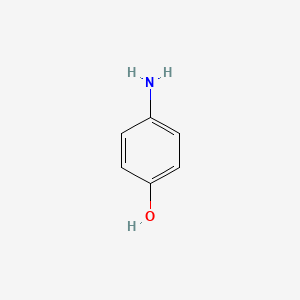
4-Aminophenol
4-aminophenol is an amino phenol (one of the three possible isomers) which has the single amino substituent located para to the phenolic -OH group. It has a role as a metabolite and an allergen. — ChEBI
- IUPAC name
- 4-aminophenol
- Molecular formula
- C6H7NO
- Molecular weight
- 109.13 g/mol
- Exact mass
- 109.052763847 Da
- XLogP3
- 0.0
- Topological polar surface area
- 46.3 Ų
- Hydrogen-bond donors
- 2
- Hydrogen-bond acceptors
- 2
- Covalent units
- 1
- Defined stereocentres
- 0
Also known as
16 more reported names
External database identifiers
- ChEBI:CHEBI:17602
- ChEMBL:CHEMBL1142
- EPA DTXSID:DTXSID3024499
- PubMed:29968805
- PubMed:23121940
- PubMed:23058976
- PubMed:23035435
- PubMed:22954810
- PubMed:22908626
- PubMed:22890133
- PubMed:22849064
- PubMed:22817955
- PubMed:22771566
- PubMed:22743607
- PubMed:22741218
Evidence from additional scientific databases
NIH PubChem PUG-View
Attributed physical-property, hazard, environmental and use annotations.
- Boiling Point: 543 °F at 760 mmHg (Decomposes) (NTP, 1992) Source: CAMEO Chemicals
- Boiling Point: 284 °C at 760 mm Hg, decomposes; 167 °C at 8.0 mm Hg; 150 °C at 3.0 mm Hg; 130.2 °C at 0.3 mm Hg Source: Hazardous Substances Data Bank (HSDB)
- Boiling Point: BP: Can be sublimed at 0.3 mm Hg and 110 °C without decomposition ... forms salts with acids and bases ... Deteriorates under the influence of air and light ... Commercial product usually pink ... MP of commercial product 186 °C Source: Hazardous Substances Data Bank (HSDB)
- Boiling Point: 187.5 °C Source: Human Metabolome Database (HMDB)
- Color/Form: Orthorhombic plates from water Source: Hazardous Substances Data Bank (HSDB)
- Color/Form: White plates from water Source: Hazardous Substances Data Bank (HSDB)
- Color/Form: Colorless crystals Source: Hazardous Substances Data Bank (HSDB)
- Color/Form: White or reddish yellow crystals turn violet on exposure to light Source: Hazardous Substances Data Bank (HSDB)
- Density: 4-Aminophenol crystals exist in two forms. The alpha form (from alcohol, water, or ethyl acetate) is the more stable and has an orthorhombic pyramidal structure, density 1.290 g/cu cm /alpha-4-Aminophenol/ Source: Hazardous Substances Data Bank (HSDB)
- Dissociation Constants: pK1 = 5.48 at 25 °C (conjugate acid) Source: Hazardous Substances Data Bank (HSDB)
- Dissociation Constants: pK2 = 10.46 Source: Hazardous Substances Data Bank (HSDB)
- Flash Point: 195 °C (383 °F) - closed cup Source: Hazardous Substances Data Bank (HSDB)
- LogP: log Kow = 0.04 at pH 7.4 Source: Hazardous Substances Data Bank (HSDB)
- LogP: 0.04 Source: Human Metabolome Database (HMDB)
- Melting Point: 367 to 369 °F (NTP, 1992) Source: CAMEO Chemicals
- Melting Point: 367-369 °F Source: Haz-Map, Information on Hazardous Chemicals and Occupational Diseases
- Melting Point: 187.5 °C Source: Hazardous Substances Data Bank (HSDB)
- Melting Point: 187.50 °C. @ 760.00 mm Hg Source: Human Metabolome Database (HMDB)
- Physical Description: P-aminophenol appears as white or reddish-yellow crystals or light brown powder. Turns violet when exposed to light. (NTP, 1992) Source: CAMEO Chemicals
- Physical Description: Dry Powder Source: EPA Chemical Data Reporting (CDR)
- Physical Description: White or reddish-yellow crystals or light-brown powder that turns violet when exposed to light; [CAMEO] Source: Haz-Map, Information on Hazardous Chemicals and Occupational Diseases
- Physical Description: Solid Source: Human Metabolome Database (HMDB)
- Solubility: less than 1 mg/mL at 73 °F (NTP, 1992) Source: CAMEO Chemicals
- Solubility: Solubility in water: 0.39% at 0 °C; 0.65% at 24 °C; 0.80% at 30 °C; in ethyl methyl ketone: 9.3% at 58.5 °C; in absolute ethanol: 4.5% at 0 °C; practically insoluble in benzene and chloroform Source: Hazardous Substances Data Bank (HSDB)
- Solubility: Slightly soluble in toluene, diethyl ether, ethanol, cold water; soluble in acetonitrile, ethyl acetate, acetone, hot water; very soluble in dimethylsulfoxide. Source: Hazardous Substances Data Bank (HSDB)
- Solubility: Very soluble in ethanol; insoluble in benzene, chloroform; slightly soluble in trifluoroacetic acid; soluble in alkalies Source: Hazardous Substances Data Bank (HSDB)
- Solubility: In water, 1.6X10+3 mg/L at 20 °C Source: Hazardous Substances Data Bank (HSDB)
- Solubility: 16.0 mg/mL Source: Human Metabolome Database (HMDB)
- Vapor Pressure: 0.00004 [mmHg] Source: Haz-Map, Information on Hazardous Chemicals and Occupational Diseases
- Vapor Pressure: 4.0X10⁻⁵ mm Hg at 25 °C Source: Hazardous Substances Data Bank (HSDB)
- Carcinogen Classification: Not listed by IARC. Source: Toxin and Toxin Target Database (T3DB)
- Exposure Routes: Oral (L138) ; inhalation (L138) Source: Toxin and Toxin Target Database (T3DB)
- First Aid: EYES: First check the victim for contact lenses and remove if present. Flush victim's eyes with water or normal saline solution for 20 to 30 minutes while simultaneously calling a hospital or poison control center. Do not put any ointments, oils, or medication in the victim's eyes without specific instructions from a physician. IMMEDIATELY transport the victim after flushing eyes to a hospital even if no symptoms (such as redness or irritation) develop.; SKIN: IMMEDIATELY flood affected skin with water while removing and isolating all contaminated clothing. Gently wash all affected skin areas thoroughly with soap and water. If symptoms such as redness or irritation develop, IMMEDIATELY call a physician and be prepared to transport the victim to a hospital for treatment.; INHALATION: IMMEDIATELY leave the contaminated area; take deep breaths of fresh air. If symptoms (such as wheezing, coughing, shortness of breath, or burning in the mouth, throat, or chest) develop, call a physician and be prepared to transport the victim to a hospital. Provide proper respiratory protection to rescuers entering an unknown atmosphere. Whenever possible, Self-Contained Breathing Apparatus (SCBA) shou Source: CAMEO Chemicals
- Signal: Warning Source: Regulation (EC) No 1272/2008 of the European Parliament and of the Council
- GHS Hazard Statements: H302: Harmful if swallowed [Warning Acute toxicity, oral]; H332: Harmful if inhaled [Warning Acute toxicity, inhalation]; H341: Suspected of causing genetic defects [Warning Germ cell mutagenicity]; H400: Very toxic to aquatic life [Warning Hazardous to the aquatic environment, acute hazard]; H410: Very toxic to aquatic life with long lasting effects [Warning Hazardous to the aquatic environment, long-term hazard] Source: Regulation (EC) No 1272/2008 of the European Parliament and of the Council
- Precautionary Statement Codes: P203, P261, P264, P270, P271, P273, P280, P301+P317, P304+P340, P317, P318, P330, P391, P405, and P501 (click each P-code to see the statement) Source: Regulation (EC) No 1272/2008 of the European Parliament and of the Council
- Signal: Warning Source: European Chemicals Agency (ECHA)
- GHS Hazard Statements: H302+H332 (29.1%): Harmful if swallowed or if inhaled [Warning Acute toxicity, oral; acute toxicity, inhalation]; H302 (100%): Harmful if swallowed [Warning Acute toxicity, oral]; H317 (34.3%): May cause an allergic skin reaction [Warning Sensitization, Skin]; H332 (99.5%): Harmful if inhaled [Warning Acute toxicity, inhalation]; H341 (100%): Suspected of causing genetic defects [Warning Germ cell mutagenicity]; H373 (34.3%): May causes damage to organs through prolonged or repeated exposure [Warning Specific target organ toxicity, repeated exposure]; H400 (98.6%): Very toxic to aquatic life [Warning Hazardous to the aquatic environment, acute hazard]; H410 (100%): Very toxic to aquatic life with long lasting effects [Warning Hazardous to the aquatic environment, long-term hazard] Source: European Chemicals Agency (ECHA)
- Precautionary Statement Codes: P203, P260, P261, P264, P270, P271, P272, P273, P280, P301+P317, P302+P352, P304+P340, P317, P318, P319, P321, P330, P333+P317, P362+P364, P391, P405, and P501 (click each P-code to see the statement) Source: European Chemicals Agency (ECHA)
- ECHA C&L Notifications Summary: Aggregated GHS information provided per 364 reports by companies from 21 notifications to the ECHA C&L Inventory. Each notification may be associated with multiple companies.; Information may vary between notifications depending on impurities, additives, and other factors. The percentage value in parenthesis indicates the notified classification ratio from companies that provide hazard codes. Only hazard codes with percentage values above 10% are shown. For more detailed information, please visit ECHA C&L website. Source: European Chemicals Agency (ECHA)
- Signal: Danger Source: NITE-CMC
- GHS Hazard Statements: H302: Harmful if swallowed [Warning Acute toxicity, oral]; H317: May cause an allergic skin reaction [Warning Sensitization, Skin]; H320: Causes eye irritation [Warning Serious eye damage/eye irritation]; H334: May cause allergy or asthma symptoms or breathing difficulties if inhaled [Danger Sensitization, respiratory]; H341: Suspected of causing genetic defects [Warning Germ cell mutagenicity]; H361: Suspected of damaging fertility or the unborn child [Warning Reproductive toxicity]; H373: May causes damage to organs through prolonged or repeated exposure [Warning Specific target organ toxicity, repeated exposure]; H400: Very toxic to aquatic life [Warning Hazardous to the aquatic environment, acute hazard]; H410: Very toxic to aquatic life with long lasting effects [Warning Hazardous to the aquatic environment, long-term hazard] Source: NITE-CMC
- Precautionary Statement Codes: P203, P233, P260, P261, P264, P264+P265, P270, P271, P272, P273, P280, P284, P301+P317, P302+P352, P304+P340, P305+P351+P338, P318, P319, P321, P330, P333+P317, P337+P317, P342+P316, P362+P364, P391, P403, P405, and P501 (click each P-code to see the statement) Source: NITE-CMC
- Signal: Warning Source: NITE-CMC
- GHS Hazard Statements: H302: Harmful if swallowed [Warning Acute toxicity, oral]; H317: May cause an allergic skin reaction [Warning Sensitization, Skin]; H332: Harmful if inhaled [Warning Acute toxicity, inhalation]; H341: Suspected of causing genetic defects [Warning Germ cell mutagenicity]; H361: Suspected of damaging fertility or the unborn child [Warning Reproductive toxicity]; H373: May causes damage to organs through prolonged or repeated exposure [Warning Specific target organ toxicity, repeated exposure]; H400: Very toxic to aquatic life [Warning Hazardous to the aquatic environment, acute hazard]; H410: Very toxic to aquatic life with long lasting effects [Warning Hazardous to the aquatic environment, long-term hazard] Source: NITE-CMC
- Health Effects: 4-Aminophenol may act as a skin sensitizer and cause contact dermatitis. In addition, inhalation of large amounts can cause methemoglobinemia and bronchial asthma. (T21) Source: Toxin and Toxin Target Database (T3DB)
- NFPA Health Rating: 4 - Materials that, under emergency conditions, can be lethal. Source: Hazardous Substances Data Bank (HSDB)
- NFPA Fire Rating: 1 - Materials that must be preheated before ignition can occur. Materials require considerable preheating, under all ambient temperature conditions, before ignition and combustion can occur. Source: Hazardous Substances Data Bank (HSDB)
- NFPA Instability Rating: 0 - Materials that in themselves are normally stable, even under fire conditions. Source: Hazardous Substances Data Bank (HSDB)
- Cosmetic Ingredient Review Finding(s): Safe in the present practices of use and concentration. Ingredient, concentration, and use information are available in documents discoverable at https://cir-reports.cir-safety.org Source: Cosmetic Ingredient Review (CIR)
- Toxicity Summary: 4-Aminobiphenyl requires metabolic activation in order to exert its toxicity. This is catalyzed by N-hydroxylation via cytochrome P450 1A2, then followed by O-sulfation and O-acetylation by sulfotransferase 1A1 and arylamine N-acetyltransferase 2. The metabolites of 4-aminobiphenyl then form adducts with DNA, inducing mutations. 4-Aminobiphenyl and its metabolites may also cross the placenta and have fetal effects. (1, 2, 3, 4). It is also though that the mode of action involves metabolic activation by N-hydroxylation, followed by N-esterification leading to the formation of a reactive electrophile, which binds covalently to DNA, principally to deoxyguanosine, leading to an increased rate of DNA mutations and ultimately to the development of cancer. In humans and dogs, the urinary bladder urothelium is the target organ, whereas in mice it is the bladder and liver; in other species, other tissues can be involved. Differences in organ specificity are thought to be due to differences in metabolic activation versus inactivation (A15085). Source: Toxin and Toxin Target Database (T3DB)
- Environmental Bioconcentration: BCFs of 10-39 and 15-46 in carp (Cyprinus carpio) were reported for a 8 week study using 1.5 and 0.15 mg/L 4-aminophenol, respectively(1). According to a classification scheme(2), these BCFs suggest the potential for bioconcentration in aquatic organisms is low to moderate(SRC). Source: Hazardous Substances Data Bank (HSDB)
- Environmental Fate: TERRESTRIAL FATE: Based on a classification scheme(1), an estimated Koc value of 90(SRC), determined from a structure estimation method(2), indicates that 4-aminophenol is expected to have high mobility in soil(SRC). However, anilines are expected to bind strongly to humus or organic matter in soils due to the high reactivity of the aromatic amino group(3,4), suggesting that mobility may be much lower in some soils(SRC). Measured pKa values are 5.48(5) and 10.46(6), for the amine and hydroxy functional groups, respectively(7). 4-Aminophenol is amphoteric and behaves either as a weak acid or weak base; the basic character usually predominates(8). Volatilization of 4-aminophenol from moist soil surfaces is not expected to be an important fate process(SRC) given an estimated Henry's Law constant of 3.6X10⁻¹⁰ atm-cu m/mole(SRC), based upon its vapor pressure, 4X10⁻⁵ mm Hg(9), and water solubility, 16,000 mg/L(10). 4-Aminophenol is not expected to volatilize from dry soil surfaces(SRC) based upon its vapor pressure(9). A 6% of theoretical BOD using activated sludge in the Japanese MITI test(11) suggests that biodegradation may not be important environmental fate process in soil(SRC). Ho Source: Hazardous Substances Data Bank (HSDB)
- Environmental Fate: AQUATIC FATE: Based on a classification scheme(1), an estimated Koc value of 90(SRC), determined from a structure estimation method(2), indicates that 4-aminophenol is expected to adsorb to suspended solids and sediment(SRC). Volatilization from water surfaces is not expected(3) based upon an estimated Henry's Law constant of 3.6X10⁻¹⁰ atm-cu m/mole(SRC), derived from its vapor pressure, 4X10⁻⁵ mm Hg(4), and water solubility, 16,000 mg/L(5). According to a classification scheme(6), BCFs of 10-39 and 15-46 in carp (Cyprinus carpio)(7) suggest bioconcentration in aquatic organisms is low to moderate(SRC). 4-Aminophenol is not expected to undergo hydrolysis in the environment due to the lack of functional groups that hydrolyze under environmental conditions(3). 4-Aminophenol, under aerobic conditions, seems to biodegrade as shown by studies where 85 and 100% of 10 mg/L 4-aminophenol was degraded in river and seawater, respectively, however at 50 mg/L no biodegradation was observed(8). Under denitrifying and methanogenic conditions in sediment, 4-aminophenol was mineralized following a long lag phase at a rate of 15.7 and 20 umol/L/day, respectively(9). Source: Hazardous Substances Data Bank (HSDB)
- Environmental Fate: ATMOSPHERIC FATE: According to a model of gas/particle partitioning of semivolatile organic compounds in the atmosphere(1), 4-aminophenol, which has a vapor pressure of 4X10⁻⁵ mm Hg at 25 °C(2), will exist in both the vapor and particulate phases in the ambient atmosphere. Vapor-phase 4-aminophenol is degraded in the atmosphere by reaction with photochemically-produced hydroxyl radicals(SRC); the half-life for this reaction in air is estimated to be 5 hours(SRC), calculated from its rate constant of 7.4X10⁻¹¹ cu cm/molecule-sec at 25 °C(SRC) that was derived using a structure estimation method(3). Particulate-phase 4-aminophenol may be removed from the air by wet or dry deposition(SRC). 4-Aminophenol absorbs light at wavelengths of 294 nm(4) and, therefore, may be susceptible to direct photolysis by sunlight(SRC). Source: Hazardous Substances Data Bank (HSDB)
- Consumer Uses: Adhesion/cohesion promoter; Intermediate Source: EPA Chemical Data Reporting (CDR)
- Industry Uses: Other; Not Known or Reasonably Ascertainable; Intermediate; Adhesion/cohesion promoter Source: EPA Chemical Data Reporting (CDR)
- Cosmetic Ingredient Review Link: CIR ingredient: p-Aminophenol Source: Cosmetic Ingredient Review (CIR)
- Sources/Uses: Used as a dye for textiles, hair, furs, and feathers; also used as a photographic developer and chemical intermediate for pharmaceuticals and dyes; [HSDB] Source: Haz-Map, Information on Hazardous Chemicals and Occupational Diseases
- Industrial Processes with risk of exposure: Photographic Processing [Category: Other]; Fur Dressing and Dyeing [Category: Industry]; Textiles (Printing, Dyeing, or Finishing) [Category: Industry]; Dressing Hair [Category: Other] Source: Haz-Map, Information on Hazardous Chemicals and Occupational Diseases
- Uses: Dyeing textiles, hair, furs, feathers; photographic developer; pharmaceuticals; antioxidants, oil additives Source: Hazardous Substances Data Bank (HSDB)
- Uses: Intermediate in the manufacture of sulfur and azo dyes Source: Hazardous Substances Data Bank (HSDB)
- Uses: CHEM INT FOR THE ANALGESIC, PHENACETIN, AND FOR OTHER ANALGESICS & ANTIPYRETICS; CHEM INT FOR THE DYES, DISPERSE YELLOW 1, ACID YELLOW 40, AND ACID YELLOW 76 Source: Hazardous Substances Data Bank (HSDB)
- Uses: 4-Aminophenol is a strong reducing agent ... it also acts as a corrosion inhibitor in paints and as an anticorrosion-lubricating agent in 2-cycle engine fuels. 4-Aminophenol is also used as a wood stain, imparting a roselike color to timber Source: Hazardous Substances Data Bank (HSDB)
- Uses: Used as a chemical intermediate for the synthesis of Acid Yellow 40; Acid Yellow 76; N-benzyl-p-aminophenol hydrochloride; N-butyryl-p-aminophenol; N-(4-hydroxyphenyl)glycine; N-lauroyl-p-aminophenol; N-methyl-p-aminophenol; paracetamol; N-pelagonoyl-p-aminophenol; N-stearoyl-p-aminophenol; Sulphur Black 11; Sulphur Green 1; Sulphur Green 9; Sulphur Green 11; Sulphur Red 10; triglycidyl-p-aminophenol Source: Hazardous Substances Data Bank (HSDB)
- Uses: 4-Aminophenol is commonly used as a developer in black and white film, marketed under the name Rodinal. Aminophenols are also intermediates in the synthesis of dyes and can thus be found in numerous cosmetics products, particularly hair dyes. (L1882, L1883) Source: Toxin and Toxin Target Database (T3DB)
Mapped by: Existing checksum-valid CAS to unique PubChem CID match. Retrieved: 2026-08-31. Open source record
Scientific classifications and hazard annotations provide context and do not replace the market-specific regulatory decision shown above.
Additional source coverage and match status
| Source | Result | Checked |
|---|---|---|
| NIH PubChem PUG-View | Exact match | 2026-08-31 |
A recorded no-match is useful evidence that the source was checked; it is not a claim that the substance does not exist elsewhere.
Retrieved from NIH PubChem on 2026-08-31 by checksum-valid CAS matching. Chemical properties do not replace the regulatory decision on this page.