
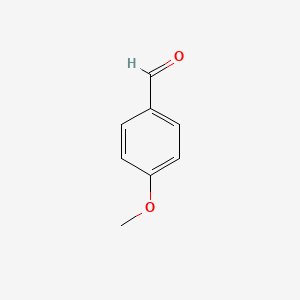
4-Methoxybenzaldehyde
P-methoxybenzaldehyde is a member of the class of benzaldehydes consisting of benzaldehyde itself carrying a methoxy substituent at position 4. It has a role as an insect repellent, a plant metabolite, a bacterial metabolite and a human urinary metabolite. — ChEBI
- IUPAC name
- 4-methoxybenzaldehyde
- Molecular formula
- C8H8O2
- Molecular weight
- 136.15 g/mol
- Exact mass
- 136.052429494 Da
- XLogP3
- 1.8
- Topological polar surface area
- 26.3 Ų
- Hydrogen-bond donors
- 0
- Hydrogen-bond acceptors
- 2
- Covalent units
- 1
- Defined stereocentres
- 0
Also known as
16 more reported names
External database identifiers
- ChEBI:CHEBI:28235
- ChEMBL:CHEMBL161598
- EPA DTXSID:DTXSID2026997
- PubMed:23064551
- PubMed:22848853
- PubMed:22707827
- PubMed:22701283
- PubMed:22685486
- PubMed:22661855
- PubMed:22606124
- PubMed:22606108
- PubMed:22606103
- PubMed:22590378
- PubMed:22590031
- PubMed:22589993
Evidence from additional scientific databases
NIH PubChem PUG-View
Attributed physical-property, hazard, environmental and use annotations.
- Boiling Point: 255 °C Source: Hazardous Substances Data Bank (HSDB)
- Boiling Point: 248.00 to 249.00 °C. @ 760.00 mm Hg Source: Human Metabolome Database (HMDB)
- Boiling Point: 248 °C Source: Joint FAO/WHO Expert Committee on Food Additives (JECFA)
- Color/Form: Oily liquid Source: Hazardous Substances Data Bank (HSDB)
- Color/Form: Colorless to pale yellow liquid Source: Hazardous Substances Data Bank (HSDB)
- Density: 1.1191 g/cu cm at 15 °C Source: Hazardous Substances Data Bank (HSDB)
- Density: 1.115-1.123 Source: Joint FAO/WHO Expert Committee on Food Additives (JECFA)
- Flash Point: 116 °C (241 °F) - closed cup Source: Hazardous Substances Data Bank (HSDB)
- LogP: log Kow = 1.76 Source: Hazardous Substances Data Bank (HSDB)
- LogP: 1.76 Source: Human Metabolome Database (HMDB)
- Melting Point: 0 °C Source: Hazardous Substances Data Bank (HSDB)
- Melting Point: 0 °C Source: Human Metabolome Database (HMDB)
- Odor: Hawthorn odor Source: Hazardous Substances Data Bank (HSDB)
- Odor: Odor resembles that of coumarin Source: Hazardous Substances Data Bank (HSDB)
- Odor: Sweet powdery, spicy creamy, fruity, vanilla and hay-like. Coumarin, almond, anisic with berry nuances. Source: Hazardous Substances Data Bank (HSDB)
- Physical Description: Liquid; Dry Powder; Liquid; CBI Source: EPA Chemical Data Reporting (CDR)
- Physical Description: Colorless to pale yellow liquid; [Hawley] Colorless liquid; [MSDSonline] Source: Haz-Map, Information on Hazardous Chemicals and Occupational Diseases
- Physical Description: Liquid Source: Human Metabolome Database (HMDB)
- Physical Description: colourless to slightly yellow liquid with a Intensely sweet, floral odour Source: Joint FAO/WHO Expert Committee on Food Additives (JECFA)
- Refractive Index: Index of refraction = 1.5730 at 20 °C Source: Hazardous Substances Data Bank (HSDB)
- Refractive Index: Index of refraction: 1.5730 at 20 °C/D Source: Hazardous Substances Data Bank (HSDB)
- Refractive Index: 1.568-1.574 Source: Joint FAO/WHO Expert Committee on Food Additives (JECFA)
- Solubility: In water, 4.29X10+3 mg/L at 25 °C Source: Hazardous Substances Data Bank (HSDB)
- Solubility: Insoluble in water Source: Hazardous Substances Data Bank (HSDB)
- Solubility: Miscible with ethanol, diethyl ether; very soluble in acetone, chloroform; soluble in benzene. Source: Hazardous Substances Data Bank (HSDB)
- Solubility: Soluble in 5 volumes of 5% alcohol Source: Hazardous Substances Data Bank (HSDB)
- Solubility: 4.29 mg/mL at 25 °C Source: Human Metabolome Database (HMDB)
- Solubility: poorly soluble in water, glycols, glycerol; soluble in organic solvents, oils Source: Joint FAO/WHO Expert Committee on Food Additives (JECFA)
- Solubility: miscible at room temperature (in ethanol) Source: Joint FAO/WHO Expert Committee on Food Additives (JECFA)
- Vapor Pressure: 0.03 [mmHg] Source: Haz-Map, Information on Hazardous Chemicals and Occupational Diseases
- Vapor Pressure: 3.29X10⁻² mm Hg at 25 °C (extrapolated) Source: Hazardous Substances Data Bank (HSDB)
- Viscosity: Dynamic viscosity = 4.22 mPa s at 25 °C 2017 Source: Hazardous Substances Data Bank (HSDB)
- Note: This chemical does not meet GHS hazard criteria for 57% (2268 of 3980) of all reports. Source: European Chemicals Agency (ECHA)
- Signal: Warning Source: European Chemicals Agency (ECHA)
- GHS Hazard Statements: H302 (40.1%): Harmful if swallowed [Warning Acute toxicity, oral] Source: European Chemicals Agency (ECHA)
- Precautionary Statement Codes: P264, P270, P301+P317, P330, and P501 (click each P-code to see the statement) Source: European Chemicals Agency (ECHA)
- ECHA C&L Notifications Summary: Aggregated GHS information provided per 3980 reports by companies from 23 notifications to the ECHA C&L Inventory.; Reported as not meeting GHS hazard criteria per 2268 of 3980 reports by companies.; There are 21 notifications provided by 1712 of 3980 reports by companies with hazard statement code(s).; Information may vary between notifications depending on impurities, additives, and other factors. The percentage value in parenthesis indicates the notified classification ratio from companies that provide hazard codes. Only hazard codes with percentage values above 10% are shown. For more detailed information, please visit ECHA C&L website. Source: European Chemicals Agency (ECHA)
- Signal: Warning Source: NITE-CMC
- GHS Hazard Statements: H361: Suspected of damaging fertility or the unborn child [Warning Reproductive toxicity] Source: NITE-CMC
- Precautionary Statement Codes: P203, P280, P318, P405, and P501 (click each P-code to see the statement) Source: NITE-CMC
- Toxicity Summary: IDENTIFICATION AND USE: p-Anisaldehyde is oily liquid. It is used in perfumery and toilet soaps. It is also used in organic syntheses. p-Anisaldehyde is also an intermediate in many industrial processes. HUMAN STUDIES: When tested at 10% in petrolatum, it produced no irritation after a 48 hr closed-patch test on human subjects. A maximization test was carried out on 25 volunteers. The material was tested at a concentration of 10% in petrolatum and produced no sensitization reactions. p-Anisaldehyde was positive for sister chromatid exchange in human lymph oocytes but not Chinese Hamster Ovary (CHO) cells in vitro. ANIMAL STUDIES: In a combined oral repeated-dose/reproductive/developmental toxicity screening test in rats, decreased body weights, decreased platelets and hypertrophy of hepatocytes were noted at 100 mg/kg/day. In reproduction studies, it showed significantly reduced fertility index, number of pups/litter, delivery index and number of live pups at 500 mg/kg/day. It was not mutagenic in bacteria but it was mutagenic in mouse lymphoma cells in vitro. Source: Hazardous Substances Data Bank (HSDB)
- Environmental Bioconcentration: An estimated BCF of 6.7 was calculated in fish for p-anisaldehyde(SRC), using a log Kow of 1.76(1) and a regression-derived equation(1). According to a classification scheme(2), this BCF suggests the potential for bioconcentration in aquatic organisms is low(SRC). Source: Hazardous Substances Data Bank (HSDB)
- Environmental Fate: TERRESTRIAL FATE: Based on a classification scheme(1), an estimated Koc value of 53(SRC), determined from a log Kow of 1.76(2) and a regression-derived equation(3), indicates that p-anisaldehyde is expected to high mobility in soil(SRC). Volatilization of p-anisaldehyde from moist soil surfaces is expected to be an important fate process(SRC) given an estimated Henry's Law constant of 1.4X10⁻⁵ atm-cu m/mole(SRC) derived from its vapor pressure, 3.29X10⁻² mm Hg(4), and water solubility, 4.29X10+3 mg/L(5). p-Anisaldehyde has a vapor pressure of 3.29X10⁻² mm Hg at 25 °C(4) and exists as a liquid under environmental conditions; therefore, p-anisaldehyde may volatilize from dry soil. A 99% of theoretical BOD using activated sludge in the Japanese MITI test(6) suggests that biodegradation is an important environmental fate process in soil(SRC). Source: Hazardous Substances Data Bank (HSDB)
- Environmental Fate: AQUATIC FATE: Based on a classification scheme(1), an estimated Koc value of 53(SRC), determined from a log Kow of 1.76(2) and a regression-derived equation(3), indicates that p-anisaldehyde is not expected to adsorb to suspended solids and sediment(SRC). Volatilization from water surfaces is expected(4) based upon an estimated Henry's Law constant of 1.4X10⁻⁵ atm-cu m/mole(SRC) derived from its vapor pressure, 3.29X10⁻² mm Hg(5), and water solubility, 4.29X10+3 mg/L(6). Using this Henry's Law constant and an estimation method(4), volatilization half-lives for a model river and model lake are 20 days and 230 days, respectively(SRC). According to a classification scheme(6), an estimated BCF of 6.7(SRC), from its log Kow(2) and a regression-derived equation(3), suggests the potential for bioconcentration in aquatic organisms is low(SRC). A 99% of theoretical BOD using activated sludge in the Japanese MITI test(7) suggests that biodegradation is an important environmental fate process in water(SRC). Source: Hazardous Substances Data Bank (HSDB)
- Environmental Fate: ATMOSPHERIC FATE: According to a model of gas/particle partitioning of semivolatile organic compounds in the atmosphere(1), p-anisaldehyde, which has a vapor pressure of 3.29X10⁻² mm Hg at 25 °C(2), is expected to exist solely as a vapor in the ambient atmosphere. Vapor-phase p-anisaldehyde is degraded in the atmosphere by reaction with photochemically-produced hydroxyl radicals(SRC); the half-life for this reaction in air is estimated to be 15 hours(SRC), calculated from its rate constant of 2.5X10⁻¹¹ cu cm/molecule-sec at 25 °C(SRC) that was derived using a structure estimation method(3). p-Anisaldehyde absorbs UV light at wavelengths >290 nm(4) and, therefore, may be susceptible to direct photolysis by sunlight(SRC). Source: Hazardous Substances Data Bank (HSDB)
- Consumer Uses: Not Known or Reasonably Ascertainable; Fragrance; Other Source: EPA Chemical Data Reporting (CDR)
- Industry Uses: Not Known or Reasonably Ascertainable; Fragrance; Other; Flavoring and nutrient Source: EPA Chemical Data Reporting (CDR)
- Sources/Uses: Metabolite of Lentinus lepidus (oderiforous fungus), Polyporus benzoinus (wood rotting fungus), and Daldalea juniperina; [Merck Index] Found in various essential oils and extracts; Used to make insect attractants (especially for cockroaches); Also used in electroplating and in fragrances and flavors; [HSDB] Source: Haz-Map, Information on Hazardous Chemicals and Occupational Diseases
- Industrial Processes with risk of exposure: Electroplating [Category: Plate] Source: Haz-Map, Information on Hazardous Chemicals and Occupational Diseases
- Uses: Perfumery and toilet soaps; ... also used in organic syntheses. Source: Hazardous Substances Data Bank (HSDB)
- Uses: p-Anisaldehyde is an intermediate in many industrial processes. Source: Hazardous Substances Data Bank (HSDB)
- Uses: Reported uses (ppm):; Table: Reported uses (ppm): (Flavor and Extract Manufacturers' Association) [Table#4114] Source: Hazardous Substances Data Bank (HSDB)
- Uses: Intermediate for antihistamines, electroplating. Source: Hazardous Substances Data Bank (HSDB)
Mapped by: Existing checksum-valid CAS to unique PubChem CID match. Retrieved: 2026-08-31. Open source record
Scientific classifications and hazard annotations provide context and do not replace the market-specific regulatory decision shown above.
Additional source coverage and match status
| Source | Result | Checked |
|---|---|---|
| NIH PubChem PUG-View | Exact match | 2026-08-31 |
A recorded no-match is useful evidence that the source was checked; it is not a claim that the substance does not exist elsewhere.
Retrieved from NIH PubChem on 2026-08-31 by checksum-valid CAS matching. Chemical properties do not replace the regulatory decision on this page.