
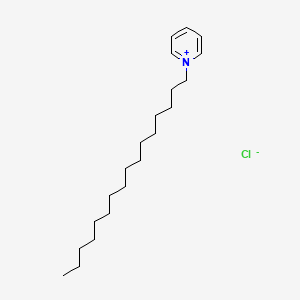
Cetylpyridinium Chloride
Cetylpyridinium chloride is a pyridinium salt that has N-hexadecylpyridinium as the cation and chloride as the anion. It has antiseptic properties and is used in solutions or lozenges for the treatment of minor infections of the mouth and throat. It has a role as a surfactant and an antiseptic drug. It is a chloride salt and an organic chloride salt. It contains a cetylpyridinium. — ChEBI
- IUPAC name
- 1-hexadecylpyridin-1-ium chloride
- Molecular formula
- C21H38ClN
- Molecular weight
- 340.0 g/mol
- Exact mass
- 339.2692779 Da
- Topological polar surface area
- 3.9 Ų
- Hydrogen-bond donors
- 0
- Hydrogen-bond acceptors
- 1
- Covalent units
- 2
- Defined stereocentres
- 0
Also known as
16 more reported names
External database identifiers
- ChEBI:CHEBI:32915
- ChEMBL:CHEMBL34833
- EPA DTXSID:DTXSID6041761
Evidence from additional scientific databases
NIH PubChem PUG-View
Attributed physical-property, hazard, environmental and use annotations.
- Color/Form: White powder Source: Hazardous Substances Data Bank (HSDB)
- LogP: log Kow= 1.71 Source: Hazardous Substances Data Bank (HSDB)
- Melting Point: 80 °C Source: Hazardous Substances Data Bank (HSDB)
- Physical Description: Dry Powder Source: EPA Chemical Data Reporting (CDR)
- Physical Description: White solid; [HSDB] Source: Haz-Map, Information on Hazardous Chemicals and Occupational Diseases
- Refractive Index: INDEX OF REFRACTION (@ 20 °C): MONOCLINIC 1.509; TRICLINIC 1.566; ORTHORHOMBIC 1.613 Source: Hazardous Substances Data Bank (HSDB)
- Solubility: Very soluble in water, chloroform Source: Hazardous Substances Data Bank (HSDB)
- Note: This chemical does not meet GHS hazard criteria for 19.3% (36 of 187) of reports. Source: European Chemicals Agency (ECHA)
- Signal: Danger Source: European Chemicals Agency (ECHA)
- GHS Hazard Statements: H301 (33.7%): Toxic if swallowed [Danger Acute toxicity, oral]; H302 (46%): Harmful if swallowed [Warning Acute toxicity, oral]; H315 (80.7%): Causes skin irritation [Warning Skin corrosion/irritation]; H318 (72.7%): Causes serious eye damage [Danger Serious eye damage/eye irritation]; H330 (80.2%): Fatal if inhaled [Danger Acute toxicity, inhalation]; H335 (78.6%): May cause respiratory irritation [Warning Specific target organ toxicity, single exposure; Respiratory tract irritation]; H400 (79.7%): Very toxic to aquatic life [Warning Hazardous to the aquatic environment, acute hazard]; H410 (13.9%): Very toxic to aquatic life with long lasting effects [Warning Hazardous to the aquatic environment, long-term hazard] Source: European Chemicals Agency (ECHA)
- Precautionary Statement Codes: P260, P261, P264, P264+P265, P270, P271, P273, P280, P284, P301+P316, P301+P317, P302+P352, P304+P340, P305+P354+P338, P316, P317, P319, P320, P321, P330, P332+P317, P362+P364, P391, P403+P233, P405, and P501 (click each P-code to see the statement) Source: European Chemicals Agency (ECHA)
- ECHA C&L Notifications Summary: Aggregated GHS information provided per 187 reports by companies from 27 notifications to the ECHA C&L Inventory. Each notification may be associated with multiple companies.; Reported as not meeting GHS hazard criteria per 36 of 187 reports by companies.; There are 26 notifications provided by 151 of 187 reports by companies with hazard statement code(s).; Information may vary between notifications depending on impurities, additives, and other factors. The percentage value in parenthesis indicates the notified classification ratio from companies that provide hazard codes. Only hazard codes with percentage values above 10% are shown. For more detailed information, please visit ECHA C&L website. Source: European Chemicals Agency (ECHA)
- Signal: Danger Source: NITE-CMC
- GHS Hazard Statements: H301: Toxic if swallowed [Danger Acute toxicity, oral]; H315: Causes skin irritation [Warning Skin corrosion/irritation]; H318: Causes serious eye damage [Danger Serious eye damage/eye irritation]; H330: Fatal if inhaled [Danger Acute toxicity, inhalation]; H400: Very toxic to aquatic life [Warning Hazardous to the aquatic environment, acute hazard]; H410: Very toxic to aquatic life with long lasting effects [Warning Hazardous to the aquatic environment, long-term hazard] Source: NITE-CMC
- Precautionary Statement Codes: P260, P264, P264+P265, P270, P271, P273, P280, P284, P301+P316, P302+P352, P304+P340, P305+P354+P338, P316, P317, P320, P321, P330, P332+P317, P362+P364, P391, P403+P233, P405, and P501 (click each P-code to see the statement) Source: NITE-CMC
- GHS Hazard Statements: H301: Toxic if swallowed [Danger Acute toxicity, oral]; H319: Causes serious eye irritation [Warning Serious eye damage/eye irritation]; H330: Fatal if inhaled [Danger Acute toxicity, inhalation]; H335: May cause respiratory irritation [Warning Specific target organ toxicity, single exposure; Respiratory tract irritation] Source: NITE-CMC
- Precautionary Statement Codes: P260, P261, P264, P264+P265, P270, P271, P280, P284, P301+P316, P304+P340, P305+P351+P338, P316, P319, P320, P321, P330, P337+P317, P403+P233, P405, and P501 (click each P-code to see the statement) Source: NITE-CMC
- Environmental Bioconcentration: Whole body BCF values of 21, 22, and 13, were measured for clams, fathead minnows, and tadpoles, respectively, under flow-through conditions over a 7-day period, for a structurally-similar compound, cetylpyridinium bromide(1). An estimated BCF of 2 was calculated for cetylpyridinium chloride(SRC), using a log Kow of 1.71(2) and a regression-derived equation(3). According to a classification scheme(4), these BCF values suggest the potential for bioconcentration in aquatic organisms is low(SRC). Source: Hazardous Substances Data Bank (HSDB)
- Environmental Fate: TERRESTRIAL FATE: Based on a classification scheme(1), an estimated Koc value of 200(SRC), determined from a log Kow of 1.71(2) and a regression-derived equation(3), indicates that cetylpyridinium chloride is expected to have moderate mobility in soil(SRC). However, quaternary ammonium compounds are known to sorb strongly and rapidly in well-mixed systems, to a wide variety of materials (such as sewage sludge, sediment, clay)(4) and the mobility of cetylpyridinium bromide in soil may be considerably less than estimated. Volatilization of cetylpyridinium chloride from moist soil surfaces is not expected as this compound is a salt(SRC). Cetylpyridinium chloride is also not expected to volatilize from dry soil surfaces(SRC) as ions do not volatilize. Cetylpyridinium chloride is expected to biodegrade rapidly in soil(SRC) based on sewage studies for structurally-similar compounds. Dodecyl and tetradecylpyridinium chloride, were biodegraded in the Spanish official test (93 and 94%, respectively) and in the OECD Confirmatory test (91 and 92%, respectively)(4). Source: Hazardous Substances Data Bank (HSDB)
- Environmental Fate: AQUATIC FATE: Based on a classification scheme(1), an estimated Koc value of 200(SRC), determined from a log Kow of 1.71(2) and a regression-derived equation(3), indicates that cetylpyridinium chloride is not expected to adsorb to suspended solids and sediment(SRC). However, quaternary ammonium compounds are known to sorb strongly, and rapidly in well-mixed systems, to a wide variety of materials (such as sewage sludge, sediment, clay)(7); therefore, cetylpyridinium bromide should be strongly adsorbed to suspended solids and sediment in water. This compound is expected to exist in the dissociated form in the environment and therefore volatilization from water surfaces will not be an important fate process(SRC). According to a classification scheme(5), an estimated BCF of 2(SRC), from its log Kow(2) and a regression-derived equation(6), suggests the potential for bioconcentration in aquatic organisms is low(SRC). Cetylpyridinium chloride is expected to biodegrade rapidly in water(SRC) based on sewage studies for structurally-similar compounds. Dodecyl and tetradecylpyridinium chloride, were biodegraded in the Spanish official test (93 and 94%, respectively) and in the OECD Confirmat Source: Hazardous Substances Data Bank (HSDB)
- Environmental Fate: ATMOSPHERIC FATE: Cetylpyridinium chloride will exist as the ion in the environment and, thus, will be present solely in the particulate phase in the atmosphere. Particulate-phase cetylpyridinium chloride may be removed from the air by wet and dry deposition. (SRC) Source: Hazardous Substances Data Bank (HSDB)
- Consumer Uses: Other; Preservative Source: EPA Chemical Data Reporting (CDR)
- Industry Uses: Preservative; Other Source: EPA Chemical Data Reporting (CDR)
- Sources/Uses: Used as a preservative/antibacterial agent in cosmetics, pharmaceuticals, cough lozenges, mouthwashes, deodorants, and antiseptics; [HSDB] Quarternary ammonium compounds are used as algaecides/slimicides (swimming pools, industrial water reservoirs, and farm ponds), antiseptics for cleaning wounds, antistatic agents for textiles, softeners for paper products, and pigment dispersers; [IPCS-PIMs] Source: Haz-Map, Information on Hazardous Chemicals and Occupational Diseases
- Industrial Processes with risk of exposure: Using Disinfectants or Biocides [Category: Clean] Source: Haz-Map, Information on Hazardous Chemicals and Occupational Diseases
- Uses: For Cetylpyridinium chloride (USEPA/OPP Pesticide Code: 069160) there are 0 labels match. /SRP: Not registered for current use in the U.S., but approved pesticide uses may change periodically and so federal, state and local authorities must be consulted for currently approved uses./ Source: Hazardous Substances Data Bank (HSDB)
- Uses: The active ingredient is no longer contained in any registered pesticide products ... "cancelled." Source: Hazardous Substances Data Bank (HSDB)
- Uses: Pharmaceutic aid (preservative), antiseptic; disinfectant/monohydrate/ Source: Hazardous Substances Data Bank (HSDB)
- Uses: Antiseptic; preservative(cosmetics, pharmaceuticals) Source: Hazardous Substances Data Bank (HSDB)
- Uses: For more Uses (Complete) data for CETYLPYRIDINIUM CHLORIDE (9 total), please visit the HSDB record page. Source: Hazardous Substances Data Bank (HSDB)
Mapped by: Existing checksum-valid CAS to unique PubChem CID match. Retrieved: 2026-08-31. Open source record
Scientific classifications and hazard annotations provide context and do not replace the market-specific regulatory decision shown above.
Additional source coverage and match status
| Source | Result | Checked |
|---|---|---|
| NIH PubChem PUG-View | Exact match | 2026-08-31 |
A recorded no-match is useful evidence that the source was checked; it is not a claim that the substance does not exist elsewhere.
Retrieved from NIH PubChem on 2026-09-02 by checksum-valid CAS matching. Chemical properties do not replace the regulatory decision on this page.