
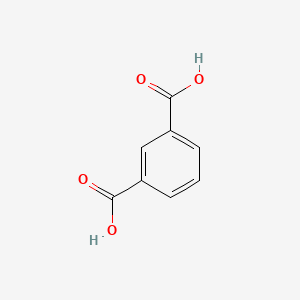
Isophthalic Acid
Isophthalic acid is a benzenedicarboxylic acid that is benzene substituted by carboxy groups at position 1 and 3. One of three possible isomers of benzenedicarboxylic acid, the others being phthalic and terephthalic acids. It is a conjugate acid of an isophthalate(1-). — ChEBI
- IUPAC name
- benzene-1,3-dicarboxylic acid
- Molecular formula
- C8H6O4
- Molecular weight
- 166.13 g/mol
- Exact mass
- 166.02660867 Da
- XLogP3
- 1.7
- Topological polar surface area
- 74.6 Ų
- Hydrogen-bond donors
- 2
- Hydrogen-bond acceptors
- 4
- Covalent units
- 1
- Defined stereocentres
- 0
Also known as
16 more reported names
External database identifiers
- ChEBI:CHEBI:30802
- ChEMBL:CHEMBL1871181
- EPA DTXSID:DTXSID3021485
- PubMed:23643828
- PubMed:22954382
- PubMed:22862681
- PubMed:22810849
- PubMed:22777783
- PubMed:22626499
- PubMed:22590323
- PubMed:22590305
- PubMed:22590058
- PubMed:22578865
- PubMed:22577521
- PubMed:22573970
Evidence from additional scientific databases
NIH PubChem PUG-View
Attributed physical-property, hazard, environmental and use annotations.
- Autoignition Temperature: 700 °C Source: ILO-WHO International Chemical Safety Cards (ICSCs)
- Boiling Point: Sublimes Source: Hazardous Substances Data Bank (HSDB)
- Boiling Point: Boiling point = 753.00 K (Based on predicted value for phthalic acid by Meissner's method with a suitable adjustment for isomerism based on similar compound relationships.) Source: Hazardous Substances Data Bank (HSDB)
- Color/Form: Crystalline powder Source: Hazardous Substances Data Bank (HSDB)
- Color/Form: Colorless crystals Source: Hazardous Substances Data Bank (HSDB)
- Color/Form: Needles from water or alcohol Source: Hazardous Substances Data Bank (HSDB)
- Density: 1.54 at 77 °F (USCG, 1999) - Denser than water; will sink Source: CAMEO Chemicals
- Density: 1.53 at 4 °C Source: Hazardous Substances Data Bank (HSDB)
- Density: Density = 9.0710 kmol/cu m at 20 °C Source: Hazardous Substances Data Bank (HSDB)
- Density: Relative density (water = 1): 1.54 Source: ILO-WHO International Chemical Safety Cards (ICSCs)
- Density: 1.507 @ 20°C Source: PAC Chemical Database, U.S. Department of Energy
- Dissociation Constants: pKa1 = 3.70; pKa2 = 4.60 at 25 °C Source: Hazardous Substances Data Bank (HSDB)
- LogP: log Kow = 1.66 Source: Hazardous Substances Data Bank (HSDB)
- LogP: 1.66 Source: ILO-WHO International Chemical Safety Cards (ICSCs)
- Melting Point: 653 °F (USCG, 1999) Source: CAMEO Chemicals
- Melting Point: 347 °C Source: Hazardous Substances Data Bank (HSDB)
- Melting Point: Triple point temperature and pressure = 619.15 K (estimated to be equal to the melting point), 2.8020X10+3 Pa Source: Hazardous Substances Data Bank (HSDB)
- Melting Point: Melting point = 619.15 K (determined in sealed tube) Source: Hazardous Substances Data Bank (HSDB)
- Melting Point: 345-348 °C Source: ILO-WHO International Chemical Safety Cards (ICSCs)
- Physical Description: Isophthalic acid is a white solid with a slight unpleasant odor. Sinks in water. (USCG, 1999) Source: CAMEO Chemicals
- Physical Description: Dry Powder; Other Solid; Large Crystals; CBI; Liquid Source: EPA Chemical Data Reporting (CDR)
- Physical Description: Colorless solid; [Hawley] Sublimes without decomposition; [Merck Index] Melting point = 347 deg C; [HSDB] Faintly beige powder; [MSDSonline] Source: Haz-Map, Information on Hazardous Chemicals and Occupational Diseases
- Physical Description: COLOURLESS CRYSTALLINE POWDER. Source: ILO-WHO International Chemical Safety Cards (ICSCs)
- Solubility: Soluble in 8000 parts cold water, 460 parts boiling water; freely soluble in alcohol; practically insoluble in petroleum ether Source: Hazardous Substances Data Bank (HSDB)
- Solubility: In methanol: 4.0 g/100 g at 25 °C; in propanol: 1.7 g/100 g at 25 °C, 2.7 g/100 g at 50 °C; in glacial acetic acid: 0.23 g/100 g at 25 °C Source: Hazardous Substances Data Bank (HSDB)
- Solubility: Insoluble in benzene, ligroin and ether Source: Hazardous Substances Data Bank (HSDB)
- Solubility: Water solubility: 120 mg/L at 25 °C, 350 mg/L at 50 °C, 3200 mg/L at 100 °C Source: Hazardous Substances Data Bank (HSDB)
- Solubility: In water, 5400 mg/L at 14 °C (pH adjusted water for complete dissociation) Source: Hazardous Substances Data Bank (HSDB)
- Solubility: Solubility in water: none in cold water, poor in boiling water Source: ILO-WHO International Chemical Safety Cards (ICSCs)
- Vapor Pressure: 0.00000002 [mmHg] Source: Haz-Map, Information on Hazardous Chemicals and Occupational Diseases
- Vapor Pressure: VP: 0.009 Pa (0.0675 mm Hg) at 100 °C Source: Hazardous Substances Data Bank (HSDB)
- Vapor Pressure: 0.068 [mm Hg] @100 °C Source: PAC Chemical Database, U.S. Department of Energy
- Viscosity: 0.00025186 Pa-s at 619.15K (346 °C) Source: Hazardous Substances Data Bank (HSDB)
- Exposure Routes: The substance can be absorbed into the body by ingestion. Source: ILO-WHO International Chemical Safety Cards (ICSCs)
- First Aid: INHALATION: remove victim to uncontaminated area; get medical attention if complications arise.; INGESTION: get medical attention if complications arise.; EYES: flush with large amounts of water for 15 min.; get prompt medical attention.; SKIN: wash with water. (USCG, 1999) Source: CAMEO Chemicals
- Note: This chemical does not meet GHS hazard criteria for 91% (614 of 675) of all reports. Source: European Chemicals Agency (ECHA)
- GHS Hazard Statements: Not Classified; Reported as not meeting GHS hazard criteria by 614 of 675 companies (only 9% companies provided GHS information). For more detailed information, please visit ECHA C&L website. Source: European Chemicals Agency (ECHA)
- ECHA C&L Notifications Summary: Aggregated GHS information provided per 675 reports by companies from 9 notifications to the ECHA C&L Inventory.; Reported as not meeting GHS hazard criteria per 614 of 675 reports by companies.; There are 5 notifications provided by 61 of 675 reports by companies with hazard statement code(s).; Information may vary between notifications depending on impurities, additives, and other factors. The percentage value in parenthesis indicates the notified classification ratio from companies that provide hazard codes. Only hazard codes with percentage values above 10% are shown. For more detailed information, please visit ECHA C&L website. Source: European Chemicals Agency (ECHA)
- Environmental Bioconcentration: An estimated BCF of 3 was calculated in fish for isophthalic acid(SRC), using a log Kow of 1.66(1) and a regression-derived equation(2). According to a classification scheme(3), this BCF suggests the potential for bioconcentration in aquatic organisms is low. Source: Hazardous Substances Data Bank (HSDB)
- Environmental Fate: TERRESTRIAL FATE: Based on a recommended classification scheme(1), an estimated Koc value of 79(SRC), derived from a molecular structure estimation method(2), suggests that isophthalic acid will have high mobility in soil(SRC). It is a dibasic (2 displaceable hydrogen atoms) acid whose pKa1 is 3.70 and pKa2 is 4.60 at 25 °C(3) and will primarily exist in the anion form in the environment and form salts with cations in soil; anions generally do not adsorb more strongly to soils containing organic carbon and clay than their neutral counterparts(4). Volatilization of isophthalic acid from moist soil surfaces is not expected to be an important fate process(SRC) given an estimated Henry's Law constant of 2.2X10⁻¹² atm-cu m/mole(SRC), using a fragment constant estimation method(5). It absorbs UV radiation >290 nm(6), and therefore may degrade by direct photolysis on the soil surface(SRC). Isophthalic acid is readily biodegradable in screening tests using sewage sludge(7-10) and may be expected to biodegrade in soil(8). Source: Hazardous Substances Data Bank (HSDB)
- Environmental Fate: AQUATIC FATE: Based on a classification scheme(1), an estimated Koc value of 79(SRC), determined from a structure estimation method(2), indicates that isophthalic acid is not expected to adsorb to suspended solids and sediment(SRC). Volatilization from water surfaces is not expected(3) based upon an estimated Henry's Law constant of 2.2X10⁻¹² atm-cu m/mole(SRC), developed using a fragment constant estimation method(4). Isophthalic acid is a dibasic (2 displaceable hydrogen atoms) acid whose pKa1 is 3.70 and pKa2 is 4.60 at 25 °C(5) and will be largely dissociated in at an environmental pH range of pH 5 to pH 9(SRC). According to a classification scheme(6), an estimated BCF of 3(SRC), from an estimated log Kow of 1.66(7) and a regression-derived equation(8), suggests the potential for bioconcentration in aquatic organisms is low. Isophthalic acid absorbs UV radiation >290 nm(9), and therefore may be susceptible to direct photolysis in surface waters(SRC). Isophthalic acid is not expected to undergo hydrolysis in the environment due to the lack of functional groups that hydrolyze under environmental conditions(3). Isophthalic acid has been shown to be readily biodegradable in screeni Source: Hazardous Substances Data Bank (HSDB)
- Environmental Fate: ATMOSPHERIC FATE: According to a theory of gas/particle partitioning of semivolatile organic compounds in the atmosphere(1), isophthalic acid, which has an estimated vapor pressure of 2.6X10⁻⁸ mm Hg at 25 °C(SRC), determined from a fragment constant method(2), will exist in both the vapor and particulate phases in the ambient atmosphere. Its existence in the atmosphere in both phases has been observed experimentally(3,4). Vapor-phase isophthalic acid is degraded in the atmosphere by reaction with photochemically-produced hydroxyl radicals(SRC); the half-life for this reaction in air is estimated to be 12 days(SRC), calculated from its rate constant of 1.3X10⁻¹² cu cm/molecule-sec at 25 °C(SRC) that was derived using a structure estimation method(5). Particulate-phase isophthalic acid may be physically removed from the air by wet and dry deposition(SRC). Isophthalic acid absorbs at wavelengths >290 nm(6), and therefore may be susceptible to direct photolysis by sunlight(SRC). Source: Hazardous Substances Data Bank (HSDB)
- Consumer Uses: Intermediate; Hardener Source: EPA Chemical Data Reporting (CDR)
- Industry Uses: Monomers; Lubricating agent; Other; Solvent; Intermediate; Not Known or Reasonably Ascertainable; Filler Source: EPA Chemical Data Reporting (CDR)
- Sources/Uses: Used to make plastics, unsaturated polyester resins, alkyd resins, polyamides, and thermoplastic polyesters; Used as a co-monomer with terephthalic acid to make plastic bottles and specialty resins; [HSDB] Used in formulations for adhesives, inks, wire enamels, and dental materials; [CAMEO] Source: Haz-Map, Information on Hazardous Chemicals and Occupational Diseases
- Industrial Processes with risk of exposure: Working with Glues and Adhesives [Category: Other]; Plastic Composites Manufacturing [Category: Industry] Source: Haz-Map, Information on Hazardous Chemicals and Occupational Diseases
- Uses: CHEM INT FOR DIPHENYL ISOPHTHALATE Source: Hazardous Substances Data Bank (HSDB)
- Uses: CHEM INT FOR THE PLASTICIZER, DIOCTYL ISOPHTHALATE, DIMETHYL ISOPHTHALATE & DIETHYL ISOPHTHALATE Source: Hazardous Substances Data Bank (HSDB)
- Uses: CHEM INT FOR DIALLYL ISOPHTHALATE (CROSS LINKING AGENT) Source: Hazardous Substances Data Bank (HSDB)
- Uses: Isophthalic acid is used as a raw material in the production of polyesters. About 35% of the isophthalic acid is used to prepare unsaturated polyester resins, about 30% is used to produce alkyd coatings, and over 20% is used in other types of polymers, primarily as a minor comonomer with terephthalic acid in saturated polyesters. Isophthalic acid is also used in formulations for adhesives, inks, wire enamels, and dental materials. In addition, it is used to produce derivative chemicals such as the diesters. Source: Hazardous Substances Data Bank (HSDB)
- Uses: Isophthalic acid is used as a comonomer with terephthalic acid in bottle and specialty resins. It is also a feedstock for coatings and for high-performance unsaturated polyesters, being first reacted with maleic anhydride and then this resin is cross-linked with styrene. Source: Hazardous Substances Data Bank (HSDB)
Mapped by: Existing checksum-valid CAS to unique PubChem CID match. Retrieved: 2026-08-31. Open source record
Scientific classifications and hazard annotations provide context and do not replace the market-specific regulatory decision shown above.
Additional source coverage and match status
| Source | Result | Checked |
|---|---|---|
| NIH PubChem PUG-View | Exact match | 2026-08-31 |
A recorded no-match is useful evidence that the source was checked; it is not a claim that the substance does not exist elsewhere.
Retrieved from NIH PubChem on 2026-08-31 by checksum-valid CAS matching. Chemical properties do not replace the regulatory decision on this page.