
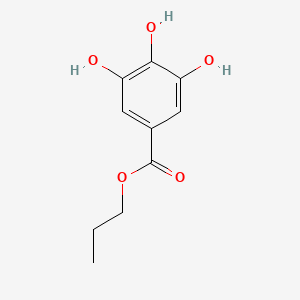
- IUPAC name
- propyl 3,4,5-trihydroxybenzoate
- Molecular formula
- C10H12O5
- Molecular weight
- 212.20 g/mol
- Exact mass
- 212.06847348 Da
- XLogP3
- 1.8
- Topological polar surface area
- 87.0 Ų
- Hydrogen-bond donors
- 3
- Hydrogen-bond acceptors
- 5
- Covalent units
- 1
- Defined stereocentres
- 0
Also known as
N-Propyl gallateProgallin PGallic acid, propyl esterTenox PGNipagallin PGallic acid propyl esterNIPA 49Propylester kyseliny gallove
16 more reported names
Benzoic acid, 3,4,5-trihydroxy-, propyl esterFEMA No. 2947n-Propyl 3,4,5-trihydroxybenzoate3,4,5-Trihydroxybenzene-1-propylcarboxylateGallate, Propyln-Propyl ester of 3,4,5-trihydroxybenzoic acidNipanox S 1NSC 2626NCI-C5058883,4,5-Trihydroxybenzoic acid, propyl ester3,4,5-Trihydroxybenzoic acid n-propyl esterNSC-2626Propyl gallate (e 310)8D4SNN7V92INS NO.310E310
External database identifiers
- ChEBI:CHEBI:10607
- ChEMBL:CHEMBL7983
- EPA DTXSID:DTXSID5021201
- PubMed:40651752
- PubMed:33301901
- PubMed:31729792
- PubMed:26928355
- PubMed:26795242
- PubMed:25724174
- PubMed:24060682
- PubMed:23063794
- PubMed:23049883
- PubMed:23046578
- PubMed:22988451
- PubMed:22939258
Evidence from additional scientific databases
NIH PubChem PUG-View
Exact identifier match4947
Attributed physical-property, hazard, environmental and use annotations.
- Boiling Point: Decomposes (NTP, 1992) Source: CAMEO Chemicals
- Color/Form: White to creamy-white crystalline powder Source: Hazardous Substances Data Bank (HSDB)
- Color/Form: Colorless crystals Source: Hazardous Substances Data Bank (HSDB)
- Color/Form: Needles in water Source: Hazardous Substances Data Bank (HSDB)
- Color/Form: Fine, ivory powder or crystals Source: Hazardous Substances Data Bank (HSDB)
- Density: 1.21 (NTP, 1992) - Denser than water; will sink Source: CAMEO Chemicals
- Density: 1.21 Source: Hazardous Substances Data Bank (HSDB)
- Dissociation Constants: pKa = 7.94 Source: Hazardous Substances Data Bank (HSDB)
- Flash Point: 368 °F (NTP, 1992) Source: CAMEO Chemicals
- Flash Point: 187 °C (369 °F) - closed cup Source: Hazardous Substances Data Bank (HSDB)
- LogP: log Kow = 1.80 Source: Hazardous Substances Data Bank (HSDB)
- LogP: 1.80 Source: Human Metabolome Database (HMDB)
- Melting Point: 302 °F (NTP, 1992) Source: CAMEO Chemicals
- Melting Point: Between 146 °C and 150 °C after drying at 110 °C for four hours Source: EU Food Improvement Agents
- Melting Point: 147-149 °C Source: Hazardous Substances Data Bank (HSDB)
- Melting Point: 150 °C Source: Human Metabolome Database (HMDB)
- Odor: Odorless Source: Hazardous Substances Data Bank (HSDB)
- Odor: Odorless or with a faint odor Source: Hazardous Substances Data Bank (HSDB)
- Physical Description: Propyl gallate appears as fine white to creamy-white crystalline powder. Odorless or with a faint odor. Melting point 150 °C. Insoluble in water. Slightly bitter taste. Source: CAMEO Chemicals
- Physical Description: White to creamy-white, crystalline, odourless solid Source: EU Food Improvement Agents
- Physical Description: Colorless or white odorless solid; [HSDB] Faintly beige crystals; [MSDSonline] Source: Haz-Map, Information on Hazardous Chemicals and Occupational Diseases
- Physical Description: Solid Source: Human Metabolome Database (HMDB)
- Solubility: less than 1 mg/mL at 68 °F (NTP, 1992) Source: CAMEO Chemicals
- Solubility: Slightly soluble in water, freely soluble in ethanol, ether and propane-1,2-diol Source: EU Food Improvement Agents
- Solubility: In water, 3490 mg/L at 25 deg, 2790 mg/L at 20 °C, 3790 mg/L at 30 °C Source: Hazardous Substances Data Bank (HSDB)
- Solubility: Solubility at 25 °C: in water 0.35 g/100 mL Source: Hazardous Substances Data Bank (HSDB)
- Solubility: Slightly soluble in acetone and 2-butanol Source: Hazardous Substances Data Bank (HSDB)
- Solubility: Solubility at 25 °C: in alcohol 103 g/100 g, in ether 83 g/100 g; Solubility at 30 °C: in cottonseed oil at 30 °C 1.23 g/100 g, in lard at 45 °C 1.14 g/100 g Source: Hazardous Substances Data Bank (HSDB)
- Solubility: 3.5 mg/mL at 25 °C Source: Human Metabolome Database (HMDB)
- pH: pH = 6.3 (0.05% aqueous solution); pH = 5.9 (0.1% aqueous solution); pH = 5.7 (0.2% aqueous solution) Source: Hazardous Substances Data Bank (HSDB)
- Substance: Propyl gallate Source: NTP Technical Reports
- NTP Technical Report: TR-240: Carcinogenesis Bioassay of Propyl Gallate (CASRN 121-79-9) in F344/N Rats and B6C3F1 Mice (Feed Study) (1982 ) Source: NTP Technical Reports
- Peer Review Date: 12/16/81 Source: NTP Technical Reports
- Conclusion for Male Rat: Equivocal Evidence Source: NTP Technical Reports
- Conclusion for Female Rat: No Evidence Source: NTP Technical Reports
- Conclusion for Male Mice: Equivocal Evidence Source: NTP Technical Reports
- Conclusion for Female Mice: No Evidence Source: NTP Technical Reports
- Summary: Under the conditions of this bioassay, propyl gallate was not considered carcinogenic for F344/N rats, although there was evidence of an increased proportion of low-dose male rats with preputial gland tumors, islet-cell tumors of the pancreas, and pheochromocytomas of the adrenal glands; rare tumors of the brain occurred in two low-dose females. Propyl gallate was not considered to be carcinogenic for B6C3F1 mice of either sex, although the increased incidence of malignant lymphoma in male mice may have been related to the dietary administration of propyl gallate. Source: NTP Technical Reports
- Carcinogen Classification: No indication of carcinogenicity to humans (not listed by IARC). Source: Toxin and Toxin Target Database (T3DB)
- First Aid: EYES: First check the victim for contact lenses and remove if present. Flush victim's eyes with water or normal saline solution for 20 to 30 minutes while simultaneously calling a hospital or poison control center. Do not put any ointments, oils, or medication in the victim's eyes without specific instructions from a physician. IMMEDIATELY transport the victim after flushing eyes to a hospital even if no symptoms (such as redness or irritation) develop.; SKIN: IMMEDIATELY flood affected skin with water while removing and isolating all contaminated clothing. Gently wash all affected skin areas thoroughly with soap and water. If symptoms such as redness or irritation develop, IMMEDIATELY call a physician and be prepared to transport the victim to a hospital for treatment.; INHALATION: IMMEDIATELY leave the contaminated area; take deep breaths of fresh air. If symptoms (such as wheezing, coughing, shortness of breath, or burning in the mouth, throat, or chest) develop, call a physician and be prepared to transport the victim to a hospital. Provide proper respiratory protection to rescuers entering an unknown atmosphere. Whenever possible, Self-Contained Breathing Apparatus (SCBA) shou Source: CAMEO Chemicals
- Signal: Warning Source: Regulation (EC) No 1272/2008 of the European Parliament and of the Council
- GHS Hazard Statements: H302: Harmful if swallowed [Warning Acute toxicity, oral]; H317: May cause an allergic skin reaction [Warning Sensitization, Skin]; H400: Very toxic to aquatic life [Warning Hazardous to the aquatic environment, acute hazard]; H410: Very toxic to aquatic life with long lasting effects [Warning Hazardous to the aquatic environment, long-term hazard] Source: Regulation (EC) No 1272/2008 of the European Parliament and of the Council
- Precautionary Statement Codes: P261, P264, P270, P272, P273, P280, P301+P317, P302+P352, P321, P330, P333+P317, P362+P364, P391, and P501 (click each P-code to see the statement) Source: Regulation (EC) No 1272/2008 of the European Parliament and of the Council
- Signal: Warning Source: European Chemicals Agency (ECHA)
- GHS Hazard Statements: H302 (100%): Harmful if swallowed [Warning Acute toxicity, oral]; H317 (> 99.9%): May cause an allergic skin reaction [Warning Sensitization, Skin] Source: European Chemicals Agency (ECHA)
- Precautionary Statement Codes: P261, P264, P270, P272, P280, P301+P317, P302+P352, P321, P330, P333+P317, P362+P364, and P501 (click each P-code to see the statement) Source: European Chemicals Agency (ECHA)
- ECHA C&L Notifications Summary: Aggregated GHS information provided per 1787 reports by companies from 10 notifications to the ECHA C&L Inventory. Each notification may be associated with multiple companies.; Information may vary between notifications depending on impurities, additives, and other factors. The percentage value in parenthesis indicates the notified classification ratio from companies that provide hazard codes. Only hazard codes with percentage values above 10% are shown. For more detailed information, please visit ECHA C&L website. Source: European Chemicals Agency (ECHA)
- Signal: Danger Source: NITE-CMC
- GHS Hazard Statements: H318: Causes serious eye damage [Danger Serious eye damage/eye irritation]; H400: Very toxic to aquatic life [Warning Hazardous to the aquatic environment, acute hazard]; H411: Toxic to aquatic life with long lasting effects [Hazardous to the aquatic environment, long-term hazard] Source: NITE-CMC
- Precautionary Statement Codes: P264+P265, P273, P280, P305+P354+P338, P317, P391, and P501 (click each P-code to see the statement) Source: NITE-CMC
- Signal: Warning Source: NITE-CMC
- GHS Hazard Statements: H317: May cause an allergic skin reaction [Warning Sensitization, Skin] Source: NITE-CMC
- Cosmetic Ingredient Review Conclusion: On the basis of the data presented in this report, the CIR Expert Panel concludes that Propyl Gallate is safe in the practices of use as described in this safety assessment at concentrations less than or equal to 0.1%. Source: Cosmetic Ingredient Review (CIR)
- Cosmetic Ingredient Review Finding(s): Safe for use in cosmetics, with qualifications Source: Cosmetic Ingredient Review (CIR)
- Toxicity Summary: IDENTIFICATION AND USE: Propyl gallate is white to creamy-white crystalline powder. It is used as an antioxidant for foods and cosmetics; especially fats, oils, emulsions, and waxes. It is used in transformer oils and as a stabilizer for synthetic vitamin A. It is also used as experimental medication. HUMAN EXPOSURE AND TOXICITY: Statistically significant increase in propyl gallate-positive rates on patch testing over the last decade have been reported. Propyl gallate produced contact dermatitis in 5 of 10 patients. Patients applied 20% in 70% ethyl alcohol to forearm daily for 24 days. 5 patients complained of pruritus and erythema. Propyl gallate was investigated in vitro at concentration of 0.5, 5.0 and 50 ug/mL employing WI-38 human embryonic lung cells for anaphase abnormalities. Propyl gallate was not mutagenic. ANIMAL STUDIES: In a 4-week oral toxicity study, rats ingested 0%, 0.1%, 0.5%, or 2.5% propyl gallate in feed. In rats ingesting the highest dose, a decrease in weight gain of more than 10%, dirty tails, thickening of the stomach wall, necrosis, and ulceration of the stomach mucosa, a moderate to severe granulomatous inflammatory response in the submucosa and muscular Source: Hazardous Substances Data Bank (HSDB)
- Environmental Bioconcentration: An estimated BCF of 7 was calculated in fish for propyl gallate(SRC), using a log Kow of 1.80(1) and a regression-derived equation(2). According to a classification scheme(3), this BCF suggests the potential for bioconcentration in aquatic organisms is low(SRC). Source: Hazardous Substances Data Bank (HSDB)
- Environmental Fate: TERRESTRIAL FATE: Based on a classification scheme(1), an estimated Koc value of 490(SRC), determined from a structure estimation method(2), indicates that propyl gallate is expected to have moderate mobility in soil(SRC). Volatilization of propyl gallate from moist soil surfaces is not expected to be an important fate process(SRC) given an estimated Henry's Law constant of 2.1X10⁻¹¹ atm-cu m/mole(SRC), derived from its estimated vapor pressure, 2.6X10⁻⁷ mm Hg(2), and water solubility, 3490 mg/L(3). Propyl gallate is not expected to volatilize from dry soil surfaces(SRC) based upon its estimated vapor pressure(2). Propyl gallate is reported to be biodegradable in the environment(4) with ultimate aerobic degradation estimated to be weeks and primary degradation in days(5). Source: Hazardous Substances Data Bank (HSDB)
- Environmental Fate: AQUATIC FATE: Based on a classification scheme(1), an estimated Koc value of 490(SRC), determined from a structure estimation method(2), indicates that propyl gallate is expected to adsorb moderately to suspended solids and sediment(SRC). Volatilization from water surfaces is not expected(3) based upon an estimated Henry's Law constant of 2.1X10⁻¹¹ atm-cu m/mole(SRC) derived from its estimated vapor pressure, 2.6X10⁻⁷ mm Hg(2), and water solubility, 3490 mg/L(4). According to a classification scheme(5), an estimated BCF of 7(SRC), from its log Kow of 1.80(6) and a regression-derived equation(2), suggests the potential for bioconcentration in aquatic organisms is low(SRC). Propyl gallate is reported to be biodegradable in the environment(7) with ultimate aerobic degradation estimated to be weeks and primary degradation in days(8). A base-catalyzed second-order hydrolysis rate constant of 0.018 L/mole-sec(SRC) was estimated using a structure estimation method(2); this corresponds to half-lives of 12 and 1.2 years at pH values of 7 and 8, respectively(2). Propyl gallate is reported to react readily with photo-oxidant radicals in aqueous media(9); therefore, photo-oxidation may have so Source: Hazardous Substances Data Bank (HSDB)
- Environmental Fate: ATMOSPHERIC FATE: According to a model of gas/particle partitioning of semivolatile organic compounds in the atmosphere(1), propyl gallate, which has an estimated vapor pressure of 2.6X10⁻⁷ mm Hg at 25 °C(SRC), determined from a fragment constant method(2), will exist in both the vapor and particulate phases in the ambient atmosphere. Vapor-phase propyl gallate is degraded in the atmosphere by reaction with photochemically-produced hydroxyl radicals(SRC); the half-life for this reaction in air is estimated to be 4.2 hours(SRC), calculated from its rate constant of 9.2X10⁻¹¹ cu cm/molecule-sec at 25 °C(SRC) that was derived using a structure estimation method(2). Particulate-phase propyl gallate may be removed from the air by wet and dry deposition(SRC). Propyl gallate absorbs at wavelengths >290 nm(3) and, therefore, may be susceptible to direct photolysis by sunlight(SRC). Source: Hazardous Substances Data Bank (HSDB)
- Cosmetic Ingredient Review Link: CIR ingredient: Propyl Gallate Source: Cosmetic Ingredient Review (CIR)
- Sources/Uses: Used as antioxidant to prevent rancidity in fats, oils, and other food products; Also used as a laboratory reagent and stabilizer for synthetic vitamin A; [HSDB] Used as an antioxidant for cosmetics, ethers, emulsions, waxes, and transformer oils; [Merck Index] Contact dermatitis documented in a baker and confectioner; [Kanerva, p. 1830] Source: Haz-Map, Information on Hazardous Chemicals and Occupational Diseases
- Uses: Reported uses (ppm):; Table: Reported uses (ppm): (Flavor and Extract Manufacturers' Association, 1994) [Table#1691] Source: Hazardous Substances Data Bank (HSDB)
- Uses: It is used as an antioxidant for foods and cosmetics; especially fats, oils, emulsions, and waxes. It is also used in transformer oils and as a stabilizer for synthetic vitamin A. Source: Hazardous Substances Data Bank (HSDB)
- Uses: Reactive peroxides in povidone often lead to degradation of oxidation-labile drugs. ... The antioxidants ascorbic acid, propyl gallate, and sodium sulfite reduced the peroxide concentration in povidone ... . Source: Hazardous Substances Data Bank (HSDB)
- Uses: Synthetic antioxidants commonly used in food include butylated hydroxyanisole (BHA), butylated hydroxytoluene (BHT), propyl gallate (PG), and tert-butylhydroquinone (TBHQ). Source: Hazardous Substances Data Bank (HSDB)
- Uses: MEDICATION Source: Hazardous Substances Data Bank (HSDB)
Mapped by: Existing checksum-valid CAS to unique PubChem CID match. Retrieved: 2026-08-31. Open source record
Scientific classifications and hazard annotations provide context and do not replace the market-specific regulatory decision shown above.
Additional source coverage and match status
| Source | Result | Checked |
|---|---|---|
| NIH PubChem PUG-View | Exact match | 2026-08-31 |
A recorded no-match is useful evidence that the source was checked; it is not a claim that the substance does not exist elsewhere.
Retrieved from NIH PubChem on 2026-08-31 by checksum-valid CAS matching. Chemical properties do not replace the regulatory decision on this page.