
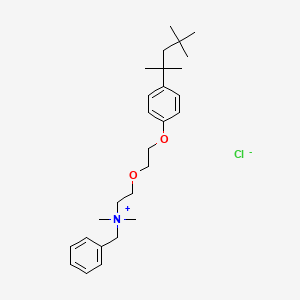
Benzethonium Chloride
Benzethonium chloride is a (synthetic) quaternary ammonium salt that is benzyldimethylamine in which the nitrogen is quaternised by a 2-{2-[p-(2,4,4-trimethylpentan-2-yl)phenoxy]ethoxy}ethyl group, with chloride as the counter-ion. An antiseptic and disinfectant, it is active against a broad spectrum of bacteria, fungi, moulds and viruses. It has a role as an antiviral agent, an antibacterial agent, an antifungal agent, an antiseptic drug and a disinfectant. It is a chloride salt, a quaternary ammonium salt and an aromatic ether. — ChEBI
- IUPAC name
- benzyl-dimethyl-[2-[2-[4-(2,4,4-trimethylpentan-2-yl)phenoxy]ethoxy]ethyl]azanium chloride
- Molecular formula
- C27H42ClNO2
- Molecular weight
- 448.1 g/mol
- Exact mass
- 447.2904073 Da
- Topological polar surface area
- 18.5 Ų
- Hydrogen-bond donors
- 0
- Hydrogen-bond acceptors
- 3
- Covalent units
- 2
- Defined stereocentres
- 0
Also known as
16 more reported names
External database identifiers
- ChEBI:CHEBI:31264
- ChEMBL:CHEMBL221753
- EPA DTXSID:DTXSID6023810
- PubMed:828
Evidence from additional scientific databases
NIH PubChem PUG-View
Attributed physical-property, hazard, environmental and use annotations.
- Color/Form: COLORLESS CRYSTALS Source: Hazardous Substances Data Bank (HSDB)
- LogP: 4.0 Source: ILO-WHO International Chemical Safety Cards (ICSCs)
- Melting Point: 327 to 331 °F (NTP, 1992) Source: CAMEO Chemicals
- Melting Point: 164-166 °C (HOT STAGE) Source: Hazardous Substances Data Bank (HSDB)
- Melting Point: EUTECTIC TEMP: PHENANTHRENE 86 °C; BENZANTHRENE 98 °C Source: Hazardous Substances Data Bank (HSDB)
- Melting Point: 160-165 °C Source: ILO-WHO International Chemical Safety Cards (ICSCs)
- Odor: MILD ODOR Source: Hazardous Substances Data Bank (HSDB)
- Physical Description: Benzethonium chloride appears as odorless white crystals or powder with a very bitter taste. A 1% solution in water is slightly alkaline to litmus. (NTP, 1992) Source: CAMEO Chemicals
- Physical Description: Colorless or white solid in various forms; Hygroscopic; Soluble in water; [ICSC] White powder; [MSDSonline] Very bitter taste; 1% solution has a pH of 4.8-5.5; [HSDB] Source: Haz-Map, Information on Hazardous Chemicals and Occupational Diseases
- Physical Description: COLOURLESS OR WHITE HYGROSCOPIC SOLID IN VARIOUS FORMS. Source: ILO-WHO International Chemical Safety Cards (ICSCs)
- Refractive Index: INDEX OF REFRACTION: 1.5101 @ 25 °C/D; INDEX OF REFRACTION FALLS ON REPETITION Source: Hazardous Substances Data Bank (HSDB)
- Refractive Index: INDEX OF REFRACTION: 1.560 (ALPHA), 1.565 (BETA), 1.589 (GAMMA) Source: Hazardous Substances Data Bank (HSDB)
- Solubility: 10 to 50 mg/mL at 64 °F (NTP, 1992) Source: CAMEO Chemicals
- Solubility: VERY SOL IN WATER GIVING FOAMY, SOAPY SOLN; SOL IN ALC, ACETONE, CHLOROFORM Source: Hazardous Substances Data Bank (HSDB)
- Solubility: SLIGHTLY SOL IN ETHER Source: Hazardous Substances Data Bank (HSDB)
- Solubility: Solubility in water: very good Source: ILO-WHO International Chemical Safety Cards (ICSCs)
- pH: PH OF 1% AQ SOLN IS BETWEEN 4.8 & 5.5 Source: Hazardous Substances Data Bank (HSDB)
- Substance: Benzethonium Chloride Source: NTP Technical Reports
- NTP Technical Report: TR-438: Toxicology and Carcinogenesis Studies of Benzethonium Chloride (CASRN 121-54-0) in F344/N Rats and B6C3F1 Mice (Dermal Studies) (1995 ) Source: NTP Technical Reports
- Peer Review Date: 06/21/94 Source: NTP Technical Reports
- Conclusion for Male Rat: No Evidence Source: NTP Technical Reports
- Conclusion for Female Rat: No Evidence Source: NTP Technical Reports
- Conclusion for Male Mice: No Evidence Source: NTP Technical Reports
- Conclusion for Female Mice: No Evidence Source: NTP Technical Reports
- Summary: Under the conditions of these 2-year dermal studies, there was no evidence of carcinogenic activity of benzethonium chloride in male or female F344/N rats receiving 0.15, 0.5, or 1.5 mg/kg. There was no evidence of carcinogenic activity in male or female B6C3F1 mice receiving 0.15, 0.5, or 1.5 mg/kg.; Exposure of rats and mice to benzethonium chloride by dermal application in ethanol for 2 years resulted in epithelial hyperplasia in male and female rats and mice and sebaceous gland hyperplasia and ulcers in female rats at the site of application. Source: NTP Technical Reports
- Exposure Routes: The substance can be absorbed into the body through the skin and by ingestion. Source: ILO-WHO International Chemical Safety Cards (ICSCs)
- First Aid: EYES: First check the victim for contact lenses and remove if present. Flush victim's eyes with water or normal saline solution for 20 to 30 minutes while simultaneously calling a hospital or poison control center. Do not put any ointments, oils, or medication in the victim's eyes without specific instructions from a physician. IMMEDIATELY transport the victim after flushing eyes to a hospital even if no symptoms (such as redness or irritation) develop.; SKIN: IMMEDIATELY flood affected skin with water while removing and isolating all contaminated clothing. Gently wash all affected skin areas thoroughly with soap and water. IMMEDIATELY call a hospital or poison control center even if no symptoms (such as redness or irritation) develop. IMMEDIATELY transport the victim to a hospital for treatment after washing the affected areas.; INHALATION: IMMEDIATELY leave the contaminated area; take deep breaths of fresh air. If symptoms (such as wheezing, coughing, shortness of breath, or burning in the mouth, throat, or chest) develop, call a physician and be prepared to transport the victim to a hospital. Provide proper respiratory protection to rescuers entering an unknown atmosphere. Whene Source: CAMEO Chemicals
- Note: This chemical does not meet GHS hazard criteria for 1.3% (5 of 394) of reports. Source: European Chemicals Agency (ECHA)
- Signal: Danger Source: European Chemicals Agency (ECHA)
- GHS Hazard Statements: H301 (81%): Toxic if swallowed [Danger Acute toxicity, oral]; H302 (17.5%): Harmful if swallowed [Warning Acute toxicity, oral]; H314 (95.2%): Causes severe skin burns and eye damage [Danger Skin corrosion/irritation]; H318 (47.5%): Causes serious eye damage [Danger Serious eye damage/eye irritation]; H400 (94.4%): Very toxic to aquatic life [Warning Hazardous to the aquatic environment, acute hazard]; H410 (84%): Very toxic to aquatic life with long lasting effects [Warning Hazardous to the aquatic environment, long-term hazard] Source: European Chemicals Agency (ECHA)
- Precautionary Statement Codes: P260, P264, P264+P265, P270, P273, P280, P301+P316, P301+P317, P301+P330+P331, P302+P361+P354, P304+P340, P305+P354+P338, P316, P317, P321, P330, P363, P391, P405, and P501 (click each P-code to see the statement) Source: European Chemicals Agency (ECHA)
- ECHA C&L Notifications Summary: Aggregated GHS information provided per 394 reports by companies from 25 notifications to the ECHA C&L Inventory. Each notification may be associated with multiple companies.; Reported as not meeting GHS hazard criteria per 5 of 394 reports by companies.; There are 24 notifications provided by 389 of 394 reports by companies with hazard statement code(s).; Information may vary between notifications depending on impurities, additives, and other factors. The percentage value in parenthesis indicates the notified classification ratio from companies that provide hazard codes. Only hazard codes with percentage values above 10% are shown. For more detailed information, please visit ECHA C&L website. Source: European Chemicals Agency (ECHA)
- Signal: Warning Source: NITE-CMC
- GHS Hazard Statements: H302: Harmful if swallowed [Warning Acute toxicity, oral]; H315: Causes skin irritation [Warning Skin corrosion/irritation]; H319: Causes serious eye irritation [Warning Serious eye damage/eye irritation] Source: NITE-CMC
- Precautionary Statement Codes: P264, P264+P265, P270, P280, P301+P317, P302+P352, P305+P351+P338, P321, P330, P332+P317, P337+P317, P362+P364, and P501 (click each P-code to see the statement) Source: NITE-CMC
- Signal: Warning Source: Hazardous Chemical Information System (HCIS), Safe Work Australia
- GHS Hazard Statements: H302: Harmful if swallowed [Warning Acute toxicity, oral]; H315: Causes skin irritation [Warning Skin corrosion/irritation]; H319: Causes serious eye irritation [Warning Serious eye damage/eye irritation] Source: Hazardous Chemical Information System (HCIS), Safe Work Australia
- Precautionary Statement Codes: P264, P264+P265, P270, P280, P301+P317, P302+P352, P305+P351+P338, P321, P330, P332+P317, P337+P317, P362+P364, and P501 (click each P-code to see the statement) Source: Hazardous Chemical Information System (HCIS), Safe Work Australia
- Cosmetic Ingredient Review Conclusion: On the basis of the available animal and clinical data, the Expert Panel concludes that Benzethonium Chloride and Methylbenzethonium Chloride are safe at concentrations of 0.5 percent in cosmetics applied to the skin. A maximum concentration of 0.02 percent is safe for cosmetics used in the eye area. Note: FDA has prohibited the use of Methylene Chloride in cosmetic products, action which supercedes this CIR conclusion (21CFR700.19). Source: Cosmetic Ingredient Review (CIR)
- Cosmetic Ingredient Review Finding(s): Safe for use in cosmetics, with qualifications Source: Cosmetic Ingredient Review (CIR)
- Cosmetic Ingredient Review Link: CIR ingredient: Benzethonium Chloride Source: Cosmetic Ingredient Review (CIR)
- Sources/Uses: Used as a cationic detergent, germicide for cleansing food and dairy utensils, swimming pool algaecide, dandruff-control agent, deodorant, topical antiseptic, spermicide, and astringent; [HSDB] Used as a preservative in cosmetics and pharmaceuticals and as a reagent for determining protein in cerebrospinal fluid; [Merck Index] Source: Haz-Map, Information on Hazardous Chemicals and Occupational Diseases
- Industrial Processes with risk of exposure: Using Disinfectants or Biocides [Category: Clean]; Dressing Hair [Category: Other] Source: Haz-Map, Information on Hazardous Chemicals and Occupational Diseases
- Uses: MEDICATION: TOPICAL ANTI-INFECTIVE; (VET) TOPICAL ANTISEPTIC Source: Hazardous Substances Data Bank (HSDB)
- Uses: SPERMICIDE, ASTRINGENT Source: Hazardous Substances Data Bank (HSDB)
- Uses: ANTISEPTIC FOR WOUNDS, INFECTED SKIN SURFACES, MILD INFECTIONS OF THE EYE, & FORNASAL & ORAL MUCOSA; GERMICIDE FOR CLEANSING FOOD & DAIRY UTENSILS; FOR CONTROLLING SWIMMING POOL ALGAE; ADDITIVE IN HAIRDRESSING PREPNS TO CONTROL DANDRUFF; DEODORANT; PRESERVATIVE Source: Hazardous Substances Data Bank (HSDB)
- Uses: APPLICATIONS (VET): ... TOPICAL ANTIBACTERIAL. 1:1000 AQ SOLN FOR COLD STERILIZATION OF INSTRUMENTS; 1:3000 FOR WASHING COW'S TEATS & UDDER, KENNELS & EQUIPMENT; 1:5000-1:10000 IN DRINKING WATER OF CHICKENS & TURKEYS; 1:500 TOPICAL POWD INSUFFLATION FOR CERVICITIS & VAGINITIS IN CATTLE. BACTERIAL INACTIVATOR IN VACCINE MFR. Source: Hazardous Substances Data Bank (HSDB)
- Uses: For more Uses (Complete) data for BENZETHONIUM CHLORIDE (6 total), please visit the HSDB record page. Source: Hazardous Substances Data Bank (HSDB)
Mapped by: Existing checksum-valid CAS to unique PubChem CID match. Retrieved: 2026-08-31. Open source record
Scientific classifications and hazard annotations provide context and do not replace the market-specific regulatory decision shown above.
Additional source coverage and match status
| Source | Result | Checked |
|---|---|---|
| NIH PubChem PUG-View | Exact match | 2026-08-31 |
A recorded no-match is useful evidence that the source was checked; it is not a claim that the substance does not exist elsewhere.
Retrieved from NIH PubChem on 2026-08-31 by checksum-valid CAS matching. Chemical properties do not replace the regulatory decision on this page.