
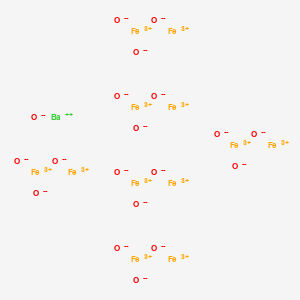
Barium hexaferrite
Barium ferrite is a chemical compound of barium and iron. It is used as a component in magnetic stripe cards. Barium is a metallic alkaline earth metal with the symbol Ba, and atomic number 56. It never occurs in nature in its pure form due to its reactivity with air, but combines with other chemicals such as sulfur or carbon and oxygen to form barium compounds that may be found as minerals. (L214, 408, L244) — Toxin and Toxin Target Database (T3DB)
- IUPAC name
- barium(2+);dodecakis(iron(3+));nonadecakis(oxygen(2-))
- Molecular formula
- BaFe12O19
- Molecular weight
- 1111.5 g/mol
- Exact mass
- 1113.02785 Da
- Topological polar surface area
- 19.0 Ų
- Hydrogen-bond donors
- 0
- Hydrogen-bond acceptors
- 19
- Covalent units
- 32
- Defined stereocentres
- 0
Also known as
11 more reported names
Evidence from additional scientific databases
NIH PubChem PUG-View
Attributed physical-property, hazard, environmental and use annotations.
- Carcinogen Classification: No indication of carcinogenicity to humans (not listed by IARC). Source: Toxin and Toxin Target Database (T3DB)
- Exposure Routes: Oral (L214) ; inhalation (L214) Source: Toxin and Toxin Target Database (T3DB)
- Note: This chemical does not meet GHS hazard criteria for 1.6% (1 of 63) of reports. Source: European Chemicals Agency (ECHA)
- Signal: Warning Source: European Chemicals Agency (ECHA)
- GHS Hazard Statements: H302+H332 (61.9%): Harmful if swallowed or if inhaled [Warning Acute toxicity, oral; acute toxicity, inhalation]; H302 (81%): Harmful if swallowed [Warning Acute toxicity, oral]; H332 (61.9%): Harmful if inhaled [Warning Acute toxicity, inhalation]; H371 (79.4%): May cause damage to organs [Warning Specific target organ toxicity, single exposure]; H373 (79.4%): May causes damage to organs through prolonged or repeated exposure [Warning Specific target organ toxicity, repeated exposure] Source: European Chemicals Agency (ECHA)
- Precautionary Statement Codes: P260, P261, P264, P270, P271, P301+P317, P304+P340, P308+P316, P317, P319, P330, P405, and P501 (click each P-code to see the statement) Source: European Chemicals Agency (ECHA)
- ECHA C&L Notifications Summary: Aggregated GHS information provided per 63 reports by companies from 6 notifications to the ECHA C&L Inventory. Each notification may be associated with multiple companies.; Reported as not meeting GHS hazard criteria per 1 of 63 reports by companies.; There are 5 notifications provided by 62 of 63 reports by companies with hazard statement code(s).; Information may vary between notifications depending on impurities, additives, and other factors. The percentage value in parenthesis indicates the notified classification ratio from companies that provide hazard codes. Only hazard codes with percentage values above 10% are shown. For more detailed information, please visit ECHA C&L website. Source: European Chemicals Agency (ECHA)
- GHS Hazard Statements: Not Classified; Reported as not meeting GHS hazard criteria by 1 of 1 companies. For more detailed information, please visit ECHA C&L website. Source: European Chemicals Agency (ECHA)
- Health Effects: The health effects of the different barium compounds depend on how well the compound dissolves in water or the stomach contents. At low doses, barium acts as a muscle stimulant, while higher doses affect the nervous system, causing cardiac irregularities, tremors, weakness, anxiety, dyspnea, paralysisand possibly death. Barium may also cause gastrointestinal disturbances, damage the kidneys and cause decreases in body weight. (L214) Source: Toxin and Toxin Target Database (T3DB)
- Toxicity Summary: Barium is a competitive potassium channel antagonist that blocks the passive efflux of intracellular potassium, resulting in a shift of potassium from extracellular to intracellular compartments. The intracellular translocation of potassium results in a decreased resting membrane potential, making the muscle fibers electrically unexcitable and causing paralysis. Some of these barium's effects may also be due to barium induced neuromuscular blockade and membrane depolarization. (L214) Source: Toxin and Toxin Target Database (T3DB)
- Uses: Barium ferrite is used as a component in magnetic stripe cards. (L244) Source: Toxin and Toxin Target Database (T3DB)
Mapped by: Existing checksum-valid CAS to unique PubChem CID match. Retrieved: 2026-08-31. Open source record
Scientific classifications and hazard annotations provide context and do not replace the market-specific regulatory decision shown above.
Additional source coverage and match status
| Source | Result | Checked |
|---|---|---|
| NIH PubChem PUG-View | Exact match | 2026-08-31 |
A recorded no-match is useful evidence that the source was checked; it is not a claim that the substance does not exist elsewhere.
Retrieved from NIH PubChem on 2026-08-31 by checksum-valid CAS matching. Chemical properties do not replace the regulatory decision on this page.