
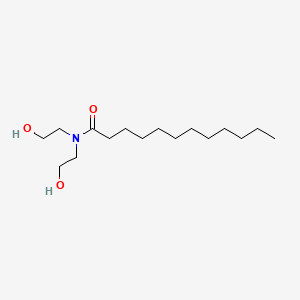
CAS 120-40-1PubChem CID 8430
Lauric acid diethanolamide
Lauric acid diethanolamine condensate (1/1) is an off-white waxy solid. (NTP, 1992) — CAMEO Chemicals
- IUPAC name
- N,N-bis(2-hydroxyethyl)dodecanamide
- Molecular formula
- C16H33NO3
- Molecular weight
- 287.44 g/mol
- Exact mass
- 287.24604391 Da
- XLogP3
- 3.5
- Topological polar surface area
- 60.8 Ų
- Hydrogen-bond donors
- 2
- Hydrogen-bond acceptors
- 3
- Covalent units
- 1
- Defined stereocentres
- 0
Also known as
Lauric diethanolamideLauramide DEALauryl diethanolamideAlkamide LEStandamidd ldComperlan LDCondensate PLMackamide LL
16 more reported names
DiethanollauramideHetamide MLMackamide LLMEmpilan LDEEthylan MLDLauroyldiethanolamineClindrol 100LRolamid cdLankrostat JPIncromide LRStandamid LDLauramido DEAN,N-Bis(2-hydroxyethyl)lauramideRichamide STDAminon L 02Lalmin D
External database identifiers
- ChEBI:CHEBI:143726
- ChEMBL:CHEMBL1996872
- EPA DTXSID:DTXSID5025491
- PubMed:19712026
- PubMed:17039784
- PubMed:11743760
Evidence from additional scientific databases
NIH PubChem PUG-View
Exact identifier match8430
Attributed physical-property, hazard, environmental and use annotations.
- Boiling Point: 462 to 471 °F at 760 mmHg (NTP, 1992) Source: CAMEO Chemicals
- Color/Form: Wax Source: Hazardous Substances Data Bank (HSDB)
- Color/Form: Amber liquid Source: Hazardous Substances Data Bank (HSDB)
- Density: Approximately 8.1 lb/gal Source: Hazardous Substances Data Bank (HSDB)
- Melting Point: 108 to 117 °F (NTP, 1992) Source: CAMEO Chemicals
- Melting Point: 38.7 °C Source: Hazardous Substances Data Bank (HSDB)
- Melting Point: 38.00 to 39.00 °C. @ 760.00 mm Hg Source: Human Metabolome Database (HMDB)
- Melting Point: 36.7 °C Source: PAC Chemical Database, U.S. Department of Energy
- Physical Description: Lauric acid diethanolamine condensate (1/1) is an off-white waxy solid. (NTP, 1992) Source: CAMEO Chemicals
- Physical Description: Liquid; Liquid; Other Solid; Large Crystals; CBI Source: EPA Chemical Data Reporting (CDR)
- Physical Description: Amber liquid or solid; [HSDB] Off-white solid; [CAMEO] Solid; mp = 38.7 deg C; [EPA HPV] Off-white pellets; [Akzo Nobel MSDS] Source: Haz-Map, Information on Hazardous Chemicals and Occupational Diseases
- Solubility: less than 1 mg/mL at 75 °F (NTP, 1992) Source: CAMEO Chemicals
- Solubility: Sol in lower alcohols, propylene glycol, polyethylene glycols, insoluble in water. Source: Hazardous Substances Data Bank (HSDB)
- Vapor Pressure: 0.00000001 [mmHg] Source: Haz-Map, Information on Hazardous Chemicals and Occupational Diseases
- pH: pH = 9-11 (1% solution) Source: Hazardous Substances Data Bank (HSDB)
- Substance: Lauric Acid Diethanolamine Condensate Source: NTP Technical Reports
- NTP Technical Report: TR-480: Toxicology and Carcinogenesis Studies of Lauric Acid Diethanolamine Condensate (CASRN 120-40-1) in F344/N Rats and B6C3F1 Mice (Dermal Studies) (1999 ) Source: NTP Technical Reports
- Peer Review Date: 12/10/97 Source: NTP Technical Reports
- Conclusion for Male Rat: No Evidence Source: NTP Technical Reports
- Conclusion for Female Rat: No Evidence Source: NTP Technical Reports
- Conclusion for Male Mice: No Evidence Source: NTP Technical Reports
- Conclusion for Female Mice: Some Evidence Source: NTP Technical Reports
- Summary: Under the conditions of these 2-year dermal studies, there was no evidence of carcinogenic activity of lauric acid diethanolamine condensate in male or female F344/N rats administered 50 or 100 mg/kg or in male B6C3F1 mice administered 100 or 200 mg/kg. There was some evidence of carcinogenic activity in female B6C3F1 mice based on increased incidences of hepatocellular neoplasms. These increases were associated with free diethanolamine, which was present as a contaminant of lauric acid diethanolamine condensate.; Dermal administration of lauric acid diethanolamine condensate to rats and mice for 2 years resulted in increased incidences of epidermal and sebaceous gland hyperplasia, hyperkeratosis, chronic inflammation, and parakeratosis at the site of application.; Lauric acid diethanolamine condensate administration also resulted in increased incidences of thyroid gland follicular cell hyperplasia in dosed male mice. Source: NTP Technical Reports
- First Aid: EYES: First check the victim for contact lenses and remove if present. Flush victim's eyes with water or normal saline solution for 20 to 30 minutes while simultaneously calling a hospital or poison control center. Do not put any ointments, oils, or medication in the victim's eyes without specific instructions from a physician. IMMEDIATELY transport the victim after flushing eyes to a hospital even if no symptoms (such as redness or irritation) develop.; SKIN: IMMEDIATELY flood affected skin with water while removing and isolating all contaminated clothing. Gently wash all affected skin areas thoroughly with soap and water. If symptoms such as redness or irritation develop, IMMEDIATELY call a physician and be prepared to transport the victim to a hospital for treatment.; INHALATION: IMMEDIATELY leave the contaminated area; take deep breaths of fresh air. If symptoms (such as wheezing, coughing, shortness of breath, or burning in the mouth, throat, or chest) develop, call a physician and be prepared to transport the victim to a hospital. Provide proper respiratory protection to rescuers entering an unknown atmosphere. Whenever possible, Self-Contained Breathing Apparatus (SCBA) shou Source: CAMEO Chemicals
- Signal: Danger Source: European Chemicals Agency (ECHA)
- GHS Hazard Statements: H315 (45.4%): Causes skin irritation [Warning Skin corrosion/irritation]; H318 (93.9%): Causes serious eye damage [Danger Serious eye damage/eye irritation]; H411 (27.1%): Toxic to aquatic life with long lasting effects [Hazardous to the aquatic environment, long-term hazard] Source: European Chemicals Agency (ECHA)
- Precautionary Statement Codes: P264, P264+P265, P273, P280, P302+P352, P305+P354+P338, P317, P321, P332+P317, P362+P364, P391, and P501 (click each P-code to see the statement) Source: European Chemicals Agency (ECHA)
- ECHA C&L Notifications Summary: Aggregated GHS information provided per 809 reports by companies from 11 notifications to the ECHA C&L Inventory. Each notification may be associated with multiple companies.; Information may vary between notifications depending on impurities, additives, and other factors. The percentage value in parenthesis indicates the notified classification ratio from companies that provide hazard codes. Only hazard codes with percentage values above 10% are shown. For more detailed information, please visit ECHA C&L website. Source: European Chemicals Agency (ECHA)
- Cosmetic Ingredient Review Conclusion: The CIR Expert Panel concluded that the following 33 diethanolamides are safe in the present practices of use and concentration described in this safety assessment when formulated to be non-irritating and when the levels of free diethanolamine in the diethanolamides do not exceed the present practices of use and concentration of diethanolamine itself. The Expert Panel cautions that ingredients should not be used in cosmetic products in which N-nitroso compounds can be formed...Lauramide DEA... Source: Cosmetic Ingredient Review (CIR)
- Cosmetic Ingredient Review Finding(s): Safe for use in cosmetics, with qualifications Source: Cosmetic Ingredient Review (CIR)
- Environmental Bioconcentration: Based upon an estimated water solubility of 226 mg/l(1), the BCF of N,N-di(2-hydroxyethyl)lauramide can be estimated to be approximately 29 from a regression-derived equation(1). Based on this BCF value, bioconcentration is not expected to be an important fate process(SRC). Source: Hazardous Substances Data Bank (HSDB)
- Environmental Fate: TERRESTRIAL FATE: When dissolved in aqueous solutions, N,N-di(2-hydroxyethyl)lauramide will have soil mobility ranging from medium to high(3) based on estimated Koc values ranging from 52 to 221(1,2). Source: Hazardous Substances Data Bank (HSDB)
- Environmental Fate: AQUATIC FATE: N,N-Di(2-hydroxyethyl)lauramide is essentially nonvolatile from water based upon an estimated Henry's Law constant of 2.16X10⁻¹² atm cu m/mol(1,2,SRC). In natural river water, 98% of N,N-di(2-hydroxyethyl)lauramide was biodegraded in 6 days (20 mg/l)(3). Aquatic bioconcentration and adsorption to sediment are not expected to be important fate processes(SRC). Source: Hazardous Substances Data Bank (HSDB)
- Environmental Fate: ATMOSPHERIC FATE: Based on an estimated vapor pressure of approximately 6.7X10⁻⁹ mm Hg at 25 °C(1), N,N-di(2- hydroxyethyl)lauramide will exist primarily in the particulate phase in the ambient atmosphere(2). In the vapor phase, it will degrade in the ambient atmosphere by reaction with photochemically produced hydroxyl radicals with an estimated half-life of 8 hrs(3). Physical removal of particulate N,N-di(2- hydroxyethyl)lauramide from air is likely to occur through wet and dry deposition(SRC). Source: Hazardous Substances Data Bank (HSDB)
- Consumer Uses: Surfactant (surface active agent); Anti-static agent Source: EPA Chemical Data Reporting (CDR)
- Industry Uses: Surfactant (surface active agent); Anti-static agent Source: EPA Chemical Data Reporting (CDR)
- Cosmetic Ingredient Review Link: CIR ingredient: Lauramide DEA Source: Cosmetic Ingredient Review (CIR)
- Sources/Uses: Used as a foam stabilizer for liquid household detergents and shampoos; [HSDB] Used as an antistatic additive; [Akzo Nobel MSDS] Source: Haz-Map, Information on Hazardous Chemicals and Occupational Diseases
- Uses: FOAM STABILIZER FOR LIQUID HOUSEHOLD DETERGENTS Source: Hazardous Substances Data Bank (HSDB)
- Uses: FOAM STABILIZER FOR SHAMPOOS Source: Hazardous Substances Data Bank (HSDB)
- Uses: MEDICATION Source: Hazardous Substances Data Bank (HSDB)
Mapped by: Existing checksum-valid CAS to unique PubChem CID match. Retrieved: 2026-08-31. Open source record
Scientific classifications and hazard annotations provide context and do not replace the market-specific regulatory decision shown above.
Additional source coverage and match status
| Source | Result | Checked |
|---|---|---|
| NIH PubChem PUG-View | Exact match | 2026-08-31 |
A recorded no-match is useful evidence that the source was checked; it is not a claim that the substance does not exist elsewhere.
Retrieved from NIH PubChem on 2026-08-31 by checksum-valid CAS matching. Chemical properties do not replace the regulatory decision on this page.