
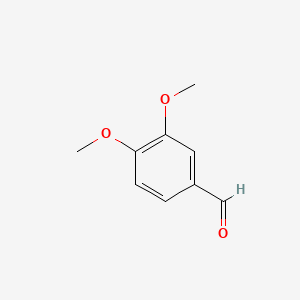
Veratraldehyde
Veratraldehyde is a dimethoxybenzene that is benzaldehyde substituted by methoxy groups at positions 3 and 4. It is found in peppermint, ginger, raspberry, and other fruits. It has a role as an antifungal agent. It is a member of benzaldehydes and a dimethoxybenzene. — ChEBI
- IUPAC name
- 3,4-dimethoxybenzaldehyde
- Molecular formula
- C9H10O3
- Molecular weight
- 166.17 g/mol
- Exact mass
- 166.062994177 Da
- XLogP3
- 1.5
- Topological polar surface area
- 35.5 Ų
- Hydrogen-bond donors
- 0
- Hydrogen-bond acceptors
- 3
- Covalent units
- 1
- Defined stereocentres
- 0
Also known as
16 more reported names
External database identifiers
- ChEBI:CHEBI:17098
- ChEMBL:CHEMBL1088937
- EPA DTXSID:DTXSID7026285
- PubMed:22669348
- PubMed:22590293
- PubMed:22589974
- PubMed:22567576
- PubMed:22496740
- PubMed:22438852
- PubMed:22412650
- PubMed:22384116
- PubMed:22347026
- PubMed:22259463
- PubMed:22219977
- PubMed:22219913
Evidence from additional scientific databases
NIH PubChem PUG-View
Attributed physical-property, hazard, environmental and use annotations.
- Boiling Point: 538 °F at 760 mmHg (NTP, 1992) Source: CAMEO Chemicals
- Boiling Point: 281.00 °C. @ 760.00 mm Hg Source: Human Metabolome Database (HMDB)
- Boiling Point: 281 °C Source: Joint FAO/WHO Expert Committee on Food Additives (JECFA)
- Boiling Point: 281 °C @760 [mm Hg] Source: PAC Chemical Database, U.S. Department of Energy
- Flash Point: greater than 230 °F (NTP, 1992) Source: CAMEO Chemicals
- LogP: 1.22 Source: Human Metabolome Database (HMDB)
- Melting Point: 108 to 109 °F (NTP, 1992) Source: CAMEO Chemicals
- Melting Point: 58 °C Source: Human Metabolome Database (HMDB)
- Physical Description: Veratraldehyde appears as needles or chunky light peach powder. Has an odor of vanilla beans. (NTP, 1992) Source: CAMEO Chemicals
- Physical Description: Solid Source: Human Metabolome Database (HMDB)
- Physical Description: white crystalline solid Source: Joint FAO/WHO Expert Committee on Food Additives (JECFA)
- Solubility: less than 1 mg/mL at 72 °F (NTP, 1992) Source: CAMEO Chemicals
- Solubility: 6.32 mg/mL at 25 °C Source: Human Metabolome Database (HMDB)
- Solubility: insoluble in cold water; soluble in hot water oils Source: Joint FAO/WHO Expert Committee on Food Additives (JECFA)
- Solubility: soluble (in ethanol) Source: Joint FAO/WHO Expert Committee on Food Additives (JECFA)
- First Aid: EYES: First check the victim for contact lenses and remove if present. Flush victim's eyes with water or normal saline solution for 20 to 30 minutes while simultaneously calling a hospital or poison control center. Do not put any ointments, oils, or medication in the victim's eyes without specific instructions from a physician. IMMEDIATELY transport the victim after flushing eyes to a hospital even if no symptoms (such as redness or irritation) develop.; SKIN: IMMEDIATELY flood affected skin with water while removing and isolating all contaminated clothing. Gently wash all affected skin areas thoroughly with soap and water. If symptoms such as redness or irritation develop, IMMEDIATELY call a physician and be prepared to transport the victim to a hospital for treatment.; INHALATION: IMMEDIATELY leave the contaminated area; take deep breaths of fresh air. If symptoms (such as wheezing, coughing, shortness of breath, or burning in the mouth, throat, or chest) develop, call a physician and be prepared to transport the victim to a hospital. Provide proper respiratory protection to rescuers entering an unknown atmosphere. Whenever possible, Self-Contained Breathing Apparatus (SCBA) shou Source: CAMEO Chemicals
- Signal: Warning Source: European Chemicals Agency (ECHA)
- GHS Hazard Statements: H302 (100%): Harmful if swallowed [Warning Acute toxicity, oral] Source: European Chemicals Agency (ECHA)
- Precautionary Statement Codes: P264, P270, P301+P317, P330, and P501 (click each P-code to see the statement) Source: European Chemicals Agency (ECHA)
- ECHA C&L Notifications Summary: Aggregated GHS information provided per 1759 reports by companies from 13 notifications to the ECHA C&L Inventory.; Information may vary between notifications depending on impurities, additives, and other factors. The percentage value in parenthesis indicates the notified classification ratio from companies that provide hazard codes. Only hazard codes with percentage values above 10% are shown. For more detailed information, please visit ECHA C&L website. Source: European Chemicals Agency (ECHA)
- Signal: Warning Source: NITE-CMC
- GHS Hazard Statements: H302: Harmful if swallowed [Warning Acute toxicity, oral]; H315: Causes skin irritation [Warning Skin corrosion/irritation] Source: NITE-CMC
- Precautionary Statement Codes: P264, P270, P280, P301+P317, P302+P352, P321, P330, P332+P317, P362+P364, and P501 (click each P-code to see the statement) Source: NITE-CMC
Mapped by: Existing checksum-valid CAS to unique PubChem CID match. Retrieved: 2026-08-31. Open source record
Scientific classifications and hazard annotations provide context and do not replace the market-specific regulatory decision shown above.
Additional source coverage and match status
| Source | Result | Checked |
|---|---|---|
| NIH PubChem PUG-View | Exact match | 2026-08-31 |
A recorded no-match is useful evidence that the source was checked; it is not a claim that the substance does not exist elsewhere.
Retrieved from NIH PubChem on 2026-08-31 by checksum-valid CAS matching. Chemical properties do not replace the regulatory decision on this page.