
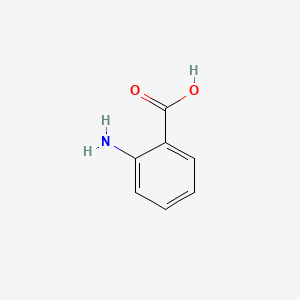
Anthranilic Acid
Anthranilic acid is an aminobenzoic acid that is benzoic acid having a single amino substituent located at position 2. It is a metabolite produced in L-tryptophan-kynurenine pathway in the central nervous system. It has a role as a mouse metabolite and a human metabolite. It is a conjugate acid of an anthranilate. — ChEBI
- IUPAC name
- 2-aminobenzoic acid
- Molecular formula
- C7H7NO2
- Molecular weight
- 137.14 g/mol
- Exact mass
- 137.047678466 Da
- XLogP3
- 1.2
- Topological polar surface area
- 63.3 Ų
- Hydrogen-bond donors
- 2
- Hydrogen-bond acceptors
- 3
- Covalent units
- 1
- Defined stereocentres
- 0
Also known as
16 more reported names
External database identifiers
- ChEBI:CHEBI:30754
- ChEMBL:CHEMBL14173
- EPA DTXSID:DTXSID8020094
- PubMed:29968805
- PubMed:23109729
- PubMed:23030663
- PubMed:22946444
- PubMed:22941480
- PubMed:22876454
- PubMed:22863798
- PubMed:22847699
- PubMed:22834303
- PubMed:22807264
- PubMed:22701112
- PubMed:22683540
Evidence from additional scientific databases
NIH PubChem PUG-View
Attributed physical-property, hazard, environmental and use annotations.
- Autoignition Temperature: >530 °C Source: ILO-WHO International Chemical Safety Cards (ICSCs)
- Boiling Point: Sublimes (NTP, 1992) Source: CAMEO Chemicals
- Boiling Point: Sublimes Source: Hazardous Substances Data Bank (HSDB)
- Color/Form: White to pale yellow, crystalline powder Source: Hazardous Substances Data Bank (HSDB)
- Color/Form: Leaves from alcohol Source: Hazardous Substances Data Bank (HSDB)
- Color/Form: NEEDLE-LIKE CRYSTALS Source: Hazardous Substances Data Bank (HSDB)
- Density: 1.412 (NTP, 1992) - Denser than water; will sink Source: CAMEO Chemicals
- Density: 1.412 at 20 °C Source: Hazardous Substances Data Bank (HSDB)
- Density: 1.4 g/cm³ Source: ILO-WHO International Chemical Safety Cards (ICSCs)
- Density: Relative density of the vapour/air-mixture at 20 °C (air = 1): 1.0 Source: ILO-WHO International Chemical Safety Cards (ICSCs)
- Density: 1.412 @ 20°C Source: PAC Chemical Database, U.S. Department of Energy
- Dissociation Constants: pKa = 2.14 Source: Hazardous Substances Data Bank (HSDB)
- Flash Point: 340 °F (NTP, 1992) Source: CAMEO Chemicals
- Flash Point: 150 °C Source: Haz-Map, Information on Hazardous Chemicals and Occupational Diseases
- Flash Point: 150 °C /from table/ Source: Hazardous Substances Data Bank (HSDB)
- Flash Point: 150 °C Source: ILO-WHO International Chemical Safety Cards (ICSCs)
- LogP: log Kow = 1.21 Source: Hazardous Substances Data Bank (HSDB)
- LogP: 1.21 Source: Human Metabolome Database (HMDB)
- LogP: 0.99-1.3 Source: ILO-WHO International Chemical Safety Cards (ICSCs)
- Melting Point: 291 to 295 °F (NTP, 1992) Source: CAMEO Chemicals
- Melting Point: 144-146 °C Source: Hazardous Substances Data Bank (HSDB)
- Melting Point: 146.5 °C Source: Human Metabolome Database (HMDB)
- Melting Point: 146-148 °C Source: ILO-WHO International Chemical Safety Cards (ICSCs)
- Physical Description: Anthranilic acid appears as odorless white to pale-yellow or tan crystalline powder with a sweetish taste. (NTP, 1992) Source: CAMEO Chemicals
- Physical Description: White to pale yellow solid; [Merck Index] Cream-colored odorless crystalline solid; [MSDSonline] Source: Haz-Map, Information on Hazardous Chemicals and Occupational Diseases
- Physical Description: Solid Source: Human Metabolome Database (HMDB)
- Physical Description: COLOURLESS-TO-YELLOW FLAKES OR WHITE-TO-YELLOW CRYSTALLINE POWDER. Source: ILO-WHO International Chemical Safety Cards (ICSCs)
- Solubility: less than 0.1 mg/mL at 68 °F (NTP, 1992) Source: CAMEO Chemicals
- Solubility: Freely soluble in alcohol, ether Source: Hazardous Substances Data Bank (HSDB)
- Solubility: Soluble in ethanol, ethyl ether, slightly soluble in trifluoroacetic acid, benzene, very soluble in chloroform, pyridine Source: Hazardous Substances Data Bank (HSDB)
- Solubility: In water, 3.5X10+3 mg/L at 25 °C Source: Hazardous Substances Data Bank (HSDB)
- Solubility: 3.5 mg/mL Source: Human Metabolome Database (HMDB)
- Solubility: Solubility in water, g/100ml at 20 °C: 0.35 (poor) Source: ILO-WHO International Chemical Safety Cards (ICSCs)
- Vapor Pressure: Negligible (NTP, 1992) Source: CAMEO Chemicals
- Vapor Pressure: 0.000278 [mmHg] Source: Haz-Map, Information on Hazardous Chemicals and Occupational Diseases
- Vapor Pressure: Vapor pressure, Pa at 52.6 °C: 0.1 Source: ILO-WHO International Chemical Safety Cards (ICSCs)
- IARC Carcinogenic Agent: Anthranilic acid Source: International Agency for Research on Cancer (IARC)
- IARC Carcinogenic Classes: Group 3: Not classifiable as to its carcinogenicity to humans Source: International Agency for Research on Cancer (IARC)
- IARC Monographs: Volume 16: (1978) Some Aromatic Amines and Related Nitro Compounds – Hair Dyes, Colouring Agents and Miscellaneous Industrial Chemicals; Volume Sup 7: Overall Evaluations of Carcinogenicity: An Updating of IARC Monographs Volumes 1 to 42, 1987; 440 pages; ISBN 92-832-1411-0 (out of print) Source: International Agency for Research on Cancer (IARC)
- Publication Year: 1987 Source: International Agency for Research on Cancer (IARC)
- Evaluation Year: 1987 Source: International Agency for Research on Cancer (IARC)
- Substance: o-Anthranilic acid Source: NTP Technical Reports
- NTP Technical Report: TR-036: Bioassay of Anthranilic Acid for Possible Carcinogenicity (CASRN 118-92-3) (1978 ) Source: NTP Technical Reports
- Peer Review Date: 11/28/77 Source: NTP Technical Reports
- Conclusion for Male Rat: No Evidence Source: NTP Technical Reports
- Conclusion for Female Rat: No Evidence Source: NTP Technical Reports
- Conclusion for Male Mice: No Evidence Source: NTP Technical Reports
- Conclusion for Female Mice: No Evidence Source: NTP Technical Reports
- Exposure Routes: The substance can be absorbed into the body by ingestion. Source: ILO-WHO International Chemical Safety Cards (ICSCs)
- Exposure Routes: Endogenous, Ingestion, Dermal (contact) Source: Toxin and Toxin Target Database (T3DB)
- First Aid: EYES: First check the victim for contact lenses and remove if present. Flush victim's eyes with water or normal saline solution for 20 to 30 minutes while simultaneously calling a hospital or poison control center. Do not put any ointments, oils, or medication in the victim's eyes without specific instructions from a physician. IMMEDIATELY transport the victim after flushing eyes to a hospital even if no symptoms (such as redness or irritation) develop.; SKIN: IMMEDIATELY flood affected skin with water while removing and isolating all contaminated clothing. Gently wash all affected skin areas thoroughly with soap and water. If symptoms such as redness or irritation develop, IMMEDIATELY call a physician and be prepared to transport the victim to a hospital for treatment.; INHALATION: IMMEDIATELY leave the contaminated area; take deep breaths of fresh air. If symptoms (such as wheezing, coughing, shortness of breath, or burning in the mouth, throat, or chest) develop, call a physician and be prepared to transport the victim to a hospital. Provide proper respiratory protection to rescuers entering an unknown atmosphere. Whenever possible, Self-Contained Breathing Apparatus (SCBA) shou Source: CAMEO Chemicals
- Note: This chemical does not meet GHS hazard criteria for 0.3% (1 of 321) of reports. Source: European Chemicals Agency (ECHA)
- Signal: Danger Source: European Chemicals Agency (ECHA)
- GHS Hazard Statements: H318 (49.5%): Causes serious eye damage [Danger Serious eye damage/eye irritation]; H319 (50.2%): Causes serious eye irritation [Warning Serious eye damage/eye irritation] Source: European Chemicals Agency (ECHA)
- Precautionary Statement Codes: P264+P265, P280, P305+P351+P338, P305+P354+P338, P317, and P337+P317 (click each P-code to see the statement) Source: European Chemicals Agency (ECHA)
- ECHA C&L Notifications Summary: Aggregated GHS information provided per 321 reports by companies from 9 notifications to the ECHA C&L Inventory. Each notification may be associated with multiple companies.; Reported as not meeting GHS hazard criteria per 1 of 321 reports by companies.; There are 8 notifications provided by 320 of 321 reports by companies with hazard statement code(s).; Information may vary between notifications depending on impurities, additives, and other factors. The percentage value in parenthesis indicates the notified classification ratio from companies that provide hazard codes. Only hazard codes with percentage values above 10% are shown. For more detailed information, please visit ECHA C&L website. Source: European Chemicals Agency (ECHA)
- Signal: Danger Source: Hazardous Chemical Information System (HCIS), Safe Work Australia
- GHS Hazard Statements: H318: Causes serious eye damage [Danger Serious eye damage/eye irritation] Source: Hazardous Chemical Information System (HCIS), Safe Work Australia
- Precautionary Statement Codes: P264+P265, P280, P305+P354+P338, and P317 (click each P-code to see the statement) Source: Hazardous Chemical Information System (HCIS), Safe Work Australia
- Health Effects: Chronic exposure to uremic toxins can lead to a number of conditions including renal damage, chronic kidney disease and cardiovascular disease. Source: Toxin and Toxin Target Database (T3DB)
- Toxicity Summary: Uremic toxins such as anthranilic acid are actively transported into the kidneys via organic ion transporters (especially OAT3). Increased levels of uremic toxins can stimulate the production of reactive oxygen species. This seems to be mediated by the direct binding or inhibition by uremic toxins of the enzyme NADPH oxidase (especially NOX4 which is abundant in the kidneys and heart) (A7868). Reactive oxygen species can induce several different DNA methyltransferases (DNMTs) which are involved in the silencing of a protein known as KLOTHO. KLOTHO has been identified as having important roles in anti-aging, mineral metabolism, and vitamin D metabolism. A number of studies have indicated that KLOTHO mRNA and protein levels are reduced during acute or chronic kidney diseases in response to high local levels of reactive oxygen species (A7869). Source: Toxin and Toxin Target Database (T3DB)
- Environmental Bioconcentration: An estimated BCF of 3 was calculated in fish for anthranilic acid(SRC), using a log Kow of 1.21(1) and a regression-derived equation(2). According to a classification scheme(3), this BCF suggests the potential for bioconcentration in aquatic organisms is low(SRC). Source: Hazardous Substances Data Bank (HSDB)
- Environmental Fate: TERRESTRIAL FATE: Based on a classification scheme(1), an estimated Koc value of 110(SRC), determined from a log Kow of 1.21(2) and a regression-derived equation(3), indicates that anthranilic acid is expected to have high mobility in soil(SRC). The pKa of anthranilic acid is 2.14(4), indicating that this compound will primarily exist in anion form in the environment and anions generally do not adsorb more strongly to soils containing organic carbon and clay than their neutral counterparts(5). Volatilization of anthranilic acid from moist soil surfaces is not expected to be an important fate process(SRC) given an estimated Henry's Law constant of 3.8X10⁻¹¹ atm-cu m/mole(SRC), using a fragment constant estimation method(6). Anthranilic acid is not expected to volatilize from dry soil surfaces(SRC) based upon an estimated vapor pressure of 2.8X10⁻⁴ mm Hg(SRC), determined from a fragment constant method(7). Anthranilic acid (10 ppm) degraded 100% in 2 days using a 1% suspension of Niagara silt loam at 25 °C(8). Source: Hazardous Substances Data Bank (HSDB)
- Environmental Fate: AQUATIC FATE: Based on a classification scheme(1), an estimated Koc value of 110(SRC), determined from a log Kow of 1.21(2) and a regression-derived equation(3), indicates that anthranilic acid is not expected to adsorb to suspended solids and sediment(SRC). Volatilization from water surfaces is not expected(3) based upon an estimated Henry's Law constant of 3.8X10⁻¹¹ atm-cu m/mole(SRC), developed using a fragment constant estimation method(4). According to a classification scheme(5), an estimated BCF of 3(SRC), from its log Kow(2) and a regression-derived equation(6), suggests the potential for bioconcentration in aquatic organisms is low(SRC). Anthranilic acid was shown to degrade rapidly in a variety of aqueous aerobic and anaerobic screening test(7-16). Anthranilic acid photodegrades rapidly in natural seawater(17). Anthranilic acid is shown to have a maximum absorption at 337 nm(18) and therefore may be susceptible to direct photolysis by sunlight(SRC). Source: Hazardous Substances Data Bank (HSDB)
- Environmental Fate: ATMOSPHERIC FATE: According to a model of gas/particle partitioning of semivolatile organic compounds in the atmosphere(1), anthranilic acid, which has an estimated vapor pressure of 2.8X10⁻⁴ mm Hg at 25 °C(SRC), determined from a fragment constant method(2), is expected to exist solely as a vapor in the ambient atmosphere. Vapor-phase anthranilic acid is degraded in the atmosphere by reaction with photochemically-produced hydroxyl radicals(SRC); the half-life for this reaction in air is estimated to be 10 hours(SRC), calculated from its rate constant of 4.0X10⁻¹¹ cu cm/molecule-sec at 25 °C(SRC) that was derived using a structure estimation method(3). Source: Hazardous Substances Data Bank (HSDB)
- Sources/Uses: Used as an intermediate for dyes, drugs, pesticides, perfumes, flavors, and bird and insect repellents; Also used as a mold inhibitor in soya sauce and to enhance the milk production in cows; [HSDB] Source: Haz-Map, Information on Hazardous Chemicals and Occupational Diseases
- Industrial Processes with risk of exposure: Farming (Feed Additives) [Category: Industry] Source: Haz-Map, Information on Hazardous Chemicals and Occupational Diseases
- Uses: Dyes, drugs, perfumes, and pharmaceuticals. Source: Hazardous Substances Data Bank (HSDB)
- Uses: CHEM INT FOR CI ACID YELLOW 121, VAT VIOLET 13, VAT BLUE 1, CI DIRECT BROWN 112, MORDANT YELLOW, MORDANT RED 9, MORDANT BROWN 40, & PIGMENT RED 60, & FOR ITS ESTERS USED IN PERFUMES & FUNGICIDES, & IN SACCHARIN; CADMIUM SALT- AN ASCARICIDE IN SWINE; MOLD INHIBITOR IN SOYA SAUCE Source: Hazardous Substances Data Bank (HSDB)
- Uses: As mold inhibitor in soya sauce; its esters have found applications in perfumes, synthetic flavors, bird and insect repellents, as fungicides for syrups Source: Hazardous Substances Data Bank (HSDB)
- Uses: THERAP CAT (VET): The cadmium salt has been used as an acaricide in swine Source: Hazardous Substances Data Bank (HSDB)
- Uses: ... Enhances the milk production in cows. ... Intermediate for dyes. ... Intermediate for tranquilizers and antiphlogistics. Source: Hazardous Substances Data Bank (HSDB)
- Uses: Naturally produced by the body (endogenous). Source: Toxin and Toxin Target Database (T3DB)
Mapped by: Existing checksum-valid CAS to unique PubChem CID match. Retrieved: 2026-08-31. Open source record
Scientific classifications and hazard annotations provide context and do not replace the market-specific regulatory decision shown above.
Additional source coverage and match status
| Source | Result | Checked |
|---|---|---|
| NIH PubChem PUG-View | Exact match | 2026-08-31 |
A recorded no-match is useful evidence that the source was checked; it is not a claim that the substance does not exist elsewhere.
Retrieved from NIH PubChem on 2026-09-02 by checksum-valid CAS matching. Chemical properties do not replace the regulatory decision on this page.