
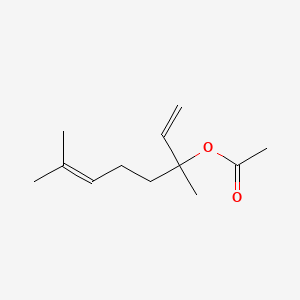
Linalyl Acetate
3,7-dimethylocta-1,6-dien-3-yl acetate is a monoterpenoid that is the acetate ester of linalool. It forms a principal component of the essential oils from bergamot and lavender. It is a monoterpenoid and an acetate ester. It is functionally related to a linalool. — ChEBI
- IUPAC name
- 3,7-dimethylocta-1,6-dien-3-yl acetate
- Molecular formula
- C12H20O2
- Molecular weight
- 196.29 g/mol
- Exact mass
- 196.146329876 Da
- XLogP3
- 3.3
- Topological polar surface area
- 26.3 Ų
- Hydrogen-bond donors
- 0
- Hydrogen-bond acceptors
- 2
- Covalent units
- 1
- Defined stereocentres
- 0
Also known as
16 more reported names
External database identifiers
- ChEBI:CHEBI:78333
- ChEMBL:CHEMBL502773
- EPA DTXSID:DTXSID7026946
- PubMed:38000518
- PubMed:31393563
- PubMed:29276222
- PubMed:22897411
- PubMed:22789458
- PubMed:22740257
- PubMed:22700236
- PubMed:22654407
- PubMed:22606003
- PubMed:22483097
- PubMed:22465092
- PubMed:22439877
Evidence from additional scientific databases
NIH PubChem PUG-View
Attributed physical-property, hazard, environmental and use annotations.
- Autoignition Temperature: 225 °C Source: ILO-WHO International Chemical Safety Cards (ICSCs)
- Boiling Point: 221 °C Source: Hazardous Substances Data Bank (HSDB)
- Boiling Point: 220.00 °C. @ 760.00 mm Hg Source: Human Metabolome Database (HMDB)
- Boiling Point: 220 °C Source: ILO-WHO International Chemical Safety Cards (ICSCs)
- Boiling Point: 220 °C Source: Joint FAO/WHO Expert Committee on Food Additives (JECFA)
- Color/Form: Clear, colorless, oily liquid Source: Hazardous Substances Data Bank (HSDB)
- Density: 0.895 g/cu cm at 20 °C Source: Hazardous Substances Data Bank (HSDB)
- Density: Relative density (water = 1): 0.9 Source: ILO-WHO International Chemical Safety Cards (ICSCs)
- Density: 0.895-0.914 Source: Joint FAO/WHO Expert Committee on Food Additives (JECFA)
- Flash Point: 94 °C (201 °F) - closed cup Source: Hazardous Substances Data Bank (HSDB)
- Flash Point: 185 °F (85 °C) (closed cup) Source: Hazardous Substances Data Bank (HSDB)
- Flash Point: 85 °C c.c. Source: ILO-WHO International Chemical Safety Cards (ICSCs)
- LogP: log Kow = 3.93 Source: Hazardous Substances Data Bank (HSDB)
- LogP: 3.93 Source: Human Metabolome Database (HMDB)
- LogP: 3.9 Source: ILO-WHO International Chemical Safety Cards (ICSCs)
- Melting Point: < 25 °C Source: Human Metabolome Database (HMDB)
- Odor: ...floral-fruity odor, reminiscent of bergamot and it also has some pear character Source: Hazardous Substances Data Bank (HSDB)
- Odor: Bergamot-lavender odor Source: Hazardous Substances Data Bank (HSDB)
- Odor: Sweet, floral-fruity odor recalling Bergamot and Pear. Source: Hazardous Substances Data Bank (HSDB)
- Physical Description: CBI; Dry Powder; Liquid; Liquid; Liquid; Other Solid Source: EPA Chemical Data Reporting (CDR)
- Physical Description: Clear colorless liquid with an odor of bergamot; [Hawley] Source: Haz-Map, Information on Hazardous Chemicals and Occupational Diseases
- Physical Description: Solid Source: Human Metabolome Database (HMDB)
- Physical Description: COLOURLESS LIQUID WITH CHARACTERISTIC ODOUR. Source: ILO-WHO International Chemical Safety Cards (ICSCs)
- Physical Description: colourless liquid with a floral, fruity odour Source: Joint FAO/WHO Expert Committee on Food Additives (JECFA)
- Refractive Index: Index of refraction: 1.4500 at 20 °C (natural); 1.4495-1.4512 at 20 °C (synthetic); optical rotation: -7 deg 42 min to +8 deg 18 min (natural); + or - 0 deg (synthetic) Source: Hazardous Substances Data Bank (HSDB)
- Refractive Index: Index of refraction: 1.4460 at 20 °C/D Source: Hazardous Substances Data Bank (HSDB)
- Refractive Index: 1.448-1.452 Source: Joint FAO/WHO Expert Committee on Food Additives (JECFA)
- Solubility: Insoluble in water Source: Hazardous Substances Data Bank (HSDB)
- Solubility: Miscible with ethanol, ether Source: Hazardous Substances Data Bank (HSDB)
- Solubility: Soluble in alcohol, ether, diethyl phthalate, benzyl benzoate, mineral oil, fixed oils; slightly soluble in propylene glycol; insoluble in glycerol. Source: Hazardous Substances Data Bank (HSDB)
- Solubility: Solubility in water: poor Source: ILO-WHO International Chemical Safety Cards (ICSCs)
- Solubility: slightly soluble in propylene glycol; insoluble in glycerol and water; miscible with alcohol and fixed oils Source: Joint FAO/WHO Expert Committee on Food Additives (JECFA)
- Solubility: 1 ml in 5 ml 70% alcohol (in ethanol) Source: Joint FAO/WHO Expert Committee on Food Additives (JECFA)
- Vapor Pressure: 0.11 [mmHg] Source: Haz-Map, Information on Hazardous Chemicals and Occupational Diseases
- Vapor Pressure: 0.111 mm Hg at 25 °C Source: Hazardous Substances Data Bank (HSDB)
- Vapor Pressure: Vapor pressure, Pa at 20 °C: 0.6 Source: ILO-WHO International Chemical Safety Cards (ICSCs)
- Viscosity: 2.4 mm²/s at 23 °C Source: ILO-WHO International Chemical Safety Cards (ICSCs)
- Carcinogen Classification: No indication of carcinogenicity to humans (not listed by IARC). Source: Toxin and Toxin Target Database (T3DB)
- Note: This chemical does not meet GHS hazard criteria for 13.5% (316 of 2347) of reports. Source: European Chemicals Agency (ECHA)
- Signal: Warning Source: European Chemicals Agency (ECHA)
- GHS Hazard Statements: H315 (85.5%): Causes skin irritation [Warning Skin corrosion/irritation]; H317 (12.2%): May cause an allergic skin reaction [Warning Sensitization, Skin]; H319 (85.3%): Causes serious eye irritation [Warning Serious eye damage/eye irritation] Source: European Chemicals Agency (ECHA)
- Precautionary Statement Codes: P261, P264, P264+P265, P272, P280, P302+P352, P305+P351+P338, P321, P332+P317, P333+P317, P337+P317, P362+P364, and P501 (click each P-code to see the statement) Source: European Chemicals Agency (ECHA)
- ECHA C&L Notifications Summary: Aggregated GHS information provided per 2347 reports by companies from 25 notifications to the ECHA C&L Inventory. Each notification may be associated with multiple companies.; Reported as not meeting GHS hazard criteria per 316 of 2347 reports by companies.; There are 24 notifications provided by 2031 of 2347 reports by companies with hazard statement code(s).; Information may vary between notifications depending on impurities, additives, and other factors. The percentage value in parenthesis indicates the notified classification ratio from companies that provide hazard codes. Only hazard codes with percentage values above 10% are shown. For more detailed information, please visit ECHA C&L website. Source: European Chemicals Agency (ECHA)
- Signal: Warning Source: NITE-CMC
- GHS Hazard Statements: H227: Combustible liquid [Warning Flammable liquids]; H315: Causes skin irritation [Warning Skin corrosion/irritation]; H317: May cause an allergic skin reaction [Warning Sensitization, Skin]; H336: May cause drowsiness or dizziness [Warning Specific target organ toxicity, single exposure; Narcotic effects]; H401: Toxic to aquatic life [Hazardous to the aquatic environment, acute hazard] Source: NITE-CMC
- Precautionary Statement Codes: P210, P261, P264, P271, P272, P273, P280, P302+P352, P304+P340, P319, P321, P332+P317, P333+P317, P362+P364, P370+P378, P403, P403+P233, P405, and P501 (click each P-code to see the statement) Source: NITE-CMC
- Signal: Warning Source: Hazardous Chemical Information System (HCIS), Safe Work Australia
- GHS Hazard Statements: H315: Causes skin irritation [Warning Skin corrosion/irritation]; H317: May cause an allergic skin reaction [Warning Sensitization, Skin] Source: Hazardous Chemical Information System (HCIS), Safe Work Australia
- Precautionary Statement Codes: P261, P264, P272, P280, P302+P352, P321, P332+P317, P333+P317, P362+P364, and P501 (click each P-code to see the statement) Source: Hazardous Chemical Information System (HCIS), Safe Work Australia
- Signal: Warning Source: Hazardous Substances Data Bank (HSDB)
- NFPA Health Rating: 2 - Materials that, under emergency conditions, can cause temporary incapacitation or residual injury. Source: Hazardous Substances Data Bank (HSDB)
- NFPA Fire Rating: 2 - Materials that must be moderately heated or exposed to relatively high ambient temperatures before ignition can occur. Materials would not under normal conditions form hazardous atmospheres with air, but under high ambient temperatures or under moderate heating could release vapor in sufficient quantities to produce hazardous atmospheres with air. Source: Hazardous Substances Data Bank (HSDB)
- NFPA Instability Rating: 0 - Materials that in themselves are normally stable, even under fire conditions. Source: Hazardous Substances Data Bank (HSDB)
- Toxicity Summary: IDENTIFICATION AND USE: Linalyl acetate is a clear, colorless, oily liquid. It is an excellent fragrance material. It can also be employed in soaps and detergents and as a food additive. It is a component of oil paint. It is used in extracts and as a substitute for petitgrain oil. HUMAN EXPOSURE AND TOXICITY: Application of linalyl acetate in acetone (33%) to the back of male volunteers without known allergies during 48 hours under occlusion did not induce signs of irritation up to 120 hours after removal of the patch. Linalyl acetate is identified as one of the constituents of lavender oil that may cause allergic reactions. Oxidized linalyl acetate could be a common fragrance contact allergen. The potential genotoxicity of linalyl acetate, was evaluated in vitro by the micronucleus test on peripheral human lymphocytes. In the range of non-toxic concentrations (0.5-100 ug/mL), linalyl acetate increased the frequency of micronuclei significantly and in concentration-dependent manner. In a chromosome aberration test with human lymphocytes, linalyl acetate did not induce aberrations, both with and without S-9 mix. ANIMAL STUDIES: Inhalation exposure of mice to 2.74 mg linalyl acetate/ Source: Hazardous Substances Data Bank (HSDB)
- Environmental Bioconcentration: An estimated BCF of 180 was calculated in fish for linalyl acetate(SRC), using a log Kow of 3.93(1) and a regression-derived equation(2). According to a classification scheme(3), this BCF suggests the potential for bioconcentration in aquatic organisms is high(SRC). Source: Hazardous Substances Data Bank (HSDB)
- Environmental Fate: TERRESTRIAL FATE: Based on a classification scheme(1), an estimated Koc value of 430(SRC), determined from a structure estimation method(2), indicates that linalyl acetate is expected to have moderate mobility in soil(SRC). Volatilization of linalyl acetate from moist soil surfaces is expected to be an important fate process(SRC) given an estimated Henry's Law constant of 1.7X10⁻⁴ atm-cu m/mole(SRC), using a fragment constant estimation method(2). Linalyl acetate has a reported vapor pressure of 0.111 mm Hg(3) and exists as a liquid under environmental conditions; therefore, linalyl acetate may volatilize from dry soil(SRC). A 75% of Theoretical BOD using activated sludge in the Japanese MITI test(4) suggests that biodegradation is an important environmental fate process in soil(SRC). Source: Hazardous Substances Data Bank (HSDB)
- Environmental Fate: AQUATIC FATE: Based on a classification scheme(1), an estimated Koc value of 430(SRC), determined from a structure estimation method(2), indicates that linalyl acetate is expected to adsorb to suspended solids and sediment(SRC). Volatilization from water surfaces is expected(3) based upon an estimated Henry's Law constant of 1.7X10⁻³ atm-cu m/mole(SRC), developed using a fragment constant estimation method(2). Using this Henry's Law constant and an estimation method(3), volatilization half-lives for a model river and model lake are 4.8 hours and 5.8 days, respectively(SRC). The hydrolysis half-life is <24 hours at 20 °C, with expected end products of linalool and acetic acid(4). According to a classification scheme(5), an estimated BCF of 180(SRC), from its log Kow of 3.93(6) and a regression-derived equation(2), suggests the potential for bioconcentration in aquatic organisms is high(SRC). A 75% of Theoretical BOD using activated sludge in the Japanese MITI test(4) suggests that biodegradation is an important environmental fate process in water(SRC). Source: Hazardous Substances Data Bank (HSDB)
- Environmental Fate: ATMOSPHERIC FATE: According to a model of gas/particle partitioning of semivolatile organic compounds in the atmosphere(1), linalyl acetate, which has a vapor pressure of 0.111 mm Hg at 25 °C(2), is expected to exist solely as a vapor in the ambient atmosphere. Vapor-phase linalyl acetate is degraded in the atmosphere by reaction with photochemically-produced hydroxyl radicals and ozone(SRC); the half-lives for these reactions in air are estimated to be 200 and 38 minutes, respectively(SRC), calculated from respective rate constants of 1.2X10⁻¹⁰ and 4.3X10⁻¹⁶ cu cm/molecule-sec at 25 °C(SRC) that were derived using structure estimation methods(3). Linalyl acetate may also react with nitrate radicals in the atmosphere(4). Linalyl acetate does not contain chromophores that absorb at wavelengths >290 nm(5) and, therefore, is not expected to be susceptible to direct photolysis by sunlight(SRC). Source: Hazardous Substances Data Bank (HSDB)
- Consumer Uses: Odor agents; Fragrance; Other Source: EPA Chemical Data Reporting (CDR)
- Industry Uses: Fragrance; Odor agents; Flavoring and nutrient; Other Source: EPA Chemical Data Reporting (CDR)
- Sources/Uses: Present in bergamot, lavender, and other volatile oils; [Merck Index] Used in perfumes, soaps, cleaning products, cosmetics, oil paints, and flavoring extracts; [HSDB] Source: Haz-Map, Information on Hazardous Chemicals and Occupational Diseases
- Industrial Processes with risk of exposure: Painting (Solvents) [Category: Paint] Source: Haz-Map, Information on Hazardous Chemicals and Occupational Diseases
- Uses: Extracts, perfumery, flavoring agent, substitute for petitgrain oil. Source: Hazardous Substances Data Bank (HSDB)
- Uses: /In perfumery/ it is widely used as a fresh and sweet blender. Source: Hazardous Substances Data Bank (HSDB)
- Uses: It is an excellent fragrance material for, among others, bergamot, lilac, lavender, linden, neroli, ylang-ylang, and phantasy notes (particularly chypre). Smaller amounts are used in other citrus products. Since linalyl acetate is fairly stable toward alkali, it can also be employed in soaps and detergents. Source: Hazardous Substances Data Bank (HSDB)
- Uses: Reported uses (ppm): (Flavor and Extract Manufacturers' Association, 1994); Table: Reported uses (ppm): (Flavor and Extract Manufacturers' Association, 1994) [Table#1850] Source: Hazardous Substances Data Bank (HSDB)
- Uses: /Lynalyl acetate/ is used as an intermediate and found in soaps, cleaning products and cosmetics (perfume) ... . It is a component of oil paint, is used in extracts and as a substitute for petitgrain oil ... Linalyl acetate is a food additive. Foodstuffs contain between 1.9 (soft drinks) and 13 ppm (chewing gum) linalyl acetate ... . The Danish product register indicates that linalyl acetate is a constituent of several industrial products (odor agents, cleaning/washing agents, cosmetics, absorbents and adsorbents, process regulators, welding and soldering agents, non-agricultural pesticides and preservatives, surface treatment). The total amount per product of the substance was 2% or less, except in odor agents (<20%) ... . The Norwegian Product register indicates that linalyl acetate is used in car polish (wax), ordinary cleaning products and detergents (for textile). The content in the products is between 0 and 1% ... . Source: Hazardous Substances Data Bank (HSDB)
Mapped by: Existing checksum-valid CAS to unique PubChem CID match. Retrieved: 2026-08-31. Open source record
Scientific classifications and hazard annotations provide context and do not replace the market-specific regulatory decision shown above.
Additional source coverage and match status
| Source | Result | Checked |
|---|---|---|
| NIH PubChem PUG-View | Exact match | 2026-08-31 |
A recorded no-match is useful evidence that the source was checked; it is not a claim that the substance does not exist elsewhere.
Retrieved from NIH PubChem on 2026-09-02 by checksum-valid CAS matching. Chemical properties do not replace the regulatory decision on this page.