
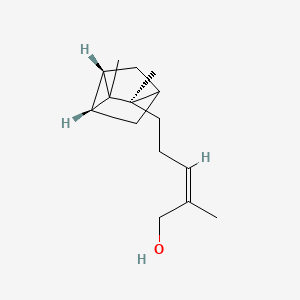
CAS 115-71-9PubChem CID 11085337
Alpha-Santalol
- IUPAC name
- (Z)-5-[(1S,3R,6R)-2,3-dimethyl-3-tricyclo[2.2.1.02,6]heptanyl]-2-methylpent-2-en-1-ol
- Molecular formula
- C15H24O
- Molecular weight
- 220.35 g/mol
- Exact mass
- 220.182715385 Da
- XLogP3
- 4.0
- Topological polar surface area
- 20.2 Ų
- Hydrogen-bond donors
- 1
- Hydrogen-bond acceptors
- 1
- Covalent units
- 1
- Defined stereocentres
- 3
Also known as
(Z)-alpha-SantalolSantalol A15X09F275512-ALPHA-SANTALEN-14-OL2-Penten-1-ol, 5-(2,3-dimethyltricyclo(2.2.1.0(sup 2,6))hept-3-yl)-2-methylCHEBI:10330(Z)-5-((1R,3R,6S)-2,3-dimethyl-3-tricyclo(2.2.1.02,6)heptanyl)-2-methylpent-2-en-1-ol(Z)-5-[(1R,3R,6S)-2,3-dimethyl-3-tricyclo[2.2.1.02,6]heptanyl]-2-methylpent-2-en-1-ol
16 more reported names
RefChem:1076563(Z)-5-(2,3-dimethyl-3-tricyclo(2.2.1.02,6)heptanyl)-2-methylpent-2-en-1-ol(2Z)-5-((2R,3R,4S)-2,3-dimethyltricyclo(2.2.1.0(2,6))hept-3-yl)-2-methylpent-2-en-1-olFEMA NO. 3006, ALPHA-(Z)-5-((1R,3R,6S)-2,3-dimethyl-4,5,6,7-tetrahydro-1H-tricyclo(2.2.1.0^(2,6))heptan-3-yl)-2-methylpent-2-en-1-ol204-102-8(R(Z))-5-(2,3-dimethyltricyclo(2.2.1.0(2,6))hept-3-yl)-2-methyl-2-penten-1-olcis-alpha-Santalol2-Penten-1-ol, 5-[(1R,3R,6S)-2,3-dimethyltricyclo[2.2.1.02,6]hept-3-yl]-2-methyl-, (2Z)-cis-.alpha.-Santalol(+)-.alpha.-Santalol.alpha.-SantalolArgeolArheol(+)-|A-santalol2-Penten-1-ol, 5-((1R,3R,6S)-2,3-dimethyltricyclo(2.2.1.02,6)hept-3-yl)-2-methyl-, (2Z)-
External database identifiers
- ChEMBL:CHEMBL512210
- EPA DTXSID:DTXSID9051587
Evidence from additional scientific databases
NIH PubChem PUG-View
Exact identifier match11085337
Attributed physical-property, hazard, environmental and use annotations.
- Boiling Point: 166-167 °C @ 14 MM HG Source: Hazardous Substances Data Bank (HSDB)
- Density: 0.9770 @ 25 °C/25 °C Source: Hazardous Substances Data Bank (HSDB)
- Density: NATURAL BETA-SANTALOL HAS SEQCIS-CONFIGURATION; BP 177-178 °C; DENSITY 0.9717 @ 25 °C/25 °C /BETA-SANTALOL/ Source: Hazardous Substances Data Bank (HSDB)
- Flash Point: Flash point > 100 °C Source: Haz-Map, Information on Hazardous Chemicals and Occupational Diseases
- Flash Point: GREATER THAN 212 °F CC Source: Hazardous Substances Data Bank (HSDB)
- Odor: SWEET, SANDALWOOD ODOR Source: Hazardous Substances Data Bank (HSDB)
- Physical Description: Liquid; [Merck Index] Sweet odor; [HSDB] Source: Haz-Map, Information on Hazardous Chemicals and Occupational Diseases
- Refractive Index: INDEX OF REFRACTION: 1.5100 @ 25 °C/D /BETA-SANTALOL/ Source: Hazardous Substances Data Bank (HSDB)
- Refractive Index: INDEX OF REFRACTION: 1.5017 @ 25 °C/D; NATURAL ALPHA-SANTALOL HAS SEQCIS-CONFIGURATION Source: Hazardous Substances Data Bank (HSDB)
- Solubility: SOL IN ALC; PRACTICALLY INSOL IN WATER /BETA-SANTALOL/ Source: Hazardous Substances Data Bank (HSDB)
- Solubility: SOL IN ALC; SLIGHTLY SOL IN PROPYLENE GLYCOL, GLYCERINE Source: Hazardous Substances Data Bank (HSDB)
- Solubility: PRACTICALLY INSOL IN WATER Source: Hazardous Substances Data Bank (HSDB)
- Note: This chemical does not meet GHS hazard criteria for 68.4% (78 of 114) of all reports. Source: European Chemicals Agency (ECHA)
- Signal: Warning Source: European Chemicals Agency (ECHA)
- GHS Hazard Statements: H317 (31.6%): May cause an allergic skin reaction [Warning Sensitization, Skin] Source: European Chemicals Agency (ECHA)
- Precautionary Statement Codes: P261, P272, P280, P302+P352, P321, P333+P317, P362+P364, and P501 (click each P-code to see the statement) Source: European Chemicals Agency (ECHA)
- ECHA C&L Notifications Summary: Aggregated GHS information provided per 114 reports by companies from 3 notifications to the ECHA C&L Inventory.; Reported as not meeting GHS hazard criteria per 78 of 114 reports by companies.; There are 2 notifications provided by 36 of 114 reports by companies with hazard statement code(s).; Information may vary between notifications depending on impurities, additives, and other factors. The percentage value in parenthesis indicates the notified classification ratio from companies that provide hazard codes. Only hazard codes with percentage values above 10% are shown. For more detailed information, please visit ECHA C&L website. Source: European Chemicals Agency (ECHA)
- Signal: Warning Source: Hazardous Chemical Information System (HCIS), Safe Work Australia
- GHS Hazard Statements: H317: May cause an allergic skin reaction [Warning Sensitization, Skin] Source: Hazardous Chemical Information System (HCIS), Safe Work Australia
- Precautionary Statement Codes: P261, P272, P280, P302+P352, P321, P333+P317, P362+P364, and P501 (click each P-code to see the statement) Source: Hazardous Chemical Information System (HCIS), Safe Work Australia
- NFPA Health Rating: 0 - Materials that, under emergency conditions, would offer no hazard beyond that of ordinary combustible materials. Source: Hazardous Substances Data Bank (HSDB)
- NFPA Fire Rating: 1 - Materials that must be preheated before ignition can occur. Materials require considerable preheating, under all ambient temperature conditions, before ignition and combustion can occur. Source: Hazardous Substances Data Bank (HSDB)
- NFPA Instability Rating: 0 - Materials that in themselves are normally stable, even under fire conditions. Source: Hazardous Substances Data Bank (HSDB)
- Sources/Uses: Together with beta-Santalol, account for about 90% of commercial sandalwood oil; Used in perfumes, soaps, and detergents; [Merck Index] Used as a synthetic flavor; [HSDB] Source: Haz-Map, Information on Hazardous Chemicals and Occupational Diseases
- Uses: IN PERFUMES, SOAPS & DETERGENTS /ALPHA & BETA-SANTALOL/ Source: Hazardous Substances Data Bank (HSDB)
- Uses: SYNTHETIC FLAVOR Source: Hazardous Substances Data Bank (HSDB)
Mapped by: Existing checksum-valid CAS to unique PubChem CID match. Retrieved: 2026-08-31. Open source record
Scientific classifications and hazard annotations provide context and do not replace the market-specific regulatory decision shown above.
Additional source coverage and match status
| Source | Result | Checked |
|---|---|---|
| NIH PubChem PUG-View | Exact match | 2026-08-31 |
A recorded no-match is useful evidence that the source was checked; it is not a claim that the substance does not exist elsewhere.
Retrieved from NIH PubChem on 2026-09-02 by checksum-valid CAS matching. Chemical properties do not replace the regulatory decision on this page.