
CAS 115-09-3PubChem CID 409301
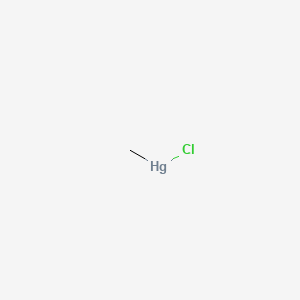
Methylmercury chloride
Methyl mercury(ii)chloride appears as white microcrystals or crystals. (NTP, 1992) — CAMEO Chemicals
- IUPAC name
- chloro(methyl)mercury
- Molecular formula
- CH3ClHg
- Molecular weight
- 251.08 g/mol
- Exact mass
- 251.962971 Da
- Topological polar surface area
- 0.0 Ų
- Hydrogen-bond donors
- 0
- Hydrogen-bond acceptors
- 0
- Covalent units
- 1
- Defined stereocentres
- 0
Also known as
Methylmercuric chlorideMercury methyl chlorideMethyl meruric chlorideMethyl mercuric chlorideMonomethyl mercury chlorideMethylmerkurichloridMethylmercury monochlorideChloromethyl mercury
16 more reported names
MercurymethylchlorideCH3HgClMeHgClMethyl mercuric(II) chlorideMonomethylmercury chlorideRWZ4L3O1X0CHEBI:28216NSC-19998methyl mercury chlorideRefChem:818645204-064-2ChloromethylmercuryCaspanMethylmercury(II) chlorideMercury, chloromethyl-Mercurymethyl chloride
External database identifiers
Evidence from additional scientific databases
NIH PubChem PUG-View
Exact identifier match409301
Attributed physical-property, hazard, environmental and use annotations.
- Color/Form: White crystals ... or plates from ethanol Source: Hazardous Substances Data Bank (HSDB)
- Density: 4.06 at 77 °F (NTP, 1992) - Denser than water; will sink Source: CAMEO Chemicals
- Density: 4.063 Source: Hazardous Substances Data Bank (HSDB)
- LogP: log Kow = 0.41 Source: Hazardous Substances Data Bank (HSDB)
- Melting Point: 338 °F (NTP, 1992) Source: CAMEO Chemicals
- Melting Point: 170 °C Source: Hazardous Substances Data Bank (HSDB)
- Odor: Characteristic Source: Hazardous Substances Data Bank (HSDB)
- Physical Description: Methyl mercury(ii)chloride appears as white microcrystals or crystals. (NTP, 1992) Source: CAMEO Chemicals
- Physical Description: White solid; [CAMEO] Source: Haz-Map, Information on Hazardous Chemicals and Occupational Diseases
- Solubility: less than 0.1 mg/mL at 70 °F (NTP, 1992) Source: CAMEO Chemicals
- Solubility: METHYL- & ETHYLMERCURY CHLORIDE HAVE A HIGH SOLUBILITY IN SOLVENTS & LIPIDS; SHORT-CHAIN ALKYLMERCURIC COMPOUNDS FORM SALTS WITH HALOGENS, WHICH ARE HIGHLY VOLATILE AT ROOM TEMP; SATURATION CONCN OF METHYLMERCURY CHLORIDE AT 20 °C IS 90000 MG MERCURY/CU M; OTHER SALTS, SUCH AS HYDROXIDE & NITRATE OF METHYLMERCURY ARE LESS VOLATILE /METHYLMERCURY COMPOUNDS/ Source: Hazardous Substances Data Bank (HSDB)
- Vapor Pressure: 0.0085 mmHg (NTP, 1992) Source: CAMEO Chemicals
- Vapor Pressure: 8.5X10⁻³ mm Hg at 25 °C Source: Hazardous Substances Data Bank (HSDB)
- Carcinogen Classification: 2B, possibly carcinogenic to humans. (L135) Source: Toxin and Toxin Target Database (T3DB)
- Exposure Routes: Oral (L7) ; inhalation (L7); dermal (L7) Source: Toxin and Toxin Target Database (T3DB)
- First Aid: EYES: First check the victim for contact lenses and remove if present. Flush victim's eyes with water or normal saline solution for 20 to 30 minutes while simultaneously calling a hospital or poison control center. Do not put any ointments, oils, or medication in the victim's eyes without specific instructions from a physician. IMMEDIATELY transport the victim after flushing eyes to a hospital even if no symptoms (such as redness or irritation) develop.; SKIN: IMMEDIATELY flood affected skin with water while removing and isolating all contaminated clothing. Gently wash all affected skin areas thoroughly with soap and water. IMMEDIATELY call a hospital or poison control center even if no symptoms (such as redness or irritation) develop. IMMEDIATELY transport the victim to a hospital for treatment after washing the affected areas.; INHALATION: IMMEDIATELY leave the contaminated area; take deep breaths of fresh air. IMMEDIATELY call a physician and be prepared to transport the victim to a hospital even if no symptoms (such as wheezing, coughing, shortness of breath, or burning in the mouth, throat, or chest) develop. Provide proper respiratory protection to rescuers entering an unknow Source: CAMEO Chemicals
- Signal: Danger Source: Regulation (EC) No 1272/2008 of the European Parliament and of the Council
- GHS Hazard Statements: H300: Fatal if swallowed [Danger Acute toxicity, oral]; H310: Fatal in contact with skin [Danger Acute toxicity, dermal]; H330: Fatal if inhaled [Danger Acute toxicity, inhalation]; H351: Suspected of causing cancer [Warning Carcinogenicity]; H360Df: May damage the unborn child; Suspected of damaging fertility [Danger Reproductive toxicity]; H362: May cause harm to breast-fed children [Reproductive toxicity, effects on or via lactation]; H372: Causes damage to organs through prolonged or repeated exposure [Danger Specific target organ toxicity, repeated exposure]; H400: Very toxic to aquatic life [Warning Hazardous to the aquatic environment, acute hazard]; H410: Very toxic to aquatic life with long lasting effects [Warning Hazardous to the aquatic environment, long-term hazard] Source: Regulation (EC) No 1272/2008 of the European Parliament and of the Council
- Precautionary Statement Codes: P203, P260, P262, P263, P264, P270, P271, P273, P280, P284, P301+P316, P302+P352, P304+P340, P316, P318, P319, P320, P321, P330, P361+P364, P391, P403+P233, P405, and P501 (click each P-code to see the statement) Source: Regulation (EC) No 1272/2008 of the European Parliament and of the Council
- Signal: Danger Source: European Chemicals Agency (ECHA)
- GHS Hazard Statements: H300 (100%): Fatal if swallowed [Danger Acute toxicity, oral]; H310 (100%): Fatal in contact with skin [Danger Acute toxicity, dermal]; H330 (100%): Fatal if inhaled [Danger Acute toxicity, inhalation]; H373 (97.7%): May causes damage to organs through prolonged or repeated exposure [Warning Specific target organ toxicity, repeated exposure]; H400 (97.7%): Very toxic to aquatic life [Warning Hazardous to the aquatic environment, acute hazard]; H410 (100%): Very toxic to aquatic life with long lasting effects [Warning Hazardous to the aquatic environment, long-term hazard] Source: European Chemicals Agency (ECHA)
- Precautionary Statement Codes: P260, P262, P264, P270, P271, P273, P280, P284, P301+P316, P302+P352, P304+P340, P316, P319, P320, P321, P330, P361+P364, P391, P403+P233, P405, and P501 (click each P-code to see the statement) Source: European Chemicals Agency (ECHA)
- ECHA C&L Notifications Summary: Aggregated GHS information provided per 44 reports by companies from 4 notifications to the ECHA C&L Inventory. Each notification may be associated with multiple companies.; Information may vary between notifications depending on impurities, additives, and other factors. The percentage value in parenthesis indicates the notified classification ratio from companies that provide hazard codes. Only hazard codes with percentage values above 10% are shown. For more detailed information, please visit ECHA C&L website. Source: European Chemicals Agency (ECHA)
- Signal: Danger Source: Hazardous Chemical Information System (HCIS), Safe Work Australia
- GHS Hazard Statements: H300: Fatal if swallowed [Danger Acute toxicity, oral]; H310: Fatal in contact with skin [Danger Acute toxicity, dermal]; H330: Fatal if inhaled [Danger Acute toxicity, inhalation]; H351: Suspected of causing cancer [Warning Carcinogenicity]; H360Df: May damage the unborn child; Suspected of damaging fertility [Danger Reproductive toxicity]; H362: May cause harm to breast-fed children [Reproductive toxicity, effects on or via lactation]; H372: Causes damage to organs through prolonged or repeated exposure [Danger Specific target organ toxicity, repeated exposure]; H410: Very toxic to aquatic life with long lasting effects [Warning Hazardous to the aquatic environment, long-term hazard] Source: Hazardous Chemical Information System (HCIS), Safe Work Australia
- Precautionary Statement Codes: P203, P260, P262, P263, P264, P270, P271, P273, P280, P284, P301+P316, P302+P352, P304+P340, P316, P318, P319, P320, P321, P330, P361+P364, P391, P403+P233, P405, and P501 (click each P-code to see the statement) Source: Hazardous Chemical Information System (HCIS), Safe Work Australia
- Health Effects: Mercury mainly affects the nervous system. Exposure to high levels of metallic, inorganic, or organic mercury can permanently damage the brain, kidneys, and developing fetus. Effects on brain functioning may result in irritability, shyness, tremors, changes in vision or hearing, and memory problems. Acrodynia, a type of mercury poisoning in children, is characterized by pain and pink discoloration of the hands and feet. Mercury poisoning can also cause Hunter-Russell syndrome and Minamata disease. (L7) Source: Toxin and Toxin Target Database (T3DB)
- Toxicity Summary: High-affinity binding of the divalent mercuric ion to thiol or sulfhydryl groups of proteins is believed to be the major mechanism for the activity of mercury. Through alterations in intracellular thiol status, mercury can promote oxidative stress, lipid peroxidation, mitochondrial dysfunction, and changes in heme metabolism. Mercury is known to bind to microsomal and mitochondrial enzymes, resulting in cell injury and death. For example, mercury is known to inhibit aquaporins, halting water flow across the cell membrane. It also inhibits the protein LCK, which causes decreased T-cell signalling and immune system depression. Mercury is also believed to inhibit neuronal excitability by acting on the postsynaptic neuronal membrane. It also affects the nervous system by inhibiting protein kinase C and alkaline phosphatase, which impairs brain microvascular formation and function, as well as alters the blood-brain barrier. Organic mercury exerts developmental effects by binding to tubulin, preventing microtubule assembly and causing mitotic inhibition. Mercury also produces an autoimmune response, likely by modification of major histocompatibility complex (MHC) class II molecules, self Source: Toxin and Toxin Target Database (T3DB)
- Uses: Methylmercuric chloride is used as fungicide (L944). Source: Toxin and Toxin Target Database (T3DB)
Mapped by: Existing checksum-valid CAS to unique PubChem CID match. Retrieved: 2026-08-31. Open source record
Scientific classifications and hazard annotations provide context and do not replace the market-specific regulatory decision shown above.
Additional source coverage and match status
| Source | Result | Checked |
|---|---|---|
| NIH PubChem PUG-View | Exact match | 2026-08-31 |
A recorded no-match is useful evidence that the source was checked; it is not a claim that the substance does not exist elsewhere.
Retrieved from NIH PubChem on 2026-09-02 by checksum-valid CAS matching. Chemical properties do not replace the regulatory decision on this page.