
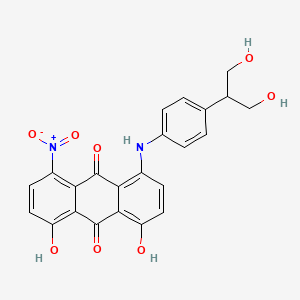
CAS 114565-66-1PubChem CID 53426469
4-(4-(1,3-Dihydroxyprop-2-yl)phenylamino)-1,8-dihydroxy-5-nitroanthraquinone
- IUPAC name
- 1-[4-(1,3-dihydroxypropan-2-yl)anilino]-4,5-dihydroxy-8-nitroanthracene-9,10-dione
- Molecular formula
- C23H18N2O8
- Molecular weight
- 450.4 g/mol
- Exact mass
- 450.10631554 Da
- XLogP3
- 3.3
- Topological polar surface area
- 173.0 Ų
- Hydrogen-bond donors
- 5
- Hydrogen-bond acceptors
- 9
- Covalent units
- 1
- Defined stereocentres
- 0
Also known as
EC 406-057-14-[4-(1,3-DIHYDROXYPROP-2-YL)PHENYLAMINO]-1,8-DIHYDROXY-5-NITROANTHRAQUINONERefChem:513543406-057-11-((4-(1,3-Dihydroxypropan-2-yl)phenyl)amino)-4,5-dihydroxy-8-nitroanthracene-9,10-dioneOXIGDVJVFLVGMW-UHFFFAOYSA-N
External database identifiers
- EPA DTXSID:DTXSID30699229
Evidence from additional scientific databases
NIH PubChem PUG-View
Exact identifier match53426469
Attributed physical-property, hazard, environmental and use annotations.
- Signal: Warning Source: Regulation (EC) No 1272/2008 of the European Parliament and of the Council
- GHS Hazard Statements: H317: May cause an allergic skin reaction [Warning Sensitization, Skin]; H351: Suspected of causing cancer [Warning Carcinogenicity]; H413: May cause long lasting harmful effects to aquatic life [Hazardous to the aquatic environment, long-term hazard] Source: Regulation (EC) No 1272/2008 of the European Parliament and of the Council
- Precautionary Statement Codes: P203, P261, P272, P273, P280, P302+P352, P318, P321, P333+P317, P362+P364, P405, and P501 (click each P-code to see the statement) Source: Regulation (EC) No 1272/2008 of the European Parliament and of the Council
- Signal: Warning Source: Hazardous Chemical Information System (HCIS), Safe Work Australia
- GHS Hazard Statements: H317: May cause an allergic skin reaction [Warning Sensitization, Skin]; H351: Suspected of causing cancer [Warning Carcinogenicity]; H413: May cause long lasting harmful effects to aquatic life [Hazardous to the aquatic environment, long-term hazard] Source: Hazardous Chemical Information System (HCIS), Safe Work Australia
- Precautionary Statement Codes: P203, P261, P272, P273, P280, P302+P352, P318, P321, P333+P317, P362+P364, P405, and P501 (click each P-code to see the statement) Source: Hazardous Chemical Information System (HCIS), Safe Work Australia
Mapped by: Existing checksum-valid CAS to unique PubChem CID match. Retrieved: 2026-08-31. Open source record
Scientific classifications and hazard annotations provide context and do not replace the market-specific regulatory decision shown above.
Additional source coverage and match status
| Source | Result | Checked |
|---|---|---|
| NIH PubChem PUG-View | Exact match | 2026-08-31 |
A recorded no-match is useful evidence that the source was checked; it is not a claim that the substance does not exist elsewhere.
Retrieved from NIH PubChem on 2026-09-02 by checksum-valid CAS matching. Chemical properties do not replace the regulatory decision on this page.