
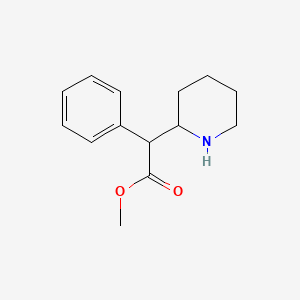
Methylphenidate
Methyl phenyl(piperidin-2-yl)acetate is a amino acid ester that is methyl phenylacetate in which one of the hydrogens alpha to the carbonyl group is replaced by a piperidin-2-yl group. It is a methyl ester, a member of piperidines and a beta-amino acid ester. — ChEBI
- IUPAC name
- methyl 2-phenyl-2-piperidin-2-ylacetate
- Molecular formula
- C14H19NO2
- Molecular weight
- 233.31 g/mol
- Exact mass
- 233.141578849 Da
- XLogP3
- 0.2
- Topological polar surface area
- 38.3 Ų
- Hydrogen-bond donors
- 1
- Hydrogen-bond acceptors
- 3
- Covalent units
- 1
- Defined stereocentres
- 0
Also known as
16 more reported names
External database identifiers
Evidence from additional scientific databases
NIH PubChem PUG-View
Attributed physical-property, hazard, environmental and use annotations.
- Boiling Point: BP: 135 to 137 °C at 0.6 mm Hg Source: Hazardous Substances Data Bank (HSDB)
- Color/Form: Crystals from ethanol (aqueous) Source: Hazardous Substances Data Bank (HSDB)
- Dissociation Constants: pKa = 8.9 Source: Hazardous Substances Data Bank (HSDB)
- Dissociation Constants: pKa = 8.77 Source: Hazardous Substances Data Bank (HSDB)
- LogP: log Kow = 0.20 at pH 7.2 Source: Hazardous Substances Data Bank (HSDB)
- LogP: 2.1 Source: Human Metabolome Database (HMDB)
- Melting Point: 74-75 °C Source: Hazardous Substances Data Bank (HSDB)
- Melting Point: 224 - 226 °C Source: Human Metabolome Database (HMDB)
- Physical Description: Solid Source: Human Metabolome Database (HMDB)
- Solubility: 1255mg/L Source: DrugBank
- Solubility: Practically insoluble in water Source: Hazardous Substances Data Bank (HSDB)
- Solubility: Soluble in alcohol, ethyl acetate, ether; practically insoluble in petroleum ether Source: Hazardous Substances Data Bank (HSDB)
- Solubility: 1.82e-01 g/L Source: Human Metabolome Database (HMDB)
- Carcinogen Classification: No indication of carcinogenicity to humans (not listed by IARC). Source: Toxin and Toxin Target Database (T3DB)
- Exposure Routes: Oral. Readily absorbed in a biphasic manner when orally administered (tablets) to children diagnosed with ADHD and to healthy adults. In children and adults males, after administration of a single oral dose of Ritalin LA and Ritalin given in two doses 4 hours apart, peak plasma concentration is reached approximately 2 hours for the first phase and 5-6 hours for the second phase. The absolute oral bioavailability of methylphenidate in children was 22±8% for d-methylphenidate and 5±3% for l-methylphenidate. These low values suggest that methylphenidate is highly metabolized presystemically. Source: Toxin and Toxin Target Database (T3DB)
- Signal: Warning Source: European Chemicals Agency (ECHA)
- GHS Hazard Statements: H302 (100%): Harmful if swallowed [Warning Acute toxicity, oral]; H315 (100%): Causes skin irritation [Warning Skin corrosion/irritation]; H319 (100%): Causes serious eye irritation [Warning Serious eye damage/eye irritation]; H341 (100%): Suspected of causing genetic defects [Warning Germ cell mutagenicity] Source: European Chemicals Agency (ECHA)
- Precautionary Statement Codes: P203, P264, P264+P265, P270, P280, P301+P317, P302+P352, P305+P351+P338, P318, P321, P330, P332+P317, P337+P317, P362+P364, P405, and P501 (click each P-code to see the statement) Source: European Chemicals Agency (ECHA)
- ECHA C&L Notifications Summary: The GHS information provided by 1 company from 1 notification to the ECHA C&L Inventory. Source: European Chemicals Agency (ECHA)
- Signal: Danger Source: Hazardous Substances Data Bank (HSDB)
- GHS Hazard Statements: H302: Harmful if swallowed [Warning Acute toxicity, oral]; H334: May cause allergy or asthma symptoms or breathing difficulties if inhaled [Danger Sensitization, respiratory] Source: Hazardous Substances Data Bank (HSDB)
- Precautionary Statement Codes: P233, P260, P264, P270, P271, P284, P301+P317, P304+P340, P330, P342+P316, P403, and P501 (click each P-code to see the statement) Source: Hazardous Substances Data Bank (HSDB)
- Health Effects: Using large amounts of these drugs can result in a condition known as amphetamine psychosis -- which can result in auditory, visual and tactile hallucinations, intense paranoia, irrational thoughts and beliefs, delusions, and mental confusion. Source: Toxin and Toxin Target Database (T3DB)
- Toxicity Summary: IDENTIFICATION AND USE: Methylphenidate Hydrochloride is a psychostimulant used to treat different behavioral disorders. Indications: Used to treat narcolepsy and hyperkinetic states in children (as an adjunct to psychological, educational and social measures) for amphetamine, dextroamphetamine and ethylphenidate. It is misused for performance enhancement and relief of fatigue. Abuse either orally or by injection is extremely common. HUMAN EXPOSURE AND TOXICITY: Main risks include: Acute central nervous system (CNS) stimulation, cardiotoxicity causing tachycardia, arrhythmias, hypertension and cardiovascular collapse. High risk of dependency and abuse. Cardiovascular effects include: palpitation, chest pain, tachycardia, arrhythmias and hypertension; cardiovascular collapse can occur in severe poisoning. Myocardial ischemia, infarction and ventricular dysfunction are described. CNS effects include: stimulation of CNS, tremor, restlessness, agitation, insomnia, increased motor activity, headache, convulsions, coma and hyperreflexia. Stroke and cerebral vasculitis have been observed. Gastrointestinal effects include: vomiting, diarrhea and cramps. Genitourinary effects include: incre Source: Hazardous Substances Data Bank (HSDB)
- Toxicity Summary: The first step in a medication overdose is to immediately contact a poison control center for the appropriate management steps. Doses that exceed 60 mg of the immediate-release formulation or 120 mg of the extended-release formulation can be considered toxic. If the overdosed quantity is unknown, the patient should be assessed for signs and symptoms such as tremors, hyperreflexia, convulsions, euphoria, confusion, hallucinations, delirium, flushing, and fever, in addition to the common adverse effects mentioned above. Supportive care with supplemental oxygen, intravenous fluids, and external cooling methods is the mainstay of treatment. Multiple studies have shown that benzodiazepines are an option, especially if dystonia, agitation, or convulsions are present. Source: StatPearls
- Toxicity Summary: Methylphenidate blocks dopamine uptake in central adrenergic neurons by blocking dopamine transport or carrier proteins. Methylphenidate acts at the brain stem arousal system and the cerebral cortex and causes increased sympathomimetic activity in the central nervous system. Alteration of serotonergic pathways via changes in dopamine transport may result. Source: Toxin and Toxin Target Database (T3DB)
- Environmental Bioconcentration: An estimated BCF of 3 was calculated in fish for methylphenidate(SRC), using a log Kow of 0.20(1) and a regression-derived equation(2). According to a classification scheme(2), this BCF suggests the potential for bioconcentration in aquatic organisms is low(SRC). Source: Hazardous Substances Data Bank (HSDB)
- Environmental Fate: TERRESTRIAL FATE: Based on a classification scheme(1), an estimated Koc value of 1600(SRC), determined from a structure estimation method(2), indicates that methylphenidate is expected to have low mobility in soil(SRC). The pKa of methylphenidate is 8.9(3), indicating that this compound will exist partially in the cation form in the environment and cations generally adsorb more strongly to soils containing organic carbon and clay than their neutral counterparts(4). Volatilization of the neutral species of methylphenidate from moist soil surfaces is not expected to be an important fate process(SRC) given an estimated Henry's Law constant of 4.4X10⁻⁹ atm-cu m/mole(SRC), using a fragment constant estimation method(5). Methylphenidate is not expected to volatilize from dry soil surfaces(SRC) based upon an estimated vapor pressure of 5.9X10⁻⁵ mm Hg at 25 °C(SRC), determined from a fragment constant method(2). Biodegradation data in soil were not available(SRC, 2015). Source: Hazardous Substances Data Bank (HSDB)
- Environmental Fate: AQUATIC FATE: Based on a classification scheme(1), an estimated Koc value of 1600(SRC), determined from a structure estimation method(2), indicates that methylphenidate is expected to adsorb to suspended solids and sediment(SRC). Volatilization of the neutral species from water surfaces is not expected(3) based upon an estimated Henry's Law constant of 4.4X10⁻⁹ atm-cu m/mole(SRC), developed using a fragment constant estimation method(4). A pKa of 8.9(5) indicates methylphenidate will exist partially in the cation form at pH values of 5 to 9 and, therefore, volatilization from water surfaces is not expected to be an important fate process(SRC). According to a classification scheme(6), an estimated BCF of 3(SRC), from its log Kow of 0.20(7) and a regression-derived equation(2), suggests the potential for bioconcentration in aquatic organisms is low(SRC). Base-catalyzed second-order hydrolysis rate constant half-lives of 23 and 2.3 years at pH values of 7 and 8, respectively(2), suggest that hydrolysis may be a slow environmental fate process. Biodegradation data in water were not available(SRC, 2015). Source: Hazardous Substances Data Bank (HSDB)
- Environmental Fate: ATMOSPHERIC FATE: According to a model of gas/particle partitioning of semivolatile organic compounds in the atmosphere(1), methylphenidate, which has an estimated vapor pressure of 5.9X10⁻⁵ mm Hg at 25 °C(SRC), determined from a fragment constant method(2), will exist in both the vapor and particulate phases in the ambient atmosphere. Vapor-phase methylphenidate is degraded in the atmosphere by reaction with photochemically-produced hydroxyl radicals(SRC); the half-life for this reaction in air is estimated to be 1 hr(SRC), calculated from its rate constant of 1.1X10⁻¹⁰ cu cm/molecule-sec at 25 °C(SRC) that was derived using a structure estimation method(3). Particulate-phase methylphenidate may be removed from the air by wet and dry deposition(SRC). Methylphenidate contains chromophores that absorb at wavelengths >290 nm(4) and, therefore, may be susceptible to direct photolysis by sunlight(SRC). Source: Hazardous Substances Data Bank (HSDB)
- Uses: Methylphenidate (DEA Code Number: 1724) is a Schedule II controlled substance. Source: Hazardous Substances Data Bank (HSDB)
- Uses: Schedule II Controlled Substance: (A) The drug or other substance has a high potential for abuse; (B) The drug or other substance has a currently accepted medical use in treatment in the United States or a currently accepted medical use with severe restrictions; and (C) Abuse of the drug or other substances may lead to severe psychological or physical dependence. Source: Hazardous Substances Data Bank (HSDB)
- Uses: MEDICATION (VET) Source: Hazardous Substances Data Bank (HSDB)
- Uses: MEDICATION Source: Hazardous Substances Data Bank (HSDB)
- Uses: Central Nervous System Stimulants; Dopamine Uptake Inhibitors Source: Hazardous Substances Data Bank (HSDB)
- Uses: Use (kg) in Switzerland (2009): >250; Use (kg; approx.) in Germany (2009): >1000; Use (kg) in USA (2002): 9090; Consumption (g per capita) in Switzerland (2009): 0.032; Consumption (g per capita; approx.) in Germany (2009): 0.012; Consumption (g per capita) in the USA (2002): 0.032; Excretion rate: 0.1; Calculated removal (%): 92.1 Source: NORMAN Suspect List Exchange
- Uses: For use as an integral part of a total treatment program which typically includes other remedial measures (psychological, educational, social) for a stabilizing effect in children with a behavioral syndrome characterized by the following group of developmentally inappropriate symptoms: moderate-to-severe distractibility, short attention span, hyperactivity, emotional lability, and impulsivity. Source: Toxin and Toxin Target Database (T3DB)
Mapped by: Existing checksum-valid CAS to unique PubChem CID match. Retrieved: 2026-08-31. Open source record
Scientific classifications and hazard annotations provide context and do not replace the market-specific regulatory decision shown above.
Additional source coverage and match status
| Source | Result | Checked |
|---|---|---|
| NIH PubChem PUG-View | Exact match | 2026-08-31 |
A recorded no-match is useful evidence that the source was checked; it is not a claim that the substance does not exist elsewhere.
Retrieved from NIH PubChem on 2026-09-02 by checksum-valid CAS matching. Chemical properties do not replace the regulatory decision on this page.