
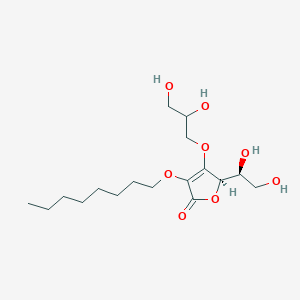
CAS 1120360-26-0PubChem CID 54588053
Glyceryl octyl ascorbic acid
- IUPAC name
- (2R)-2-[(1S)-1,2-dihydroxyethyl]-3-(2,3-dihydroxypropoxy)-4-octoxy-2H-furan-5-one
- Molecular formula
- C17H30O8
- Molecular weight
- 362.4 g/mol
- Exact mass
- 362.19406791 Da
- XLogP3
- 0.9
- Topological polar surface area
- 126.0 Ų
- Hydrogen-bond donors
- 4
- Hydrogen-bond acceptors
- 8
- Covalent units
- 1
- Defined stereocentres
- 2
Also known as
BZNPYIWZPTYCQH-KFTPUPIBSA-N3-o-glyceryl-2-o-octyl ascorbic acid
External database identifiers
- EPA DTXSID:DTXSID301336528
Evidence from additional scientific databases
NIH PubChem PUG-View
Exact identifier match54588053
Attributed physical-property, hazard, environmental and use annotations.
Mapped by: Existing checksum-valid CAS to unique PubChem CID match. Retrieved: 2026-08-31. Open source record
Scientific classifications and hazard annotations provide context and do not replace the market-specific regulatory decision shown above.
Additional source coverage and match status
| Source | Result | Checked |
|---|---|---|
| NIH PubChem PUG-View | Exact match | 2026-08-31 |
A recorded no-match is useful evidence that the source was checked; it is not a claim that the substance does not exist elsewhere.
Retrieved from NIH PubChem on 2026-08-31 by checksum-valid CAS matching. Chemical properties do not replace the regulatory decision on this page.