
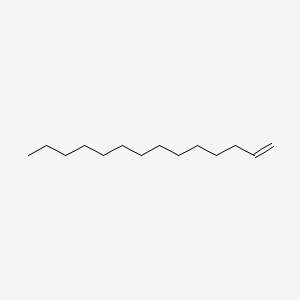
CAS 1120-36-1PubChem CID 14260
1-Tetradecene
1-tetradecene is an unbranched fourteen-carbon alkene with one double bond between C-1 and C-2. — ChEBI
- IUPAC name
- tetradec-1-ene
- Molecular formula
- C14H28
- Molecular weight
- 196.37 g/mol
- Exact mass
- 196.219100893 Da
- XLogP3
- 7.9
- Topological polar surface area
- 0.0 Ų
- Hydrogen-bond donors
- 0
- Hydrogen-bond acceptors
- 0
- Covalent units
- 1
- Defined stereocentres
- 0
Also known as
n-Tetradec-1-ene1-Tetradecylenealpha-Tetradecene1-butadeceneNeodene 14CCRIS 3785HSDB 1087AI3-10509
16 more reported names
EINECS 214-306-9NSC 66434UNII-FW23481S7SNSC-66434CHEBI:77505EC 214-306-9dodecylethyleneaplha-TetradeceneRefChem:6724214-306-9Tetradecene.alpha.-Tetradecenea-TetradeceneTetradecene-11-TETRADECENE [HSDB]1-Tetradecene, analytical standard
External database identifiers
- ChEBI:CHEBI:77505
- ChEMBL:CHEMBL1892257
- EPA DTXSID:DTXSID4027367
- PubMed:26321153
- PubMed:22684118
- PubMed:22324432
- PubMed:22291612
- PubMed:22100714
- PubMed:22070996
- PubMed:21760786
- PubMed:21711870
- PubMed:21526231
- PubMed:21232877
- PubMed:19928126
- PubMed:19788223
Evidence from additional scientific databases
NIH PubChem PUG-View
Exact identifier match14260
Attributed physical-property, hazard, environmental and use annotations.
- Autoignition Temperature: 455 °F (USCG, 1999) Source: CAMEO Chemicals
- Autoignition Temperature: 455 °F (235 °C) Source: Hazardous Substances Data Bank (HSDB)
- Autoignition Temperature: 239 °C Source: ILO-WHO International Chemical Safety Cards (ICSCs)
- Boiling Point: 484 °F at 760 mmHg (USCG, 1999) Source: CAMEO Chemicals
- Boiling Point: 232-234 °C @ 760 MM HG Source: Hazardous Substances Data Bank (HSDB)
- Boiling Point: 252 °C Source: ILO-WHO International Chemical Safety Cards (ICSCs)
- Color/Form: COLORLESS LIQUID Source: Hazardous Substances Data Bank (HSDB)
- Density: 0.771 at 68 °F (USCG, 1999) - Less dense than water; will float Source: CAMEO Chemicals
- Density: 0.7745 @ 20 °C/4 °C Source: Hazardous Substances Data Bank (HSDB)
- Density: Relative density (water = 1): 0.8 Source: ILO-WHO International Chemical Safety Cards (ICSCs)
- Flash Point: 230 °F (USCG, 1999) Source: CAMEO Chemicals
- Flash Point: 110 °C Source: Haz-Map, Information on Hazardous Chemicals and Occupational Diseases
- Flash Point: 230 °F (110 °C) (CLOSED CUP) Source: Hazardous Substances Data Bank (HSDB)
- Flash Point: 107 °C c.c. Source: ILO-WHO International Chemical Safety Cards (ICSCs)
- LogP: 7.08 Source: ILO-WHO International Chemical Safety Cards (ICSCs)
- Melting Point: 8.8 °F (USCG, 1999) Source: CAMEO Chemicals
- Melting Point: -12 °C Source: Hazardous Substances Data Bank (HSDB)
- Melting Point: -12 °C Source: ILO-WHO International Chemical Safety Cards (ICSCs)
- Odor: Mild, pleasant Source: Hazardous Substances Data Bank (HSDB)
- Physical Description: Watery liquid; colorless; mild pleasant odor. Floats on water. (USCG, 1999) Source: CAMEO Chemicals
- Physical Description: Liquid Source: EPA Chemical Data Reporting (CDR)
- Physical Description: Colorless liquid; [HSDB] Source: Haz-Map, Information on Hazardous Chemicals and Occupational Diseases
- Physical Description: COLOURLESS LIQUID. Source: ILO-WHO International Chemical Safety Cards (ICSCs)
- Refractive Index: INDEX OF REFRACTION: 1.4351 @ 20 °C/D Source: Hazardous Substances Data Bank (HSDB)
- Solubility: SOL IN ETHANOL, ETHER, BENZENE Source: Hazardous Substances Data Bank (HSDB)
- Solubility: Solubility in water: none Source: ILO-WHO International Chemical Safety Cards (ICSCs)
- Vapor Pressure: 4.55 mmHg at 220 °F (USCG, 1999) Source: CAMEO Chemicals
- Vapor Pressure: 0.01 [mmHg] Source: Haz-Map, Information on Hazardous Chemicals and Occupational Diseases
- Vapor Pressure: 1.5X10⁻² mm Hg at 25 °C Source: Hazardous Substances Data Bank (HSDB)
- Vapor Pressure: Vapor pressure, Pa at 25 °C: 2 Source: ILO-WHO International Chemical Safety Cards (ICSCs)
- Viscosity: 2.61 cu mm/s (Kinematic) Source: Hazardous Substances Data Bank (HSDB)
- First Aid: EYES: flush with water for 15 minutes. (USCG, 1999) Source: CAMEO Chemicals
- Note: This chemical does not meet GHS hazard criteria for 2% (20 of 1014) of reports. Source: European Chemicals Agency (ECHA)
- Signal: Danger Source: European Chemicals Agency (ECHA)
- GHS Hazard Statements: H304 (97.5%): May be fatal if swallowed and enters airways [Danger Aspiration hazard]; H315 (15%): Causes skin irritation [Warning Skin corrosion/irritation] Source: European Chemicals Agency (ECHA)
- Precautionary Statement Codes: P264, P280, P301+P316, P302+P352, P321, P331, P332+P317, P362+P364, P405, and P501 (click each P-code to see the statement) Source: European Chemicals Agency (ECHA)
- ECHA C&L Notifications Summary: Aggregated GHS information provided per 1014 reports by companies from 10 notifications to the ECHA C&L Inventory. Each notification may be associated with multiple companies.; Reported as not meeting GHS hazard criteria per 20 of 1014 reports by companies.; There are 9 notifications provided by 994 of 1014 reports by companies with hazard statement code(s).; Information may vary between notifications depending on impurities, additives, and other factors. The percentage value in parenthesis indicates the notified classification ratio from companies that provide hazard codes. Only hazard codes with percentage values above 10% are shown. For more detailed information, please visit ECHA C&L website. Source: European Chemicals Agency (ECHA)
- NFPA Health Rating: 0 - Materials that, under emergency conditions, would offer no hazard beyond that of ordinary combustible materials. Source: Hazardous Substances Data Bank (HSDB)
- NFPA Fire Rating: 1 - Materials that must be preheated before ignition can occur. Materials require considerable preheating, under all ambient temperature conditions, before ignition and combustion can occur. Source: Hazardous Substances Data Bank (HSDB)
- NFPA Instability Rating: 0 - Materials that in themselves are normally stable, even under fire conditions. Source: Hazardous Substances Data Bank (HSDB)
- Environmental Bioconcentration: Estimated bioconcentration factors ranging from 17500 to 51000(1,SRC) can be calculated for 1-tetradecene using appropriate regression equations(1) and its estimated water solubility, 4.0X10⁻⁴ mg/L at 25 °C(1,SRC) obtained from a vapor pressure of 1.5X10⁻² mm Hg at 25 °C(2) and estimated Henry's Law constant of 8.48 atm-cu m/mole at 25 °C(3,SRC), and its estimated octanol/water partition coefficient, 7.3(1,SRC), obtained from its estimated water solubility. These values indicate that 1-tetradecene will bioconcentrate in fish and aquatic organisms(SRC). Source: Hazardous Substances Data Bank (HSDB)
- Environmental Fate: TERRESTRIAL FATE: If released to soil, estimated soil adsorption coefficients ranging from 19,700 to 32,300(1-3,SRC) indicate that 1-tetradecene will be essentially immobile in soil(4). Its estimated Henry's Law constant, 8.48 atm-cu m/mole(3,SRC), indicates that 1-tetradecene may rapidly volatilize from moist soil to the atmosphere although expected strong adsorption to soil may attenuate the rate of this process(SRC). The vapor pressure of 1-tetradecene, 1.5X10⁻² mm Hg at 25 °C(2) indicates that volatilization from dry soil to the atmosphere will be very slow. Pure culture studies indicate that 1-tetradecene has the potential to biodegrade in soil under aerobic conditions(5-10,SRC). Source: Hazardous Substances Data Bank (HSDB)
- Environmental Fate: AQUATIC FATE: If released to water, estimated bioconcentration factors ranging from 17500 to 51000(1-3,SRC) indicate that 1-tetradecene will bioconcentrate in fish and aquatic organisms(SRC). Estimated soil adsorption coefficients ranging from 19,700 to 32,300(1-3,SRC) indicate that it will strongly adsorb to sediment and suspended organic matter(SRC). Its estimated Henry's Law constant, 8.48 atm-cu m/mole(3,SRC), indicates that 1-tetradecene may rapidly volatilize from water to the atmosphere. The estimated half-life for volatilization from a model river 1 m deep flowing at 1 m/sec with a wind speed of 3 m/sec is 4.1 hrs(1,SRC). Its expected strong adsorption to soil may attenuate the rate of this process. The estimated half-life for volatilization from a model pond, which takes into account adsorptive processes, is 7.3 months(4,SRC). Pure culture studies indicate that 1-tetradecene has the potential to biodegrade in water under aerobic conditions(5-10,SRC). Source: Hazardous Substances Data Bank (HSDB)
- Environmental Fate: ATMOSPHERIC FATE: If released to the atmosphere, 1-tetradecene may undergo removal by gas-phase reactions with atmospheric oxidants. An estimated rate constant for the gas-phase reaction of 1-tetradecene with photochemically produced hydroxyl radicals of 4.2X10⁻¹³ cu cm/molec sec(1,SRC) translates to an atmospheric half-life of 9.3 hrs using an average atmospheric hydroxyl radical concn of 5X10+5 molec/cu cm(1). An estimated rate constant for the gas-phase reaction of 1-tetradecene with ozone of 1.2X10⁻¹⁷ cu cm/molec sec(1,SRC) translates to an atmospheric half-life of 23 hrs(SRC) using an average atmospheric ozone concn of 7X10+11 molec/cu cm(1). Source: Hazardous Substances Data Bank (HSDB)
- Consumer Uses: Solvent; Intermediate; Not Known or Reasonably Ascertainable Source: EPA Chemical Data Reporting (CDR)
- Industry Uses: Fuel; Processing aids not otherwise specified; Surfactant (surface active agent); Lubricating agent; Solvent; Intermediate; Not Known or Reasonably Ascertainable Source: EPA Chemical Data Reporting (CDR)
- Sources/Uses: Used as a chemical intermediate and as a solvent in perfumes, flavors, medicines, dyes, oils, and resins; [HSDB] Source: Haz-Map, Information on Hazardous Chemicals and Occupational Diseases
- Uses: CHEMICAL INTERMEDIATE (AS PART OF ALKENE MIXT) Source: Hazardous Substances Data Bank (HSDB)
- Uses: IN LINEAR ALPHA-OLEFIN MIXTURE FOR PRODN OF SULFONATES; CHEM INT FOR N-TETRADECYL DIMETHYL AMINE Source: Hazardous Substances Data Bank (HSDB)
- Uses: SOLVENT IN PERFUMES, FLAVORS, MEDICINES, DYES, OILS, RESINS Source: Hazardous Substances Data Bank (HSDB)
Mapped by: Existing checksum-valid CAS to unique PubChem CID match. Retrieved: 2026-08-31. Open source record
Scientific classifications and hazard annotations provide context and do not replace the market-specific regulatory decision shown above.
Additional source coverage and match status
| Source | Result | Checked |
|---|---|---|
| NIH PubChem PUG-View | Exact match | 2026-08-31 |
A recorded no-match is useful evidence that the source was checked; it is not a claim that the substance does not exist elsewhere.
Retrieved from NIH PubChem on 2026-08-31 by checksum-valid CAS matching. Chemical properties do not replace the regulatory decision on this page.