
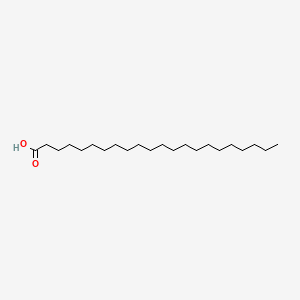
Docosanoic Acid
Docosanoic acid is a straight-chain, C22, long-chain saturated fatty acid. It has a role as a plant metabolite. It is a long-chain fatty acid and a straight-chain saturated fatty acid. It is a conjugate acid of a behenate. — ChEBI
- IUPAC name
- docosanoic acid
- Molecular formula
- C22H44O2
- Molecular weight
- 340.6 g/mol
- Exact mass
- 340.334130642 Da
- XLogP3
- 9.6
- Topological polar surface area
- 37.3 Ų
- Hydrogen-bond donors
- 1
- Hydrogen-bond acceptors
- 2
- Covalent units
- 1
- Defined stereocentres
- 0
Also known as
16 more reported names
External database identifiers
- ChEBI:CHEBI:28941
- ChEMBL:CHEMBL1173474
- EPA DTXSID:DTXSID3026930
- PubMed:29968805
- PubMed:23122141
- PubMed:22882126
- PubMed:22809287
- PubMed:22692081
- PubMed:22679362
- PubMed:22675394
- PubMed:22656448
- PubMed:22558065
- PubMed:22497562
- PubMed:22489128
- PubMed:22472447
Evidence from additional scientific databases
NIH PubChem PUG-View
Attributed physical-property, hazard, environmental and use annotations.
- Boiling Point: 306 °C at 60 mm Hg Source: Hazardous Substances Data Bank (HSDB)
- Color/Form: Waxy solid Source: Hazardous Substances Data Bank (HSDB)
- Color/Form: Needles Source: Hazardous Substances Data Bank (HSDB)
- Density: 0.8221 at 100 °C/4 °C Source: Hazardous Substances Data Bank (HSDB)
- LogP: 9.910 Source: Human Metabolome Database (HMDB)
- Melting Point: 79.95 °C Source: Hazardous Substances Data Bank (HSDB)
- Melting Point: 81 °C Source: Human Metabolome Database (HMDB)
- Physical Description: Other Solid; Large Crystals; Liquid; Other Solid; Liquid Source: EPA Chemical Data Reporting (CDR)
- Physical Description: White to cream or yellow solid; [CHEMINFO] White crystalline powder; [MSDSonline] Source: Haz-Map, Information on Hazardous Chemicals and Occupational Diseases
- Physical Description: Solid Source: Human Metabolome Database (HMDB)
- Refractive Index: Index of refraction: 1.4270 at 100 °C/D Source: Hazardous Substances Data Bank (HSDB)
- Solubility: 0.102 g are sol in 100 g of 90% ethanol at 17 °C;0.218 g are sol in 100 ml of 91.5% ethanol at 25 °C; 0.116 g are sol in 100 ml of 86.2% ethanol at 25 °C; 0.011 g are sol in 100 ml of 63.07% ethanol at 25 °C; 0.1922 g are sol in 100 g of ether at 16 °C Source: Hazardous Substances Data Bank (HSDB)
- Solubility: Slightly soluble in water, ethanol, ethyl ether Source: Hazardous Substances Data Bank (HSDB)
- Solubility: In water, 160 mg/L, temp not specified Source: Hazardous Substances Data Bank (HSDB)
- Solubility: 1.6e-05 mg/mL Source: Human Metabolome Database (HMDB)
- Vapor Pressure: 0.00000007 [mmHg] Source: Haz-Map, Information on Hazardous Chemicals and Occupational Diseases
- Note: This chemical does not meet GHS hazard criteria for 97.4% (185 of 190) of all reports. Source: European Chemicals Agency (ECHA)
- GHS Hazard Statements: Not Classified; Reported as not meeting GHS hazard criteria by 185 of 190 companies (only 2.6% companies provided GHS information). For more detailed information, please visit ECHA C&L website. Source: European Chemicals Agency (ECHA)
- ECHA C&L Notifications Summary: Aggregated GHS information provided per 190 reports by companies from 2 notifications to the ECHA C&L Inventory.; Reported as not meeting GHS hazard criteria per 185 of 190 reports by companies.; There is 1 notification provided by 5 of 190 reports by companies with hazard statement code(s).; Information may vary between notifications depending on impurities, additives, and other factors. The percentage value in parenthesis indicates the notified classification ratio from companies that provide hazard codes. Only hazard codes with percentage values above 10% are shown. For more detailed information, please visit ECHA C&L website. Source: European Chemicals Agency (ECHA)
- GHS Hazard Statements: Not Classified Source: NITE-CMC
- Cosmetic Ingredient Review Conclusion: The CIR Expert Panel concluded that the following ingredients are safe in the present practices of use andconcentration described in the safety assessment when formulated to be non-irritating and non-sensitizing, which may be basedon a QRA...Behenic Acid... Source: Cosmetic Ingredient Review (CIR)
- Cosmetic Ingredient Review Finding(s): Safe for use in cosmetics, with qualifications Source: Cosmetic Ingredient Review (CIR)
- Toxicity Summary: Oral LD50 value of docosanoic acid for rats is greater than 2,000 mg/kg. There are no available data for irritation and sensitization. In an oral study using the OECD combined repeated dose and reproductive/developmental toxicity test [OECD TG 422], docosanoic acid was administered to rats at doses of 0, 100, 300, 1,000 mg/kg/day for at least 42 days . No deaths occurred and also no substance related toxic effects were observed in any parameters. Therefore, the NOAEL is considered to be 1,000 mg/kg/day for both repeated dose toxicity and reproductive/developmental toxicity. The chemical was negative in both a bacterial mutation test [OECD TG 471, 472] and a chromosomal aberration test in vitro [OECD TG 473]. ... Acute toxicity values of docosanoic acid on alga (Selenastrum capricornutum), aquatic invertebrate (Daphnia magna) or fish (Oryzias latipes) are greater than its water solubility (0.016 mg/L). The NOEC in a 21-day reproduction test with Daphnia magna is also greater than its water solubility. No significant effects are observed in any tests conducted at extremely high concentrations by using dispersant under OECD test guidelines [TG201, 202, 203, 204, or 211]. There is info Source: Hazardous Substances Data Bank (HSDB)
- Environmental Bioconcentration: An estimated BCF of 3 was calculated in fish for docosanoic acid(SRC), using an estimated log Kow of 9.91(1) and a regression-derived equation(2). According to a classification scheme(3), this BCF suggests the potential for bioconcentration in aquatic organisms is low(SRC). Source: Hazardous Substances Data Bank (HSDB)
- Environmental Fate: TERRESTRIAL FATE: Based on a classification scheme(1), an estimated Koc value of 1.4X10+5(SRC), determined from a structure estimation method(2), indicates that undissociated docosanoic acid is expected to be immobile in soil(SRC). The estimated pKa of docosanoic acid is 4.7(3), indicating that this compound will exist almost entirely in anion form in the environment and anions generally do not adsorb more strongly to soils containing organic carbon and clay than their neutral counterparts(4). Volatilization from moist soil is not expected because the acid exists as an anion and anions do not volatilize(SRC). Docosanoic is not expected to volatilize from dry soil surfaces(SRC) based upon an estimated vapor pressure of 7.1X10⁻⁸ mm Hg(SRC), determined from a fragment constant method(5). Biodegradation of 69% of the theoretical BOD using a modified closed bottle Blok test employing a sewage inoculum incubated 28 days(6) suggests that biodegadation may be an important environmental fate process in soil(SRC). Source: Hazardous Substances Data Bank (HSDB)
- Environmental Fate: AQUATIC FATE: Based on a classification scheme(1), an estimated Koc value of 1.4X10+5 for the free acid(SRC), determined from a structure estimation method(2), indicates that undissociated docosanoic acid is expected to adsorb to suspended solids and sediment(SRC). An estimated pKa of 4.7(3) indicates docosanoic acid will exist almost entirely in the anion form at pH values of 5 to 9 and therefore volatilization from water surfaces is not expected to be an important fate process(4). According to a classification scheme(5), an estimated BCF of 3(SRC), from an estimated log Kow of 9.91(6) and a regression-derived equation(7), suggests the potential for bioconcentration in aquatic organisms is low(SRC). A half life of 1.7 days in freshwater after a 29 days(8) suggests that biodegradation may be an important environmental fate process in water(SRC). Source: Hazardous Substances Data Bank (HSDB)
- Environmental Fate: ATMOSPHERIC FATE: According to a model of gas/particle partitioning of semivolatile organic compounds in the atmosphere(1), docosanoic acid, which has an estimated vapor pressure of 7.1X10⁻⁸ mm Hg at 25 °C(SRC), determined from a fragment constant method(2), will exist in both the vapor and particulate phases in the ambient atmosphere. Vapor-phase docosanoic acid is degraded in the atmosphere by reaction with photochemically-produced hydroxyl radicals(SRC); the half-life for this reaction in air is estimated to be 14 hours(SRC), calculated from its rate constant of 2.8X10⁻¹¹ cu cm/molecule-sec at 25 °C(SRC) that was derived using a structure estimation method(3). Particulate-phase docosanoic acid may be removed from the air by wet or dry deposition(SRC). Docosanoic acid does not contain chromophores that absorb at wavelengths >290 nm(4) and therefore is not expected to be susceptible to direct photolysis by sunlight(SRC). Source: Hazardous Substances Data Bank (HSDB)
- Consumer Uses: Lubricating agent; Other; Not Known or Reasonably Ascertainable Source: EPA Chemical Data Reporting (CDR)
- Industry Uses: Monomers; Lubricating agent; Other; Defoamer; Intermediate; Not Known or Reasonably Ascertainable Source: EPA Chemical Data Reporting (CDR)
- Cosmetic Ingredient Review Link: CIR ingredient: Behenic Acid Source: Cosmetic Ingredient Review (CIR)
- Sources/Uses: Used in cosmetics, waxes, plasticizers, stabilizers and as a chemical intermediate; [HSDB] Used in lubricating oils and to retard solvent evaporation in paint removers; A minor constituent of most seed fats, animal milk fats, and marine animal oils; [Merck Index] Source: Haz-Map, Information on Hazardous Chemicals and Occupational Diseases
- Uses: In lubricating oils, as solvent evaporation retarder in paint removers. Amide as anti-foam in the manufacture of detergents, in floor polishes, in dripless candles Source: Hazardous Substances Data Bank (HSDB)
- Uses: Cosmetics; waxes; plasticizers; chemicals; stabilizers Source: Hazardous Substances Data Bank (HSDB)
- Uses: CHEM INT FOR LITHIUM DOCOSANOATE (LITHIUM BEHENATE) Source: Hazardous Substances Data Bank (HSDB)
- Uses: CHEM INT FOR SILVER DOCOSANOATE (SILVER BEHENATE) Source: Hazardous Substances Data Bank (HSDB)
- Uses: For more Uses (Complete) data for DOCOSANOIC ACID (7 total), please visit the HSDB record page. Source: Hazardous Substances Data Bank (HSDB)
Mapped by: Existing checksum-valid CAS to unique PubChem CID match. Retrieved: 2026-08-31. Open source record
Scientific classifications and hazard annotations provide context and do not replace the market-specific regulatory decision shown above.
Additional source coverage and match status
| Source | Result | Checked |
|---|---|---|
| NIH PubChem PUG-View | Exact match | 2026-08-31 |
A recorded no-match is useful evidence that the source was checked; it is not a claim that the substance does not exist elsewhere.
Retrieved from NIH PubChem on 2026-08-31 by checksum-valid CAS matching. Chemical properties do not replace the regulatory decision on this page.