
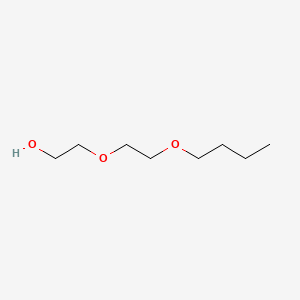
CAS 112-34-5PubChem CID 8177
Diethylene Glycol Monobutyl Ether
Ethanol, 2-(2-butoxyethoxy)- is an ether. — ChEBI
- IUPAC name
- 2-(2-butoxyethoxy)ethanol
- Molecular formula
- C8H18O3
- Molecular weight
- 162.23 g/mol
- Exact mass
- 162.125594432 Da
- XLogP3
- 0.6
- Topological polar surface area
- 38.7 Ų
- Hydrogen-bond donors
- 1
- Hydrogen-bond acceptors
- 3
- Covalent units
- 1
- Defined stereocentres
- 0
Also known as
Diethylene glycol butyl etherButyl carbitolButoxydiglycolButyl diglycolButyl dioxitolButyl digolGlycol ether DBBUCB
16 more reported names
Dowanol DBButoxyethoxyethanolEthanol, 2-(2-butoxyethoxy)-Jeffersol dbEktasolve DBButoxydiethylene glycolDiethylene glycol mono-n-butyl etherDiglycol monobutyl etherO-Butyl diethylene glycolButoxy diethylene glycolDiethylene glycol n-butyl etherDiethylene gylcol monobutyl etherButyl Ethyl CellosolveMonobutyl diethylene glycol etherEthanol, 2,2'-oxybis-, monobutyl ether9TB90IYC0E
External database identifiers
- ChEBI:CHEBI:195270
- ChEMBL:CHEMBL1904721
- EPA DTXSID:DTXSID8021519
- PubMed:22931403
- PubMed:20976153
- PubMed:17854990
- PubMed:17693786
- PubMed:16433236
- PubMed:15705492
- PubMed:15059798
- PubMed:14996047
- PubMed:12943003
- PubMed:11962702
- PubMed:11485228
Evidence from additional scientific databases
NIH PubChem PUG-View
Exact identifier match8177
Attributed physical-property, hazard, environmental and use annotations.
- Autoignition Temperature: 442 °F (USCG, 1999) Source: CAMEO Chemicals
- Autoignition Temperature: 400 degF (204 °C) Source: Hazardous Substances Data Bank (HSDB)
- Autoignition Temperature: 223 °C Source: ILO-WHO International Chemical Safety Cards (ICSCs)
- Boiling Point: 448 °F at 760 mmHg (NTP, 1992) Source: CAMEO Chemicals
- Boiling Point: 230.4 °C Source: Hazardous Substances Data Bank (HSDB)
- Boiling Point: 230 °C Source: ILO-WHO International Chemical Safety Cards (ICSCs)
- Boiling Point: 448 °F Source: Occupational Safety and Health Administration (OSHA)
- Boiling Point: 230.6 °C @760 [mm Hg] Source: PAC Chemical Database, U.S. Department of Energy
- Color/Form: Colorless liquid Source: Hazardous Substances Data Bank (HSDB)
- Color/Form: Clear liquid Source: Hazardous Substances Data Bank (HSDB)
- Density: 0.954 at 68 °F (USCG, 1999) - Less dense than water; will float Source: CAMEO Chemicals
- Density: 0.9553 g/cu cm at 20 °C Source: Hazardous Substances Data Bank (HSDB)
- Density: Density: 0.952 at 20 °C; 0.948 at 25 °C Source: Hazardous Substances Data Bank (HSDB)
- Density: Relative density (water = 1): 0.95 Source: ILO-WHO International Chemical Safety Cards (ICSCs)
- Density: 0.954 at 68 °F Source: Occupational Safety and Health Administration (OSHA)
- Density: 0.9553 @ 20°C Source: PAC Chemical Database, U.S. Department of Energy
- Flash Point: 172 °F (NTP, 1992) Source: CAMEO Chemicals
- Flash Point: 78 °C Source: Haz-Map, Information on Hazardous Chemicals and Occupational Diseases
- Flash Point: 99 °C (Closed cup) Source: Hazardous Substances Data Bank (HSDB)
- Flash Point: 172 °F (78 °C) (Closed cup) Source: Hazardous Substances Data Bank (HSDB)
- Flash Point: 78 °C c.c. Source: ILO-WHO International Chemical Safety Cards (ICSCs)
- Flash Point: 176 °F Source: Occupational Safety and Health Administration (OSHA)
- LogP: log Kow = 0.56 Source: Hazardous Substances Data Bank (HSDB)
- LogP: 0.3 Source: ILO-WHO International Chemical Safety Cards (ICSCs)
- Melting Point: -90.6 °F (NTP, 1992) Source: CAMEO Chemicals
- Melting Point: -68.1 °C Source: Hazardous Substances Data Bank (HSDB)
- Melting Point: -68 °C Source: ILO-WHO International Chemical Safety Cards (ICSCs)
- Melting Point: -90.6 °F Source: Occupational Safety and Health Administration (OSHA)
- Melting Point: -68.1 °C Source: PAC Chemical Database, U.S. Department of Energy
- Odor: Faint butyl odor Source: Hazardous Substances Data Bank (HSDB)
- Odor: Mild ether odor Source: Hazardous Substances Data Bank (HSDB)
- Physical Description: Diethylene glycol monobutyl ether is a colorless liquid with a mild pleasant odor. Mixes with water. (USCG, 1999) Source: CAMEO Chemicals
- Physical Description: Liquid; Other Solid; Gas Vapor; Liquid; Liquid; Other Solid; CBI Source: EPA Chemical Data Reporting (CDR)
- Physical Description: Colorless liquid with a mild pleasant odor; [CAMEO] Source: Haz-Map, Information on Hazardous Chemicals and Occupational Diseases
- Physical Description: COLOURLESS LIQUID. Source: ILO-WHO International Chemical Safety Cards (ICSCs)
- Physical Description: Colorless liquid Source: Occupational Safety and Health Administration (OSHA)
- Refractive Index: Index of refraction: 1.4258 at 27 °C/D Source: Hazardous Substances Data Bank (HSDB)
- Solubility: greater than or equal to 100 mg/mL at 68 °F (NTP, 1992) Source: CAMEO Chemicals
- Solubility: Miscible with water at 25 °C Source: Hazardous Substances Data Bank (HSDB)
- Solubility: Miscible with oils Source: Hazardous Substances Data Bank (HSDB)
- Solubility: Very soluble in ethanol, ethyl ether, acetone; soluble in benzene Source: Hazardous Substances Data Bank (HSDB)
- Solubility: Solubility in water: very good Source: ILO-WHO International Chemical Safety Cards (ICSCs)
- Vapor Pressure: 0.01 mmHg at 68 °F (NTP, 1992) Source: CAMEO Chemicals
- Vapor Pressure: 0.02 [mmHg] Source: Haz-Map, Information on Hazardous Chemicals and Occupational Diseases
- Vapor Pressure: VP: 0.06 mm Hg at 25 °C Source: Hazardous Substances Data Bank (HSDB)
- Vapor Pressure: 2.19X10⁻² mm Hg at 25 °C Source: Hazardous Substances Data Bank (HSDB)
- Vapor Pressure: Vapor pressure, Pa at 20 °C: 3 Source: ILO-WHO International Chemical Safety Cards (ICSCs)
- Vapor Pressure: 0.01 mmHg at 68 °F Source: Occupational Safety and Health Administration (OSHA)
- Vapor Pressure: 0.022 [mm Hg] @25 °C Source: PAC Chemical Database, U.S. Department of Energy
- Viscosity: 0.0649 cP at 20 °C Source: Hazardous Substances Data Bank (HSDB)
- pH: Neutral Source: Hazardous Substances Data Bank (HSDB)
- First Aid: EYES: First check the victim for contact lenses and remove if present. Flush victim's eyes with water or normal saline solution for 20 to 30 minutes while simultaneously calling a hospital or poison control center. Do not put any ointments, oils, or medication in the victim's eyes without specific instructions from a physician. IMMEDIATELY transport the victim after flushing eyes to a hospital even if no symptoms (such as redness or irritation) develop.; SKIN: IMMEDIATELY flood affected skin with water while removing and isolating all contaminated clothing. Gently wash all affected skin areas thoroughly with soap and water. If symptoms such as redness or irritation develop, IMMEDIATELY call a physician and be prepared to transport the victim to a hospital for treatment.; INHALATION: IMMEDIATELY leave the contaminated area; take deep breaths of fresh air. If symptoms (such as wheezing, coughing, shortness of breath, or burning in the mouth, throat, or chest) develop, call a physician and be prepared to transport the victim to a hospital. Provide proper respiratory protection to rescuers entering an unknown atmosphere. Whenever possible, Self-Contained Breathing Apparatus (SCBA) shou Source: CAMEO Chemicals
- Signal: Warning Source: Regulation (EC) No 1272/2008 of the European Parliament and of the Council
- GHS Hazard Statements: H319: Causes serious eye irritation [Warning Serious eye damage/eye irritation] Source: Regulation (EC) No 1272/2008 of the European Parliament and of the Council
- Precautionary Statement Codes: P264+P265, P280, P305+P351+P338, and P337+P317 (click each P-code to see the statement) Source: Regulation (EC) No 1272/2008 of the European Parliament and of the Council
- Note: This chemical does not meet GHS hazard criteria for < 0.1% (2 of 4089) of reports. Source: European Chemicals Agency (ECHA)
- Signal: Warning Source: European Chemicals Agency (ECHA)
- GHS Hazard Statements: H319 (> 99.9%): Causes serious eye irritation [Warning Serious eye damage/eye irritation] Source: European Chemicals Agency (ECHA)
- Precautionary Statement Codes: P264+P265, P280, P305+P351+P338, and P337+P317 (click each P-code to see the statement) Source: European Chemicals Agency (ECHA)
- ECHA C&L Notifications Summary: Aggregated GHS information provided per 4089 reports by companies from 12 notifications to the ECHA C&L Inventory.; Reported as not meeting GHS hazard criteria per 2 of 4089 reports by companies.; There are 11 notifications provided by 4087 of 4089 reports by companies with hazard statement code(s).; Information may vary between notifications depending on impurities, additives, and other factors. The percentage value in parenthesis indicates the notified classification ratio from companies that provide hazard codes. Only hazard codes with percentage values above 10% are shown. For more detailed information, please visit ECHA C&L website. Source: European Chemicals Agency (ECHA)
- Signal: Danger Source: NITE-CMC
- GHS Hazard Statements: H227: Combustible liquid [Warning Flammable liquids]; H319: Causes serious eye irritation [Warning Serious eye damage/eye irritation]; H336: May cause drowsiness or dizziness [Warning Specific target organ toxicity, single exposure; Narcotic effects]; H372: Causes damage to organs through prolonged or repeated exposure [Danger Specific target organ toxicity, repeated exposure] Source: NITE-CMC
- Precautionary Statement Codes: P210, P260, P261, P264, P264+P265, P270, P271, P280, P304+P340, P305+P351+P338, P319, P337+P317, P370+P378, P403, P403+P233, P405, and P501 (click each P-code to see the statement) Source: NITE-CMC
- Signal: Warning Source: NITE-CMC
- NFPA Health Rating: 1 - Materials that, under emergency conditions, can cause significant irritation. Source: Hazardous Substances Data Bank (HSDB)
- NFPA Fire Rating: 2 - Materials that must be moderately heated or exposed to relatively high ambient temperatures before ignition can occur. Materials would not under normal conditions form hazardous atmospheres with air, but under high ambient temperatures or under moderate heating could release vapor in sufficient quantities to produce hazardous atmospheres with air. Source: Hazardous Substances Data Bank (HSDB)
- NFPA Instability Rating: 1 - Materials that in themselves are normally stable but that can become unstable at elevated temperatures and pressures. Source: Hazardous Substances Data Bank (HSDB)
- Toxicity Summary: IDENTIFICATION AND USE: Diethylene glycol mono-n-butyl ether (DGBE) is a colorless liquid with a faint butyl odor. It is used as an inert ingredient that is not registered for current use as a pesticide in the U.S., but is used in pesticide products. It is also used as a coalescing agent in latex paints; solvent for stamp pad inks; dye solvent; solvent in high baked enamels; dispersant; diluent for hydraulic brake fluids; and a mutual solvent for soap, oil, and water in household cleaners. HUMAN EXPOSURE AND TOXICITY: The ethers of diethylene glycol are lower in toxicity than the ethers of ethylene glycol, but they have many similar characteristics. Exposure to some ether derivatives of ethylene and diethylene glycols can cause central nervous depression, no hypocalcemic tetany or metabolic acidosis, nausea, vomiting, & sometimes diarrhea, headache, later abdominal and lumbar pain, costovertebral angle tenderness, transient polyuria & then oliguria, progressing to anuria, acute renal failure, and pathological lesions may appear in brain, lung, liver, meninges & heart. ANIMAL STUDIES: Observations in animals suggest a possibility of pulmonary edema, intravascular hemolysis and bone Source: Hazardous Substances Data Bank (HSDB)
- Environmental Bioconcentration: An estimated BCF of 3 was calculated in fish for diethylene glycol mono-n-butyl ether(SRC), using a log Kow of 0.56(1) and a regression-derived equation(2). According to a classification scheme(3), this BCF suggests the potential for bioconcentration in aquatic organisms is low(SRC). Source: Hazardous Substances Data Bank (HSDB)
- Environmental Fate: TERRESTRIAL FATE: Based on a classification scheme(1), an estimated Koc value of 10(SRC), determined from a structure estimation method(2), indicates that diethylene glycol mono-n-butyl ether is expected to have very high mobility in soil(SRC). Volatilization of diethylene glycol mono-n-butyl ether from moist soil surfaces is not expected to be an important fate process(SRC) given a Henry's Law constant of 7.2X10⁻⁹ atm-cu m/mole(3). Diethylene glycol mono-n-butyl ether is not expected to volatilize from dry soil surfaces(SRC) based upon a vapor pressure of 0.0219 mm Hg at 25 °C(4). Biodegradation of ethylene glycol mono-n-butyl ether ranges from 2% using 5 day BOD(5) to 100% in 6 days using a modified Zahns-Wellens test(6), suggesting that biodegradation may be an important fate process in aerobic soil under certain conditions(SRC). Source: Hazardous Substances Data Bank (HSDB)
- Environmental Fate: AQUATIC FATE: Based on a classification scheme(1), an estimated Koc value of 10(SRC), determined from a structure estimation method(2), indicates that diethylene glycol mono-n-butyl ether is not expected to adsorb to suspended solids and sediment(SRC). Volatilization from water surfaces is not expected(3) based upon a Henry's Law constant of 7.2X10⁻⁹ atm-cu m/mole(4). Diethylene glycol mono-n-butyl ether is not expected to undergo hydrolysis in the environment due to the lack of functional groups that hydrolyze under environmental conditions(3). According to a classification scheme(5), an estimated BCF of 3(SRC), from its log Kow of 0.56(6) and a regression-derived equation(2), suggests the potential for bioconcentration in aquatic organisms is low(SRC). Aqueous aerobic screening tests gave biodegradation rates ranging from 2% in 5 day BOD(7) to 100% in 6 days using a modified Zahns-Wellens test(8), suggesting that biodegradation may be an important environmental fate process in water under certain condtions(SRC). Source: Hazardous Substances Data Bank (HSDB)
- Environmental Fate: ATMOSPHERIC FATE: According to a model of gas/particle partitioning of semivolatile organic compounds in the atmosphere(1), diethylene glycol mono-n-butyl ether, which has a vapor pressure of 0.0219 mm Hg at 25 °C(2), is expected to exist solely as a vapor in the ambient atmosphere. Vapor-phase diethylene glycol mono-n-butyl ether is degraded in the atmosphere by reaction with photochemically-produced hydroxyl radicals(SRC); the half-life for this reaction in air is estimated to be 5.2 hours(SRC), calculated from its rate constant of 7.44X10⁻¹¹ cu cm/molecule-sec at 23 °C(3). Alcohols and ethers do not contain chromophores that absorb at wavelengths >290 nm(4) and, therefore, diethylene glycol mono-n-butyl ether is not expected to be susceptible to direct photolysis by sunlight(SRC). Source: Hazardous Substances Data Bank (HSDB)
- Consumer Uses: Cleaning agent; Hydraulic fluids; Corrosion inhibitor; Thickening agent; Not Known or Reasonably Ascertainable; Viscosity modifiers; Film former; Intermediate; Etching agent; Humectant; Softener and conditioner; Solvent; Lubricating agent; Other Source: EPA Chemical Data Reporting (CDR)
- Industry Uses: Plating agent; Processing aids not otherwise specified; Monomers; Lubricating agent; Solvent; Defoamer; Surface modifier; Softener and conditioner; Humectant; Laboratory chemicals; Drier; Etching agent; Chelating agent; Intermediate; Processing aids, specific to petroleum production; Film former; Anti-stain agent; Emulsifier; Viscosity modifiers; Waterproofing agent; Corrosion inhibitor; Not Known or Reasonably Ascertainable; Cleaning agent Source: EPA Chemical Data Reporting (CDR)
- Sources/Uses: Used as a solvent and diluent for polymers, resins, coatings, inks, cleaners, and metalworking fluids; [HSDB] Used as a solvent (nitrocellulose, oils, dyes, gums, soaps, and polymers) and coalescing agent in latex paints; In paints containing 1.5% w/w, painters exposed to 4-5 mg/m3; [ACGIH] Source: Haz-Map, Information on Hazardous Chemicals and Occupational Diseases
- Industrial Processes with risk of exposure: Metal Machining [Category: Heat or Machine]; Semiconductor Manufacturing [Category: Industry]; Painting (Solvents) [Category: Paint]; Plastic Composites Manufacturing [Category: Industry]; Textiles (Printing, Dyeing, or Finishing) [Category: Industry]; Silk-Screen Printing [Category: Other] Source: Haz-Map, Information on Hazardous Chemicals and Occupational Diseases
- Uses: For diethylene glycol monobutyl ether (USEPA/OPP Pesticide Code: 011502) there are 0 labels match. /SRP: Not registered for current use in the U.S., but approved pesticide uses may change periodically and so federal, state and local authorities must be consulted for currently approved uses./ Source: Hazardous Substances Data Bank (HSDB)
- Uses: Inert ingredient in pesticide products. Diethylene glycol monobutyl ether is found on List 2: potentially toxic other ingredients/high priority for testing inerts. ... List 2 inert ingredients are structurally similar to chemicals known to be toxic; some have data suggesting a concern. Source: Hazardous Substances Data Bank (HSDB)
- Uses: CHEM INT FOR DIETHYLENE GLYCOL MONOBUTYL ETHER ACETATE; COALESCING AGENT IN LATEX PAINTS; SOLVENT FOR STAMP PAD INKS; DYE SOLVENT; SOLVENT IN HIGH BAKED ENAMELS; DISPERSANT FOR VINYL CHLORIDE RESINS IN ORGANOSOLS; DILUENT FOR HYDRAULIC BRAKE FLUIDS; MUTUAL SOLVENT FOR SOAP, OIL, WATER IN HOUSEHOLD CLEANERS Source: Hazardous Substances Data Bank (HSDB)
- Uses: In textile industry as wetting-out soln Source: Hazardous Substances Data Bank (HSDB)
- Uses: For more Uses (Complete) data for DIETHYLENE GLYCOL MONO-N-BUTYL ETHER (10 total), please visit the HSDB record page. Source: Hazardous Substances Data Bank (HSDB)
Mapped by: Existing checksum-valid CAS to unique PubChem CID match. Retrieved: 2026-08-31. Open source record
Scientific classifications and hazard annotations provide context and do not replace the market-specific regulatory decision shown above.
Additional source coverage and match status
| Source | Result | Checked |
|---|---|---|
| NIH PubChem PUG-View | Exact match | 2026-08-31 |
A recorded no-match is useful evidence that the source was checked; it is not a claim that the substance does not exist elsewhere.
Retrieved from NIH PubChem on 2026-09-02 by checksum-valid CAS matching. Chemical properties do not replace the regulatory decision on this page.