
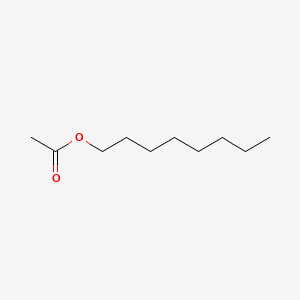
Octyl Acetate
Octyl acetate is the acetate ester of octan-1-ol. It has a role as a plant metabolite. It is functionally related to an octan-1-ol. — ChEBI
- IUPAC name
- octyl acetate
- Molecular formula
- C10H20O2
- Molecular weight
- 172.26 g/mol
- Exact mass
- 172.146329876 Da
- XLogP3
- 3.4
- Topological polar surface area
- 26.3 Ų
- Hydrogen-bond donors
- 0
- Hydrogen-bond acceptors
- 2
- Covalent units
- 1
- Defined stereocentres
- 0
Also known as
16 more reported names
External database identifiers
- ChEBI:CHEBI:87495
- ChEMBL:CHEMBL2228456
- EPA DTXSID:DTXSID8044202
- PubMed:22908589
- PubMed:22860456
- PubMed:22785378
- PubMed:22649749
- PubMed:22619540
- PubMed:22590009
- PubMed:22590006
- PubMed:22577295
- PubMed:22506397
- PubMed:22489157
- PubMed:22417835
- PubMed:22412629
Evidence from additional scientific databases
NIH PubChem PUG-View
Attributed physical-property, hazard, environmental and use annotations.
- Boiling Point: 206.00 to 211.00 °C. @ 760.00 mm Hg Source: Human Metabolome Database (HMDB)
- Boiling Point: 203-208 °C Source: Joint FAO/WHO Expert Committee on Food Additives (JECFA)
- Density: 0.865-0.868 Source: Joint FAO/WHO Expert Committee on Food Additives (JECFA)
- Melting Point: -38.5 °C Source: Human Metabolome Database (HMDB)
- Physical Description: Colorless liquid with an odor like orange blossom or jasmine; [Acros Organics MSDS] Source: Haz-Map, Information on Hazardous Chemicals and Occupational Diseases
- Physical Description: Liquid Source: Human Metabolome Database (HMDB)
- Physical Description: colourless liquid with a fruity, orange-like, jasmine-like odour Source: Joint FAO/WHO Expert Committee on Food Additives (JECFA)
- Refractive Index: 1.418-1.421 Source: Joint FAO/WHO Expert Committee on Food Additives (JECFA)
- Solubility: miscible with alcohol, most fixed oils, organic solvents; insoluble in water Source: Joint FAO/WHO Expert Committee on Food Additives (JECFA)
- Solubility: 1 ml in 4 ml 70% alcohol (in ethanol) Source: Joint FAO/WHO Expert Committee on Food Additives (JECFA)
- Vapor Pressure: 0.4 [mmHg] Source: Haz-Map, Information on Hazardous Chemicals and Occupational Diseases
- Note: This chemical does not meet GHS hazard criteria for 99.1% (1646 of 1661) of all reports. Source: European Chemicals Agency (ECHA)
- GHS Hazard Statements: Not Classified; Reported as not meeting GHS hazard criteria by 1646 of 1661 companies (only 0.9% companies provided GHS information). For more detailed information, please visit ECHA C&L website. Source: European Chemicals Agency (ECHA)
- ECHA C&L Notifications Summary: Aggregated GHS information provided per 1661 reports by companies from 4 notifications to the ECHA C&L Inventory.; Reported as not meeting GHS hazard criteria per 1646 of 1661 reports by companies.; There are 3 notifications provided by 15 of 1661 reports by companies with hazard statement code(s).; Information may vary between notifications depending on impurities, additives, and other factors. The percentage value in parenthesis indicates the notified classification ratio from companies that provide hazard codes. Only hazard codes with percentage values above 10% are shown. For more detailed information, please visit ECHA C&L website. Source: European Chemicals Agency (ECHA)
- Sources/Uses: Used as flavoring agent or adjuvant; [FDA] Source: Haz-Map, Information on Hazardous Chemicals and Occupational Diseases
Mapped by: Existing checksum-valid CAS to unique PubChem CID match. Retrieved: 2026-08-31. Open source record
Scientific classifications and hazard annotations provide context and do not replace the market-specific regulatory decision shown above.
Additional source coverage and match status
| Source | Result | Checked |
|---|---|---|
| NIH PubChem PUG-View | Exact match | 2026-08-31 |
A recorded no-match is useful evidence that the source was checked; it is not a claim that the substance does not exist elsewhere.
Retrieved from NIH PubChem on 2026-08-31 by checksum-valid CAS matching. Chemical properties do not replace the regulatory decision on this page.