
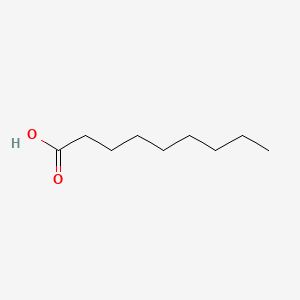
Nonanoic Acid
Nonanoic acid is a C9 straight-chain saturated fatty acid which occurs naturally as esters of the oil of pelargonium. Has antifungal properties, and is also used as a herbicide as well as in the preparation of plasticisers and lacquers. It has a role as an antifeedant, a plant metabolite, a Daphnia magna metabolite and an algal metabolite. It is a straight-chain saturated fatty acid and a medium-chain fatty acid. It is a conjugate acid of a nonanoate. It derives from a hydride of a nonane. — ChEBI
- IUPAC name
- nonanoic acid
- Molecular formula
- C9H18O2
- Molecular weight
- 158.24 g/mol
- Exact mass
- 158.130679813 Da
- XLogP3
- 3.5
- Topological polar surface area
- 37.3 Ų
- Hydrogen-bond donors
- 1
- Hydrogen-bond acceptors
- 2
- Covalent units
- 1
- Defined stereocentres
- 0
Also known as
16 more reported names
External database identifiers
- ChEBI:CHEBI:29019
- ChEMBL:CHEMBL108436
- EPA DTXSID:DTXSID3021641
- PubMed:29968805
- PubMed:22925715
- PubMed:22876644
- PubMed:22871146
- PubMed:22870060
- PubMed:22750508
- PubMed:22654729
- PubMed:22649749
- PubMed:22649490
- PubMed:22649277
- PubMed:22639651
- PubMed:22608768
Evidence from additional scientific databases
NIH PubChem PUG-View
Attributed physical-property, hazard, environmental and use annotations.
- Boiling Point: 254.5 °C Source: Hazardous Substances Data Bank (HSDB)
- Boiling Point: Boiling point = 255.6 °C Source: Hazardous Substances Data Bank (HSDB)
- Boiling Point: 254 °C Source: Joint FAO/WHO Expert Committee on Food Additives (JECFA)
- Boiling Point: 254 °C @760 [mm Hg] Source: PAC Chemical Database, U.S. Department of Energy
- Color/Form: Colorless, oily liquid at ordinary temp; crystallizes when cooled Source: Hazardous Substances Data Bank (HSDB)
- Color/Form: Yellowish oil Source: Hazardous Substances Data Bank (HSDB)
- Density: 0.9052 g/cu cm at 20 °C Source: Hazardous Substances Data Bank (HSDB)
- Density: 0.901-0.906 Source: Joint FAO/WHO Expert Committee on Food Additives (JECFA)
- Density: 0.9055 @ 20°C Source: PAC Chemical Database, U.S. Department of Energy
- Dissociation Constants: pKa = 4.95 at 25 °C Source: Hazardous Substances Data Bank (HSDB)
- Flash Point: 133 °C (open cup) Source: Hazardous Substances Data Bank (HSDB)
- LogP: log Kow = 3.42 Source: Hazardous Substances Data Bank (HSDB)
- LogP: 3.42 Source: Human Metabolome Database (HMDB)
- Melting Point: 12.4 °C Source: Hazardous Substances Data Bank (HSDB)
- Melting Point: 12.3 °C Source: Human Metabolome Database (HMDB)
- Odor: FATTY ODOR Source: Hazardous Substances Data Bank (HSDB)
- Odor: COCONUT AROMA Source: Hazardous Substances Data Bank (HSDB)
- Odor: Slight odor Source: Hazardous Substances Data Bank (HSDB)
- Physical Description: Liquid; Large Crystals Source: EPA Chemical Data Reporting (CDR)
- Physical Description: Colorless or yellowish liquid; mp = 12.5 deg C; [Hawley] Source: Haz-Map, Information on Hazardous Chemicals and Occupational Diseases
- Physical Description: Liquid Source: Human Metabolome Database (HMDB)
- Physical Description: colourless to pale yellow liquid Source: Joint FAO/WHO Expert Committee on Food Additives (JECFA)
- Refractive Index: Index of refraction: 1.4343 at 20 °C/D Source: Hazardous Substances Data Bank (HSDB)
- Refractive Index: 1.431-1.435 Source: Joint FAO/WHO Expert Committee on Food Additives (JECFA)
- Solubility: Soluble in ethanol, chloroform, ether Source: Hazardous Substances Data Bank (HSDB)
- Solubility: 1:8 IN 50% ALCOHOL; 1:3 IN 60% ALCOHOL; INSOL IN WATER; SOL IN MOST ORG SOLVENTS Source: Hazardous Substances Data Bank (HSDB)
- Solubility: In water, 284 mg/L at 30 °C Source: Hazardous Substances Data Bank (HSDB)
- Solubility: 0.284 mg/mL Source: Human Metabolome Database (HMDB)
- Solubility: soluble inmost organic solvents; Insoluble in water Source: Joint FAO/WHO Expert Committee on Food Additives (JECFA)
- Solubility: (in ethanol) Source: Joint FAO/WHO Expert Committee on Food Additives (JECFA)
- Vapor Pressure: 0.00165 [mmHg] Source: Haz-Map, Information on Hazardous Chemicals and Occupational Diseases
- Vapor Pressure: 1.65X10⁻³ mm Hg at 25 °C Source: Hazardous Substances Data Bank (HSDB)
- Vapor Pressure: 0.00165 [mm Hg] @25 °C Source: PAC Chemical Database, U.S. Department of Energy
- Viscosity: 8.08 mPa.sec at 20 °C Source: Hazardous Substances Data Bank (HSDB)
- Signal: Warning Source: Regulation (EC) No 1272/2008 of the European Parliament and of the Council
- GHS Hazard Statements: H315: Causes skin irritation [Warning Skin corrosion/irritation]; H319: Causes serious eye irritation [Warning Serious eye damage/eye irritation]; H412: Harmful to aquatic life with long lasting effects [Hazardous to the aquatic environment, long-term hazard] Source: Regulation (EC) No 1272/2008 of the European Parliament and of the Council
- Precautionary Statement Codes: P264, P264+P265, P273, P280, P302+P352, P305+P351+P338, P321, P332+P317, P337+P317, P362+P364, and P501 (click each P-code to see the statement) Source: Regulation (EC) No 1272/2008 of the European Parliament and of the Council
- Signal: Danger Source: European Chemicals Agency (ECHA)
- GHS Hazard Statements: H314 (87.4%): Causes severe skin burns and eye damage [Danger Skin corrosion/irritation]; H315 (12.6%): Causes skin irritation [Warning Skin corrosion/irritation]; H318 (19.1%): Causes serious eye damage [Danger Serious eye damage/eye irritation]; H319 (12.6%): Causes serious eye irritation [Warning Serious eye damage/eye irritation]; H412 (30.1%): Harmful to aquatic life with long lasting effects [Hazardous to the aquatic environment, long-term hazard] Source: European Chemicals Agency (ECHA)
- Precautionary Statement Codes: P260, P264, P264+P265, P273, P280, P301+P330+P331, P302+P352, P302+P361+P354, P304+P340, P305+P351+P338, P305+P354+P338, P316, P317, P321, P332+P317, P337+P317, P362+P364, P363, P405, and P501 (click each P-code to see the statement) Source: European Chemicals Agency (ECHA)
- ECHA C&L Notifications Summary: Aggregated GHS information provided per 2504 reports by companies from 13 notifications to the ECHA C&L Inventory. Each notification may be associated with multiple companies.; Information may vary between notifications depending on impurities, additives, and other factors. The percentage value in parenthesis indicates the notified classification ratio from companies that provide hazard codes. Only hazard codes with percentage values above 10% are shown. For more detailed information, please visit ECHA C&L website. Source: European Chemicals Agency (ECHA)
- Signal: Warning Source: NITE-CMC
- GHS Hazard Statements: H315: Causes skin irritation [Warning Skin corrosion/irritation]; H319: Causes serious eye irritation [Warning Serious eye damage/eye irritation]; H336: May cause drowsiness or dizziness [Warning Specific target organ toxicity, single exposure; Narcotic effects]; H402: Harmful to aquatic life [Hazardous to the aquatic environment, acute hazard]; H411: Toxic to aquatic life with long lasting effects [Hazardous to the aquatic environment, long-term hazard] Source: NITE-CMC
- Precautionary Statement Codes: P261, P264, P264+P265, P271, P273, P280, P302+P352, P304+P340, P305+P351+P338, P319, P321, P332+P317, P337+P317, P362+P364, P391, P403+P233, P405, and P501 (click each P-code to see the statement) Source: NITE-CMC
- GHS Hazard Statements: H315: Causes skin irritation [Warning Skin corrosion/irritation]; H319: Causes serious eye irritation [Warning Serious eye damage/eye irritation] Source: NITE-CMC
- Precautionary Statement Codes: P264, P264+P265, P280, P302+P352, P305+P351+P338, P321, P332+P317, P337+P317, and P362+P364 (click each P-code to see the statement) Source: NITE-CMC
- Cosmetic Ingredient Review Finding(s): Safe in the present practices of use and concentration. Ingredient, concentration, and use information are available in documents discoverable at https://cir-reports.cir-safety.org Source: Cosmetic Ingredient Review (CIR)
- Environmental Bioconcentration: An estimated BCF of 3 was calculated in fish for nonanoic acid(SRC), using a log Kow of 3.42(1) and a regression-derived equation(2). According to a classification scheme(3), this BCF suggests the potential for bioconcentration in aquatic organisms is low(SRC). Source: Hazardous Substances Data Bank (HSDB)
- Environmental Fate: TERRESTRIAL FATE: Based on a classification scheme(1), an estimated Koc value of 1,700 for the free acid(SRC), determined from a log Kow of 3.42(2) and a regression-derived equation(3), indicates that undissociated nonanoic acid is expected to have low mobility in soil(SRC). The pKa of nonanoic acid is 4.95(4), indicating that this compound will exist almost entirely in anion form in the environment and anions generally do not adsorb more strongly to soils containing organic carbon and clay than their neutral counterparts(5). Volatilization of nonanoic acid from moist soil surfaces is not expected to be an important fate process(SRC) given the pKa. Nonanoic acid is not expected to volatilize from dry soil surfaces(SRC) based upon a vapor pressure of 1.65X10⁻³ mm Hg(6). Biodegradation studies of nonanoic acid show a total organic carbon removal ratio of 99% using a non-acclimated activated sludge(7), and a BOD of 0.59 (g/g) after 5 days incubation using a sewage inoculum(8), suggesting biodegradation is an important environmental fate process in soil(SRC). Source: Hazardous Substances Data Bank (HSDB)
- Environmental Fate: AQUATIC FATE: Based on a classification scheme(1), an estimated Koc value of 1,700 for the free acid(SRC), determined from a log Kow of 3.42(2) and a regression-derived equation(3), indicates that undissociated nonanoic acid is expected to adsorb to suspended solids and sediment(SRC). A pKa of 4.95(4) indicates nonanoic acid will exist almost entirely in the anion form at pH values of 5 to 9 and therefore volatilization from water surfaces is not expected to be an important fate process(5). According to a classification scheme(6), an estimated BCF of 3(SRC), from its log Kow(2) and a regression-derived equation(7), suggests the potential for bioconcentration in aquatic organisms is low(SRC). Biodegradation studies of nonanoic acid show a total organic carbon removal ratio of 99% using a non-acclimated activated sludge(8), and a BOD of 0.59 (g/g) after 5 days incubation using a sewage inoculum(9), suggesting biodegradation is an important environmental fate process in water(SRC). Source: Hazardous Substances Data Bank (HSDB)
- Environmental Fate: ATMOSPHERIC FATE: According to a model of gas/particle partitioning of semivolatile organic compounds in the atmosphere(1), nonanoic acid, which has a vapor pressure of 1.65X10⁻³ mm Hg at 25 °C(2), is expected to exist solely as a vapor in the ambient atmosphere. Vapor-phase nonanoic acid is degraded in the atmosphere by reaction with photochemically-produced hydroxyl radicals(SRC); the half-life for this reaction in air is estimated to be 1.6 days(SRC), calculated from its rate constant of 9.8X10⁻¹² cu cm/molecule-sec at 25 °C(SRC) that was derived using a structure estimation method(3). Nonanoic acid does not contain chromophores that absorb at wavelengths >290 nm and therefore is not expected to be susceptible to direct photolysis by sunlight(4). Source: Hazardous Substances Data Bank (HSDB)
- Consumer Uses: Other; Soil amendments (fertilizers) Source: EPA Chemical Data Reporting (CDR)
- Industry Uses: Intermediate; Soil amendments (fertilizers); Lubricating agent; Other Source: EPA Chemical Data Reporting (CDR)
- Cosmetic Ingredient Review Link: CIR ingredient: Pelargonic Acid Source: Cosmetic Ingredient Review (CIR)
- Sources/Uses: Naturally occurs as an ester in oil of pelargonium; [Merck Index] Found in several essential oils; Used in lacquers, pharmaceuticals, plastics, and in esters for turbojet lubricants; Also used as a flavor and fragrance, flotation agent, gasoline additive, herbicide, blossom thinner for apple and pear trees, sanitizer, and to peel fruits and vegetables; [HSDB] Used to make peroxides and greases, as a catalyst for alkyd resins, in insect attractants, and as a topical bactericide and fungicide medication; [CHEMINFO] Source: Haz-Map, Information on Hazardous Chemicals and Occupational Diseases
- Industrial Processes with risk of exposure: Petroleum Production and Refining [Category: Industry]; Painting (Pigments, Binders, and Biocides) [Category: Paint]; Using Disinfectants or Biocides [Category: Clean]; Farming (Pesticides) [Category: Industry] Source: Haz-Map, Information on Hazardous Chemicals and Occupational Diseases
- Uses: For Nonanoic acid (USEPA/OPP Pesticide Code: 217500) ACTIVE products with label matches. /SRP: Registered for use in the U.S. but approved pesticide uses may change periodically and so federal, state and local authorities must be consulted for currently approved uses./ Source: Hazardous Substances Data Bank (HSDB)
- Uses: Organic synthesis, lacquers, plastics, production of hydrotropic salts, pharmaceuticals, synthetic flavors and odors, flotation agent, esters for turbojet lubricants, vinyl plasticizer, gasoline additive. Source: Hazardous Substances Data Bank (HSDB)
- Uses: CHEM INT FOR NONANOYL CHLORIDE Source: Hazardous Substances Data Bank (HSDB)
- Uses: CHEM INT FOR SPECIALTY DIESTERS-EG, WITH PROPYLENE GLYCOL Source: Hazardous Substances Data Bank (HSDB)
- Uses: For more Uses (Complete) data for NONANOIC ACID (7 total), please visit the HSDB record page. Source: Hazardous Substances Data Bank (HSDB)
Mapped by: Existing checksum-valid CAS to unique PubChem CID match. Retrieved: 2026-08-31. Open source record
Scientific classifications and hazard annotations provide context and do not replace the market-specific regulatory decision shown above.
Additional source coverage and match status
| Source | Result | Checked |
|---|---|---|
| NIH PubChem PUG-View | Exact match | 2026-08-31 |
A recorded no-match is useful evidence that the source was checked; it is not a claim that the substance does not exist elsewhere.
Retrieved from NIH PubChem on 2026-08-31 by checksum-valid CAS matching. Chemical properties do not replace the regulatory decision on this page.