
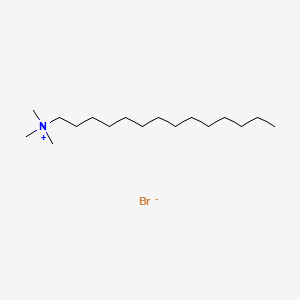
CAS 1119-97-7PubChem CID 14250
Tetradecyltrimethylammonium bromide
Cetrimide is an organic molecular entity. — ChEBI
- IUPAC name
- trimethyl(tetradecyl)azanium bromide
- Molecular formula
- C17H38BrN
- Molecular weight
- 336.4 g/mol
- Exact mass
- 335.21876 Da
- Topological polar surface area
- 0.0 Ų
- Hydrogen-bond donors
- 0
- Hydrogen-bond acceptors
- 1
- Covalent units
- 2
- Defined stereocentres
- 0
Also known as
Tetradonium bromideTetradecyl Trimethyl Ammonium BromideMytabMorpan TQuaternium 13Tetradonio bromuroTetradonii bromidumTrimethyltetradecylammonium bromide
16 more reported names
Bromuro de tetradonioBromure de tetradoniumTrimethylmyristylammonium bromideAmmonium, trimethyltetradecyl-, bromideSumquat 6110Myristyl trimethyl ammonium bromide8483H94W1ERHODAQUAT M-214C/99C14QACTTAB cpdtAtradonium (cation)RefChem:896962myristyl trimethylammonium bromidetetradecyl-trimethylammonium bromidetrimethyl tetradecyl ammonium bromide214-291-9
External database identifiers
- ChEBI:CHEBI:3565
- EPA DTXSID:DTXSID0044367
Evidence from additional scientific databases
NIH PubChem PUG-View
Exact identifier match14250
Attributed physical-property, hazard, environmental and use annotations.
- Physical Description: White solid; [Merck Index] Colorless hygroscopic crystals; [Sigma-Aldrich MSDS] Source: Haz-Map, Information on Hazardous Chemicals and Occupational Diseases
- Note: This chemical does not meet GHS hazard criteria for 0.4% (3 of 698) of reports. Source: European Chemicals Agency (ECHA)
- Signal: Danger Source: European Chemicals Agency (ECHA)
- GHS Hazard Statements: H302 (25.4%): Harmful if swallowed [Warning Acute toxicity, oral]; H314 (10.7%): Causes severe skin burns and eye damage [Danger Skin corrosion/irritation]; H315 (21.9%): Causes skin irritation [Warning Skin corrosion/irritation]; H318 (89.7%): Causes serious eye damage [Danger Serious eye damage/eye irritation]; H335 (21.8%): May cause respiratory irritation [Warning Specific target organ toxicity, single exposure; Respiratory tract irritation]; H373 (18.2%): May causes damage to organs through prolonged or repeated exposure [Warning Specific target organ toxicity, repeated exposure]; H400 (22.8%): Very toxic to aquatic life [Warning Hazardous to the aquatic environment, acute hazard]; H410 (12.2%): Very toxic to aquatic life with long lasting effects [Warning Hazardous to the aquatic environment, long-term hazard] Source: European Chemicals Agency (ECHA)
- Precautionary Statement Codes: P260, P261, P264, P264+P265, P270, P271, P273, P280, P301+P317, P301+P330+P331, P302+P352, P302+P361+P354, P304+P340, P305+P354+P338, P316, P317, P319, P321, P330, P332+P317, P362+P364, P363, P391, P403+P233, P405, and P501 (click each P-code to see the statement) Source: European Chemicals Agency (ECHA)
- ECHA C&L Notifications Summary: Aggregated GHS information provided per 698 reports by companies from 21 notifications to the ECHA C&L Inventory. Each notification may be associated with multiple companies.; Reported as not meeting GHS hazard criteria per 3 of 698 reports by companies.; There are 20 notifications provided by 695 of 698 reports by companies with hazard statement code(s).; Information may vary between notifications depending on impurities, additives, and other factors. The percentage value in parenthesis indicates the notified classification ratio from companies that provide hazard codes. Only hazard codes with percentage values above 10% are shown. For more detailed information, please visit ECHA C&L website. Source: European Chemicals Agency (ECHA)
- Cosmetic Ingredient Review Conclusion: The CIR Expert Panel concluded the following ingredients are safe in the present practices of use and concentration described in the safety assessment when formulated to be non-irritating...Myrtrimonium Bromide... Source: Cosmetic Ingredient Review (CIR)
- Cosmetic Ingredient Review Finding(s): Safe for use in cosmetics, with qualifications Source: Cosmetic Ingredient Review (CIR)
- Cosmetic Ingredient Review Link: CIR ingredient: Myrtrimonium Bromide Source: Cosmetic Ingredient Review (CIR)
- Sources/Uses: Used as a disinfectant, deodorant, and laboratory reagent; [Merck Index] Formerly registered in the US as a disinfectant and carpet cleaner for institutional, hospital, restaurant, and related applications; [NPIRS] Source: Haz-Map, Information on Hazardous Chemicals and Occupational Diseases
- Industrial Processes with risk of exposure: Using Disinfectants or Biocides [Category: Clean] Source: Haz-Map, Information on Hazardous Chemicals and Occupational Diseases
Mapped by: Existing checksum-valid CAS to unique PubChem CID match. Retrieved: 2026-08-31. Open source record
Scientific classifications and hazard annotations provide context and do not replace the market-specific regulatory decision shown above.
Additional source coverage and match status
| Source | Result | Checked |
|---|---|---|
| NIH PubChem PUG-View | Exact match | 2026-08-31 |
A recorded no-match is useful evidence that the source was checked; it is not a claim that the substance does not exist elsewhere.
Retrieved from NIH PubChem on 2026-09-02 by checksum-valid CAS matching. Chemical properties do not replace the regulatory decision on this page.